



Firm management made easy

Industry data shows that half of architecture and engineering marketing teams still rely on spreadsheets, even though 86% of marketers identify business development as a top priority.
If you're a principal running a small A&E firm, you feel this gap every day. You're winning work, delivering projects, and managing the business at the same time. A spreadsheet that goes stale by Wednesday creates risk and hides what is actually in your pipeline.
The right lead tracking software gives you visibility into what's coming, what's worth pursuing, and where your next revenue is likely to come from.
Why Generic CRMs Don't Work for A&E Firms
Architects and engineers have tried the big-name customer relationship management (CRM) platforms. Many firms find generic CRM tools poorly matched to project-based work. PSMJ has identified seller-doer resistance as a core reason CRM investments fail at A&E firms.
Architecture, engineering, and construction (AEC) pursuits do not move through a standard sales funnel. They move through stages generic CRMs often cannot handle without heavy customization:
- Go/no-go evaluations where principals decide if a project is worth pursuing
- Shortlisting and interviews that require tracking firm qualifications
- Scope negotiations and contract awards that involve technical and legal review
Principals doing billable work do not have time to build custom pipelines in Salesforce. The bigger problem is connection across systems. When CRM, project management, and financials live in different places, nobody keeps the CRM current. 89% of AEC firms rely on seller-doers for business development, according to industry research, so tools have to match how those people actually work.
Features That Actually Matter for A&E Lead Tracking
Not every CRM feature matters equally for architecture and engineering firms. Vendor comparison sheets often focus on contact management, email sequences, and marketing features. A&E firms need pursuit tracking that fits project work instead.
- Pipeline stages that reflect qualifications-based selection (QBS) workflows. The software should support shortlisting, interviews, and award stages without forcing a standard sales funnel.
- Go/no-go support inside the opportunity record. Industry guidance describes this as a checkpoint for fit with firm strategy.
- Connection to accounting workflows. When won work requires manual re-entry, data gets lost and the handoff breaks.
- Low-friction updates for seller-doers. If the tool feels like extra admin work, adoption drops fast.
Once those basics are in place, firms can get more value from win-rate analytics, proposal history, and long-term client context.
A&E Platforms Worth Evaluating
Many firms have moved beyond customizing Salesforce and similar horizontal tools for project-based work.
Deltek Vantagepoint combines CRM, project management, resource planning, and accounting in one system. It is best suited to mid-to-large firms with dedicated business development (BD) staff.
Unanet CRM is built for AEC firms and covers opportunity tracking, proposal workflows, go/no-go functionality, and AI features for capture and proposal work. Its Outlook-based pipeline supports seller-doer adoption by meeting principals where they already work.
HSO AEC360 supports request for proposal (RFP) work and helps teams surface relevant past projects and qualifications, which strengthens data foundations for future pursuits. Built on Microsoft Dynamics, it makes the most sense for firms already invested in Microsoft tools.
ProjectMark focuses on pipeline visibility, forecasting, and an AI assistant called Bolt.
TrebleHook, built on Salesforce, tracks pursuits as projects rather than generic deals. Its engineering-focused positioning speaks to a familiar problem: leadership cannot see upcoming design workload when data is spread across disconnected systems.
The Connection Problem Nobody Talks About
The most important question when evaluating lead tracking software is simple. What happens when you win a project?
At Jordan & Skala Engineers, the pursuit record moves to accounting for billing setup when work is awarded. If the pursuit is unsuccessful, the data goes back to marketing for analysis. That feedback loop matters because project outcomes should inform future BD decisions.
Before committing to any platform, ask these questions:
- Does a won opportunity automatically create a project record in your project management (PM) system?
- Does it connect to your accounting system without manual re-entry?
- Can project outcome data flow back into the BD database for win/loss analysis?
If the answer to any of these is no, you are rebuilding the same manual handoff problem that made your spreadsheet fail in the first place.
Where Monograph Fits
Monograph serves a distinct part of this market. Built for architecture and engineering firms, it focuses on smaller firms where the principal is often the seller, doer, project manager, and financial lead at the same time.
Monograph's pipeline workflow connects leads, proposals, and forecasts in one place. You can use the lead creation workflow to pull in historical project data, track proposal status with e-signatures, and forecast revenue from pipeline data. When work is won, the opportunity becomes an active project with scope, budget, and client context carried forward.
Smaller firms using the platform have reported measurable gains from connected workflows. Brunton Architects & Engineers reported 25% time saved on admin, 2x faster billing, and 25% less budget overage.
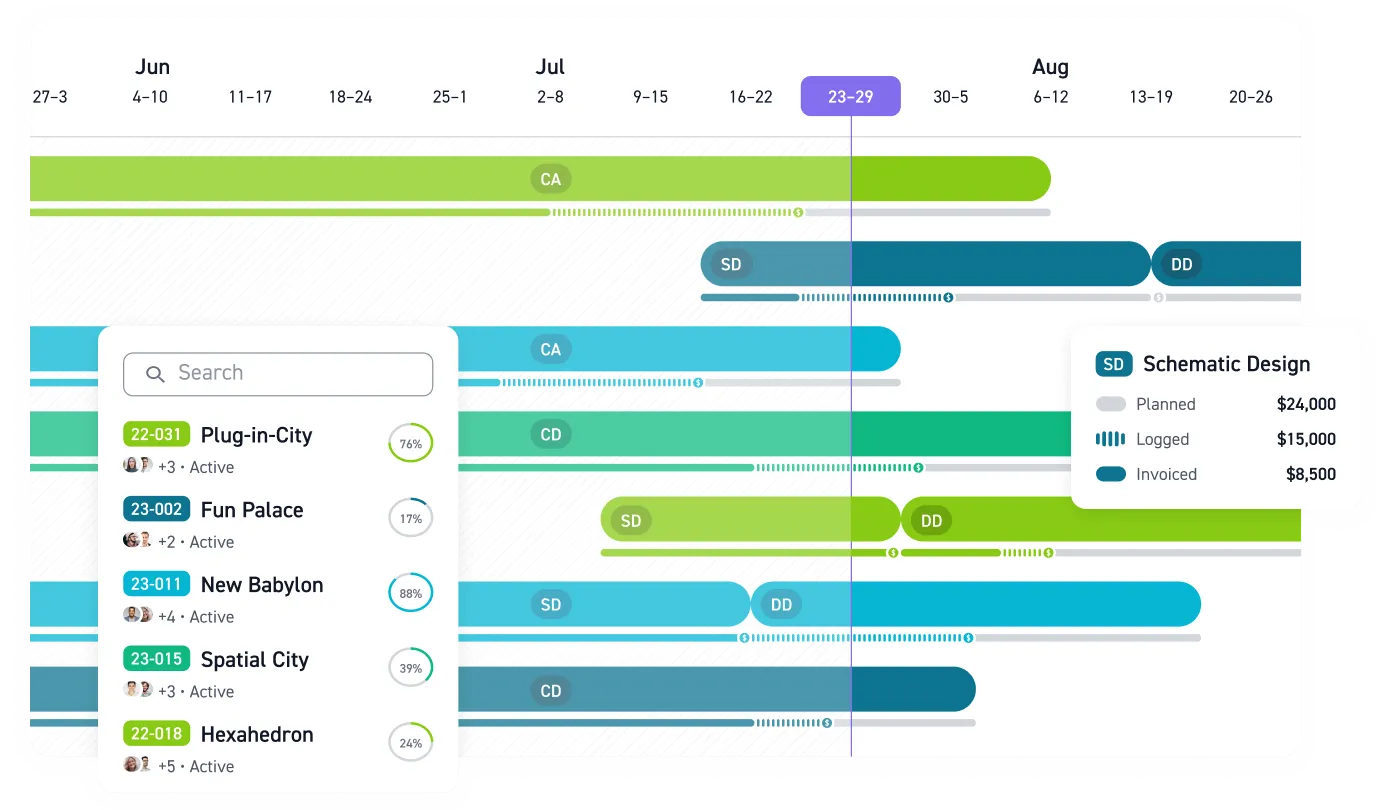
The platform also connects capacity planning to pipeline decisions. Before committing to a new pursuit, you can see how future work affects utilization, workload, and timing. Monograph's MoneyGantt™ shows planned, logged, invoiced, and paid status across project phases so you can spot trouble quickly.
For firms tracking opportunities, forecasting revenue, and planning future work, Pipeline can replace a standalone CRM workflow. For firms that need deeper contact management or email logging, it can work alongside those tools while serving as the source of truth for firm-wide planning.
Clear project finance views and disciplined pursuit decisions matter more when firms are taking a more targeted approach to business development.
Stop Letting New Work Live in a Spreadsheet
If your firm is still tracking leads in a spreadsheet, you're making growth decisions with stale information. The same problems keep showing up. Unclear next steps, missed follow-ups, and won work that still has to be re-entered into the systems that actually run the business.
Monograph helps principals, project managers, and operations leaders connect lead tracking, proposals, forecasting, and project planning in one place. You can see what work is worth pursuing, how it affects capacity, and what happens when a pursuit becomes a real project.
See your pipeline, capacity, and financials in one place. Book a demo.
Frequently Asked Questions
What is the best lead tracking software for architecture and engineering firms?
The best lead tracking software for an A&E firm matches how pursuits move through go/no-go decisions, shortlists, interviews, and project handoff. For many firms, that means looking beyond generic CRMs and prioritizing tools built for project-based workflows.
Why don't generic CRMs work well for A&E firms?
Generic CRMs are often built around standard sales funnels and heavy contact management. A&E firms usually need pursuit tracking tied to qualifications, proposals, project delivery, and financial handoff. When those systems stay disconnected, data entry drops and the CRM goes stale.
What features matter most in A&E lead tracking software?
The most important features are pipeline stages that reflect A&E workflows, built-in go/no-go support, connections to project management and accounting, and low-friction data entry for seller-doers.
Is Monograph a CRM?
Monograph Pipeline handles lead tracking, proposals, and forecasting for A&E firms. It can replace a standalone CRM workflow for firms focused on opportunity tracking and planning, and it can also work alongside other tools when deeper contact management is needed.
What should happen after a pursuit is won?
A won opportunity should move cleanly into project setup without manual re-entry. The strongest systems connect business development with project management and accounting so scope, budget, and client context carry forward and project outcomes can feed back into future win/loss analysis.