
.png)
Most A&E firm leaders can tell you whether a project is going well from a design or technical standpoint. Ask whether that same project is profitable right now, and the answer often gets vague. The data either does not exist in real time or lives across spreadsheets, accounting software, and email chains.
That gap is where margin disappears. In an industry dominated by fixed-fee contracts, there is no safety net.
The Structural Problem Behind the Spreadsheet
The financial visibility challenge in A&E firms runs deeper than technology. The structure of how work gets contracted and tracked creates the exposure. Percentage-based compensation introduces its own complexity, and when most work runs on fixed fees, rising costs come straight out of margin.
Fee pressure adds to the problem. Forty-six percent of firm leaders say fee negotiations are harder than they were four to five years ago. Firms are holding price on one side and tracking cost with slow processes on the other.
Annual benchmarking across the A&E sector reinforces the urgency. Profitability depends on seeing budget drift early enough to act.
What Invisible Margins Cost You
Benchmark data shows a clear spread between average firms and stronger performers. Firm profitability as a share of net billings averaged 13.2% across the profession, while operating profit at firms that actively benchmark reached 19% of net revenue. That gap is material for any firm trying to protect annual profit.
The margin damage usually comes from a few familiar blind spots:
- Scope creep goes unbilled. Teams realize too late that the project expanded beyond fee.
- Weak timekeeping distorts cost data. Future fees get set from flawed history.
- Profitability is reviewed only at closeout. By then, the lesson is expensive.
- Utilization becomes guesswork. Leaders make staffing decisions from instinct instead of data.
- WIP goes untracked. Firms lose a clear view of cash flow, and shortfalls arrive before anyone is ready.
These are separate symptoms of the same visibility problem. ACEC's guidance on fixed-fee engineering services confirms the pattern: when fee is fixed, visibility matters more.
The Seven Metrics That Define Real-Time Visibility
You do not need to track every number. You need to track the right ones. Drawn from A&E performance data and income statement KPIs, these seven metrics help firm leaders judge project financial health before problems harden into losses.
- Direct labor cost vs. budget, by phase. Shows where scope creep or inefficiency is consuming fee.
- Labor utilization rate. Billable payroll visibility remains a common blind spot for many firms.
- Net direct labor multiplier. This core profitability ratio ties labor cost to revenue generated.
- Consultant costs vs. budget, by phase. Early overruns can consume margin planned for later work.
- Operating overhead rate. This tells you the minimum multiplier needed to break even.
- Operating profit as a share of net revenue. Recent A&E valuation trends show why this remains the terminal metric.
- WIP days and AR collection rate. Industry data on cash conversion timelines shows how long it takes profit to turn into money in the bank.
Together, these metrics form a loop. Cost metrics show whether a project is earning its fee, and cash metrics show whether that profit is actually reaching the bank account.
Building the Habits Behind the Numbers
Real-time data only works when project managers use it. Guidance on project work planning emphasizes regular review of schedule, budget, fees, manpower, billings, and changes during delivery.
Those habits sit with the people leading projects every day. PM training highlights project leadership as part of sound financial management across A&E firms.
AIA guidance on budgeting fundamentals makes the same point: managers at every level need to understand budgeting. Profitability cannot live only with the CFO.
How Monograph Makes This Visible
Monograph was built by architects who lived these problems. Used by 13,000+ architects and engineers across 1,800+ firms, it connects projects, people, budgets, time, and clients in one system built for A&E workflows.
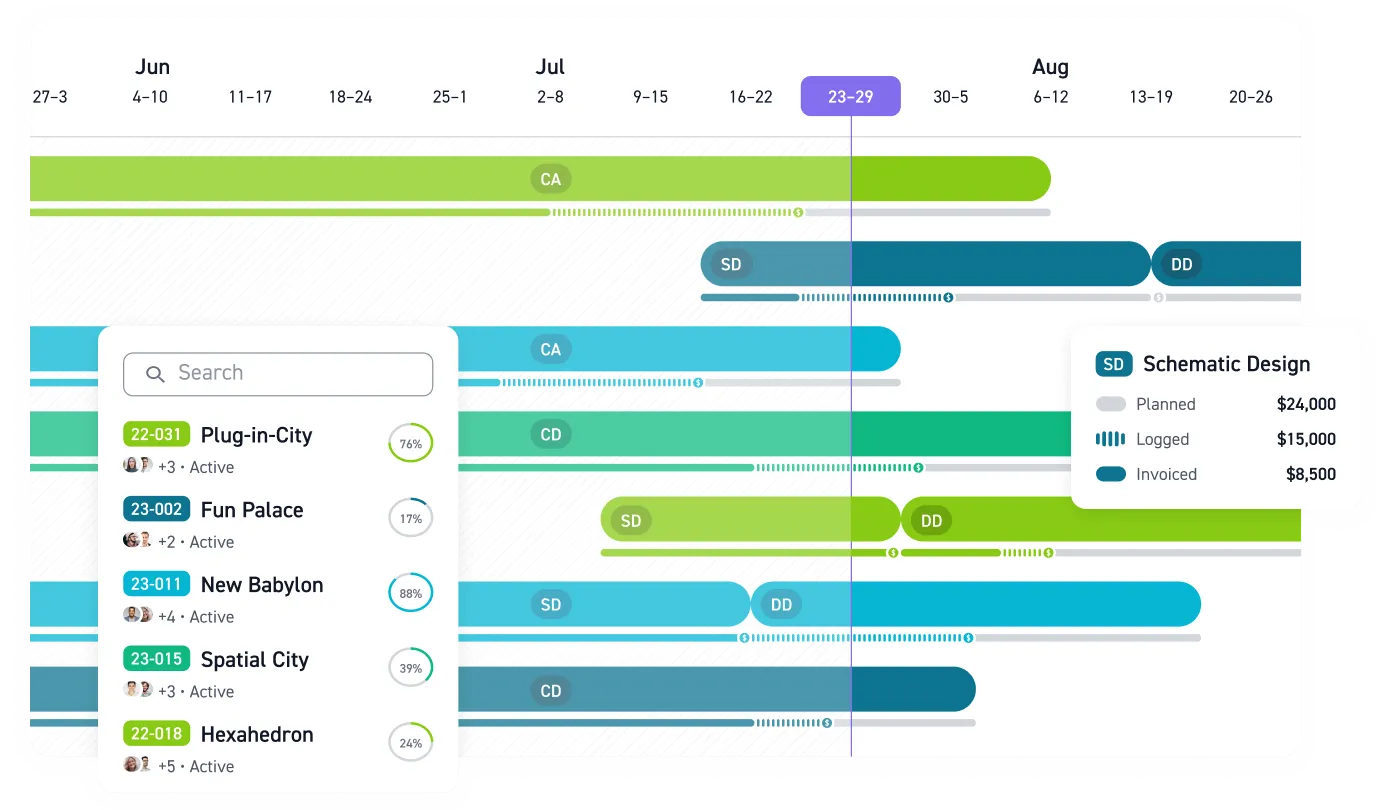
Monograph's MoneyGantt™ layers planned fee across the project schedule and tracks how dollars move from planned to logged to invoiced. When a phase trends over budget, the drift is visible fast.
A second layer of visibility comes from phase-based budget control:
- Phase budgets map to AIA project phases.
- Time entries update budget visibility while work is in progress.
- Consultant bills can be tracked against fee and reflected in project profitability.
That gives teams a clearer view of where margin starts to slip. Fixed-fee work breaks down at the phase level first. When teams can see which phase is drifting, they can act before the whole project goes sideways.
For finance teams, the QuickBooks integration connects invoices, expenses, and client records, while project accounting gives teams clearer visibility into WIP and profitability. Monograph also handles reporting across project financials, including salary, overhead, project types, clients, and phases.
Customer results show measurable gains. Take a look at these first using Monograph and reporting 1.5x faster billing, 4x billing speed, 25% profit growth, and 50% admin savings.
See the Drift Before It Costs You
When fixed fees, scattered spreadsheets, and month-end reporting shape your decisions, margin disappears before anyone sees the problem. Real-time visibility gives principals, PMs, and finance leaders a way to catch scope drift, labor overages, consultant overruns, and billing delays while a project is still recoverable.
Monograph brings phase budgets, time tracking, invoicing, and profitability into one place so your team can work from the same numbers instead of reconciling different versions of the truth. If you want to replace postmortems with live project financial visibility, book a demo.
Frequently Asked Questions
What should an A&E firm track first to improve financial visibility?
Start with the metrics that show budget health before a project is finished: direct labor cost vs. budget by phase, labor utilization rate, consultant costs vs. budget by phase, and WIP days and AR collection rate. Those numbers give you an early read on whether fee, cost, and cash flow are moving in the right direction.
Why is real-time visibility especially important for fixed-fee work?
Fixed-fee projects do not give you a built-in way to recover overruns. When labor or consultant costs run past budget, those dollars come straight out of margin. Real-time tracking gives you a window to catch the drift before the project reaches closeout.
How often should project managers review project financials?
Project profitability should be managed during the project, not reviewed only at closeout or month-end. When PMs can read budget-to-actual data, track changes, and use project-phase checklists throughout delivery, financial visibility becomes part of daily project management instead of a postmortem.
What if my team sees time tracking as busywork?
That usually means the data is being collected without being used well. Inaccurate timekeeping leads to flawed project costs and weaker future fee setting. When teams can see that phase-level time data helps catch overruns, manage scope changes, and protect project profitability, tracking becomes a management tool instead of an administrative chore.