
Traditional accounting tells you whether your firm made money last quarter. Project accounting tells you whether you're making money right now on each specific engagement. It provides visibility into each design phase and consultant relationship.
For finance leaders at architecture and engineering firms, this distinction determines whether you discover cost overruns after they've already damaged profitability or catch them while there's still time to course-correct.
What Sets Project Accounting Apart
Project accounting tracks revenues, costs, and profitability at the individual project level rather than across the entire enterprise. While traditional accounting answers "How profitable was our firm this quarter?", project accounting answers far more actionable questions: Which phases are consuming budget? Where should we adjust resources? Should we accept this change order?
The distinction matters because A&E projects span months or years, crossing multiple fiscal periods. Traditional time-based accounting obscures project-level performance. A firm may show strong quarterly profits while several major projects quietly burn through their margins. This reality only surfaces when it's too late to fix.
This is why 98% of A&E firms use accrual basis accounting. Cash-basis methods significantly understate a firm's net worth when substantial work-in-progress exists, completed work not yet billed or billed work not yet collected.
The Percentage of Completion Method
The percentage of completion method is one of several GAAP-compliant approaches used in A&E project accounting, alongside other over-time and milestone-based revenue recognition methods. Under the ASC 606 revenue recognition framework, firms recognize revenue proportionally as work progresses rather than waiting until project completion or invoice issuance.
Three primary calculation approaches drive percentage of completion:
1. Cost-to-Cost Method (Most Common)
- Formula: (Costs Incurred to Date / Total Estimated Costs) × Contract Value
- Example: On a $500,000 contract with $400,000 estimated costs, if $200,000 has been incurred, the firm is 50% complete and recognizes $250,000 in revenue.
2. Efforts-Expended Method
- Formula: (Labor Hours Used / Total Estimated Hours) × Contract Value
- Appropriate for labor-intensive A&E design and engineering projects
3. Units-of-Delivery Method
- Formula: (Units Completed / Total Units) × Contract Value
- Applied to projects with clearly defined, measurable deliverable units
The percentage of completion method requires robust cost estimation and project tracking systems. Estimation errors can materially impact financial statements. The alternative, waiting until project completion to recognize revenue, creates wildly inaccurate pictures of firm financial health during multi-year engagements.
Phase-Based Cost Tracking
A&E projects follow distinct phases: Schematic Design, Design Development, Construction Documents, Bidding, and Construction Administration. Each phase has different staffing requirements, deliverables, and fee allocations.
The Construction Documents phase requires the most time, which can surprise clients because the design seems complete after Design Development. This reality underscores why robust time-tracking and budget monitoring prevent scope creep during intensive production phases.
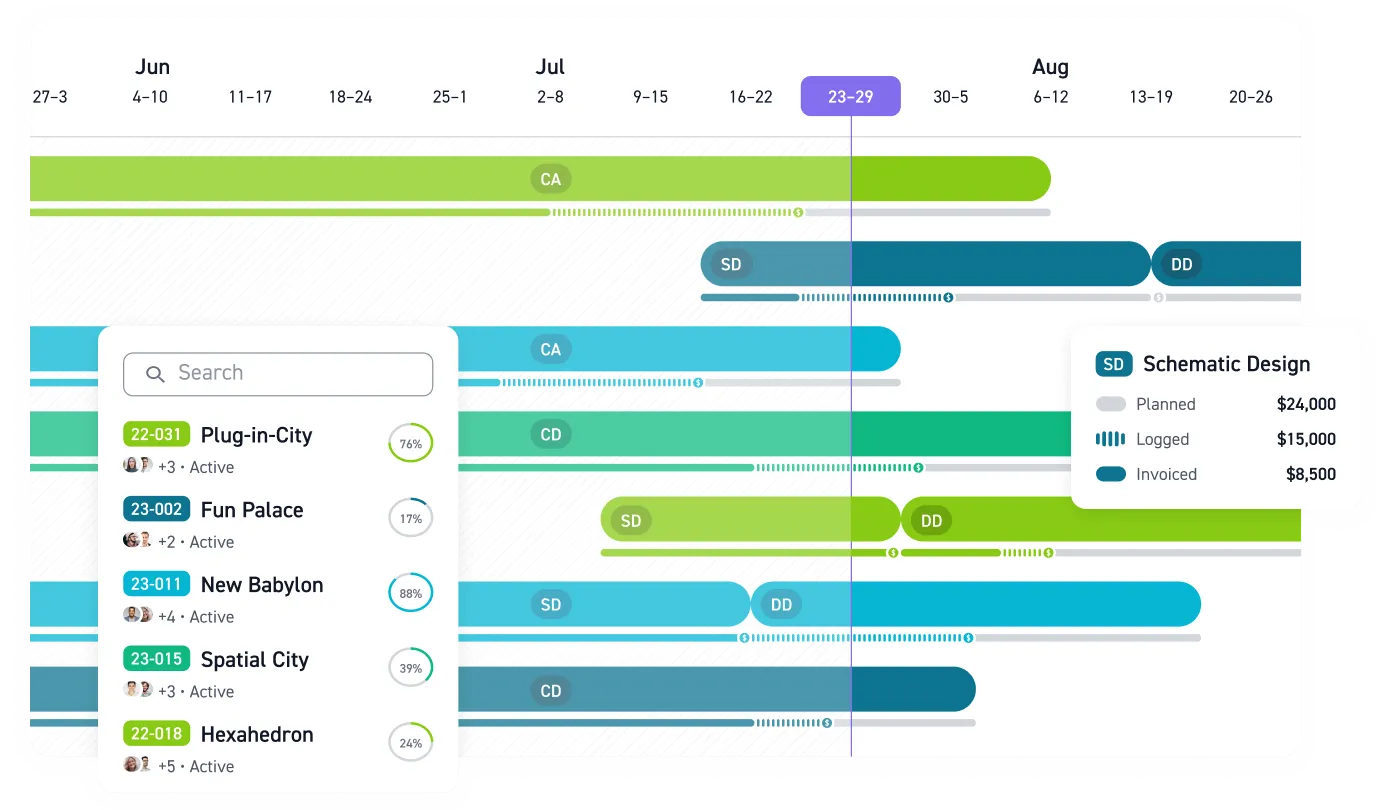
The critical implementation requirement: phases must align one-to-one with your chart of accounts. When a designer logs two hours in SD, that burn should hit the SD budget line and project timeline simultaneously. This real-time visibility separates top-performing firms from peers.
Most A&E firms lack this capability, discovering cost overruns only after they've already impacted profitability. Firms that implement this capability see dramatic improvements. Workshop/APD, a 50+ person New York firm, achieved 50% profit growth and 50% efficiency gains by establishing real-time phase-level visibility after migrating from BigTime.
Phase sign-off creates another crucial control point. According to Monograph's design phases guide, client sign-off at each phase (from Programming through Construction Documents) locks scope before moving to the next, more costly phase. This prevents scope expansion without corresponding budget adjustments.
Best Practices for A&E Finance Leaders
Finance leaders should prioritize these foundational practices:
- Monthly realization rate reviews: Track how much billable work actually hits an invoice. Pull realization reports regularly rather than discovering billing gaps during annual reviews.
- Cash flow metric monitoring: Track Days Sales Outstanding, operating cash-flow ratio, and WIP conversion rate. According to Monograph's Cash-Flow Management Guide, late payments and project delays consistently rank among the biggest cash-flow headaches for A&E firms.
- Consultant cost integration: Integrate subconsultant costs into project budgets from the planning stage. Maintain accurate contractor files linked to specific projects and phases.
- Weekly cash reviews: A 15-minute Monday review that flags unbilled work older than two weeks, invoices approaching 30 days, and projects overrunning scope catches problems before they cascade.
Industry Benchmarks Worth Tracking
Finance leaders need context for their firm's performance. Industry benchmarking data provides essential reference points for measuring success against peers.
Utilization rates deserve particular attention. Architecture firms actively track chargeability for design staff. Current data shows recent utilization trends: 44% of firms reporting stable utilization rates, 43% reporting lower rates than recent years, and only 13% seeing improvement.
Project-level profitability metrics reveal actionable insights:
- Profit per direct hour: Reached $23.40 in 2022, representing a 51% increase from $15.45 in 2013
- Billing multiple: 3.20 in 2022, with breakeven multiple at 2.73
- Total overhead rate: 173.3%, comprising indirect labor, benefits, occupancy, professional fees, and IT expenses
Month-End Closing for Project-Based Firms
Month-end closing in A&E firms requires procedures that traditional accounting cycles don't anticipate:
- WIP posting: Record unbilled work completed across all active projects
- Revenue recognition: Compute percent-complete using your chosen method
- Consultant accruals: Capture subconsultant costs for work completed but not yet invoiced
- Phase variance analysis: Compare actual costs to phase budgets to identify overruns
- Utilization calculations: Segment billable versus total hours by staff level
- Cash flow review: Analyze DSO, operating cash-flow ratio, and WIP conversion rate
As firms scale, these procedures require increasing documentation. Benchmark data shows 50% of firms with 1-20 staff use no outside accounting services, while 85% of firms over 750 staff use audited financial statements.
Get Real-Time Project Accounting Visibility
You've just read about percentage-of-completion methods, phase-based tracking, and month-end procedures that separate profitable firms from struggling ones. The question is whether your current systems can actually execute these workflows.
If you're still calculating percent-complete in spreadsheets, manually reconciling consultant costs across projects, or discovering budget overruns weeks after they happen, you're missing critical visibility into firm performance.
Monograph handles the project accounting workflows this article describes as automated reality. Our platform calculates percentage-of-completion automatically as time gets logged. Phase-based budgets sync with your chart of accounts in real-time.
Monograph's MoneyGantt™ transforms complex budget tracking into visual intelligence, showing exactly which phases burn through budget before problems cascade. No mathematical complexity required. Month-end WIP posting happens with a few clicks instead of a few days.
Your firm tracks projects across multiple phases, coordinates consultant costs, and manages complex fee structures. You need project accounting that works the way A&E firms actually operate, not generic job costing retrofitted from construction or manufacturing.
Book a demo with Monograph to see how we handle these workflows for A&E firms managing the same challenges you face every day.
Frequently Asked Questions
How do I choose between cost-to-cost and efforts-expended methods for my firm?
Cost-to-cost works best when you have reliable cost data and projects with significant material or consultant expenses beyond labor. Efforts-expended is better for labor-intensive design and engineering work where hours are your primary cost driver. Most A&E firms default to efforts-expended because it's simpler to track and more reflective of how design work actually progresses. You can measure hours logged more accurately than estimating total project costs mid-stream.
What if my firm doesn't have robust cost estimation systems yet?
Start simple. Track actual costs against budgets on current projects to build historical data. Use that performance data to inform future estimates.
You don't need perfect estimation to start using percentage-of-completion. You need consistent tracking and regular variance analysis. Begin with efforts-expended on straightforward projects, then expand to cost-to-cost as your data quality improves. The key is establishing the discipline of regular tracking before worrying about estimation sophistication.
How long does it take to implement phase-based cost tracking?
Implementation depends on your starting point. If you're using spreadsheets, expect 4-6 weeks to get phase-based tracking running smoothly: mapping your chart of accounts, training staff on time tracking by phase, and establishing monthly review cycles.
Firms switching from generic project management tools to A&E-specific platforms typically see full implementation in 2-4 weeks because phase structures are built into the workflows. The real timeline isn't technical setup. It's building the discipline of consistent phase-level tracking across your team.
Can project accounting work for smaller firms under 10 people?
Yes, and arguably it matters more. Small firms can't absorb cost overruns the way larger practices can. When you're running 5-8 active projects with a team of 6, one project going 20% over budget can wipe out your quarterly profit.
Start with basic phase-based time tracking and monthly budget reviews. Use simplified percentage-of-completion based on hours logged versus budgeted hours. You don't need enterprise ERP systems. You need consistent tracking and regular visibility into project performance before problems compound.
What's the biggest mistake firms make when implementing percentage-of-completion methods?
Treating it as an accounting exercise instead of an operational discipline. Firms implement the calculations but don't change how project managers monitor budgets or how teams track time by phase. The method only works when your operational data is accurate and timely.
If teams log time weekly instead of daily, or lump hours into generic project codes instead of specific phases, your percentage-of-completion calculations will be garbage. Fix the operational discipline first (daily time tracking, phase-specific cost codes, regular consultant invoice processing), then layer on the accounting method.


.png)