TL;DR
- Dates: June 10 to 13, 2026.
- Venue: San Diego Convention Center.
- Expo days: Thursday June 11 and Friday June 12, 10am to 5pm.
- Firm Award: Duvall Decker, of Jackson, Mississippi.
- Thursday keynote: Shigeru Ban on Humanity, Sustainability, and the Future of Architecture.
- Monograph booth: #2945, with firm-leader fireside conversations running all day Thursday and Friday.
AIA 2026 runs June 10 through 13 at the San Diego Convention Center. The sections below pull together the sessions on the program that speak to how firms are owned, financed, organized, grown, and digitized, with detail drawn from the AIA's own session descriptions.
The 2026 Firm Award: Duvall Decker
The Architecture Firm Award is the AIA's highest honor for a practice. The 2026 recipient is Duvall Decker, the Jackson, Mississippi firm whose work runs through libraries, schools, civic and justice facilities in rural and resource-limited communities. Duvall Decker appears on the program three times, and these are the three sessions we would hand-pick to understand the firm and the work that earned the award.
Thu Jun 11, 7:30 to 8:30amA Conversation with the 2026 AIA Firm Award Winner.
What does a Firm Award-winning practice actually look like from the inside? This session blends work presentation, personal reflection, moderated discussion, and audience Q&A. It is hosted by the AIA Committee on Design and led by Anne Marie Duvall Decker, FAIA of Duvall Decker, a Monograph customer, with two previous Firm Award honorees: Karen Lu of Snow Kreilich Architects, also part of the Monograph community, and Rod Kruse of BNIM.
Fri Jun 12, 2:30 to 4:00pmWorkshopping Design: Impact of Young Architects.
How do design values carry across career stages, from a young architect's first work to a partner's late practice? This workshop is led by Shannon Gathings, AIA, NOMA, of Duvall Decker.
Fri Jun 12, 4:00 to 5:15pmArchitalk: Duvall Decker on Design as an Act of Service.
What does it mean to ground a practice in service, humility, and respect for place? This Architalk frames architecture as a civic act and the design process as one that listens first, responds with care, and builds trust over time. It is led by Anne Marie Duvall Decker, FAIA, and Roy Decker, FAIA.
Business of practice
The program runs deep on practice management this year. These three are the ones we would hand-pick for firm leaders: how a firm is run, how it grows, and how the next generation gets ready to lead it.
Wed Jun 10, 2:00 to 5:00pmFrom Licensed to Leading: Business Skills That Shape Your Next 10 Years.
What are the skills that move an architect from licensed to leading? This half-day YAF workshop runs through how daily operations align with long-term strategy, how firms manage change and growth, succession, partnerships, and inter-firm work. CEOs from the Large Firm Round Table and Small Firm Exchange take part. The session is led by Will Teass, AIA of Teass \ Warren Architects, a Monograph customer, with Arlenne Gil, AIA, NOMA.
Thu Jun 11, 4:00 to 5:00pmFrom Better to Best: How Midsized Firms Grow.
What does it actually take to grow past 40 employees without losing design quality or cultural alignment? The session works through case studies of firms that restructured to keep growing, in conversation with the owners who ran those changes. It is led by Rena Klein, FAIA, Senior Partner at AVEC and author of The Architect's Guide to Small Firm Management (Wiley, 2010). AVEC works with many firms across the Monograph community, and Rena is joining us at Booth #2945 for a fireside chat on Fri Jun 12 at 2:00pm.
Fri Jun 12, 12:00 to 1:30pm (ticketed)Practice Management Luncheon. How does a recognized design firm align ambition with disciplined business practice? The session walks through the internal systems, decision-making frameworks, and operational strategies that hold resilient work together across diverse project types. A networking lunch is part of the format. It is led by Jeffrey E. Huber, FAIA, partner at Brooks + Scarpa, a long-time Monograph customer, and lead of its South Florida office.
AI in practice
AI shows up across the program in dozens of places. These four are the ones we would hand-pick: the full-day symposium, two CE sessions on near-term workflow change, and the Friday keynote.
Wed Jun 10, 9:00am to 5:00pmPractical AI for Every Architect (TAP Symposium). What does it mean to be an AI-enabled architect right now? The 2026 TAP Symposium focuses on accessible, off-the-shelf tools (Autodesk Assistant, Copilot, and similar) that are reshaping daily workflows for task management, documentation, coordination, visualization, and decision-making across firms of all sizes. It is hosted by AIA TAP and the AI Task Force.
Thu Jun 11, 2:30 to 3:00pmAutomating QA/QC: How AI Is Reshaping Plan Review & Specifications. What can purpose-built AI tools actually do for compliance review today? The session covers tools that produce a structured list of compliance issues from 2D plans and specs in minutes, with concrete examples (flagging incorrect exit counts in a drawing set, ensuring plans and specs match) and a framework for evaluating AI compliance tools. It is led by Scott Reynolds.
Fri Jun 12, 9:00 to 10:15amKeynote: Disruptive Transformation: Leveraging AI for Greater Impact. Where are the high-leverage applications of AI inside a firm, and how do you build a team culture around shared practice? The keynote opens with AIA EVP/CEO Carole Wedge, FAIA, and AIA 2026 President Illya Azaroff, FAIA, presenting the Whitney M. Young Award to Michael Ford, FAIA, and the Firm Award to Duvall Decker. President Azaroff then delivers an address on disaster risk reduction and regenerative design. Charlene Li follows, with Weijia Jiang as emcee.
Fri Jun 12, 2:30 to 3:30pmAI vs. Reality: Trust, Perception & Differentiation. Can people reliably tell authentic photography from AI-generated visuals, and what does that mean for firm communication? The session presents an IRB-approved Kent State University study of over 250 designers and non-designers, testing accuracy, confidence, and how perception shapes trust in design work.
Tours
There are sixty-four educational tours in the program. These are the three we would hand-pick: how a firm is run, what kind of work scales, and where San Diego itself sits in the history of American modernism.
Wed Jun 10, 10:45am to 1:15pmBig Impact, Mid-Size Firm: Studio E at UC San Diego. How does a midsized firm build and sustain a long institutional client relationship? The tour walks the UCSD campus through Studio E's long, deep relationship with one of the most architecturally active campuses in the country.
Fri Jun 12, 10:45am to 1:45pmMore with Less: Architect as Developer (Little Italy). What does the architect-as-developer model look like in practice? The tour starts inside one of Jonathan Segal's own Little Italy developments and runs as a working demonstration of the model, from the private car collection in the garage to the residential units above. It is led by Jonathan Segal, FAIA, who coined the term.
Fri Jun 12, 12:45 to 5:30pmIrving Gill: Early Modernism in La Jolla. Where does San Diego sit in the history of American modernism? Gill is the city's patron saint of architectural modernism, and La Jolla is where his most concentrated residential work survives. The tour overlaps with the Segal tour, so plan for one or the other.
A note on the show floor
Outside the named seminars, workshops, keynotes, and Architalks, the bulk of expo-floor programming sits in the Learning Lounge and CE Theater tier: 127 sessions across the two expo days, roughly a third of the entire conference catalog by session count.
This tier is built around manufacturer-led continuing education on products and systems. The program's most-repeated speakers each have eight appearances and all sit at material manufacturers (WoodWorks, GAF, Specified Technologies, Tamlyn). It is useful for CE credits and current specification work. The firm-leadership and design-research content sits in the curated sections above.
Find us at Booth #2945
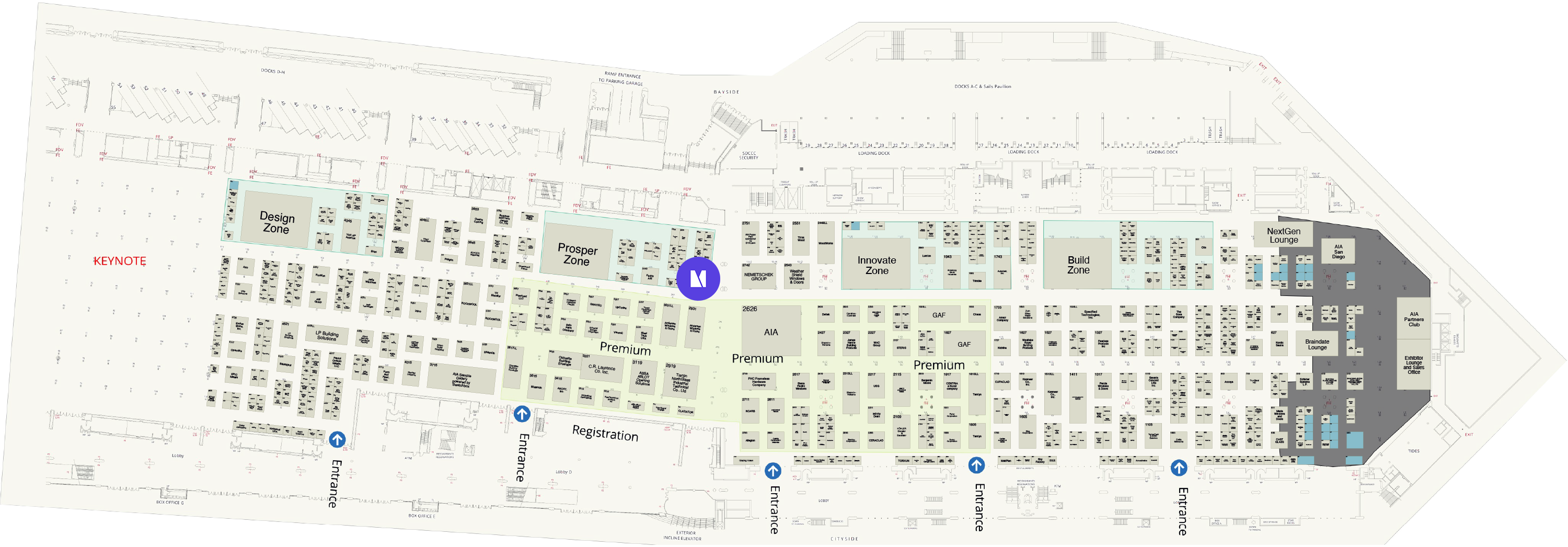
Monograph is at Booth #2945 on the expo floor, open Thursday Jun 11 and Friday Jun 12 from 10:00am to 5:00pm. Both days we are running short fireside conversations with firm leaders on the operating side of practice, all day. Rena Klein, FAIA of AVEC is joining us at 2:00pm on Friday. Stop by, say hello, and pull up a stool.
San Diego: three places to see
San Diego is a deep architectural city. These are the three stops we would hand-pick for a working architect with a free afternoon.
La JollaSalk Institute. Louis Kahn, completed 1965. The pilgrimage building of West Coast modernism. Free architectural tours run by reservation, and the central travertine courtyard, with its single channel of water running to the Pacific, is open to the public daily.
La JollaBirch Aquarium at Scripps. Operated by UC San Diego's Scripps Institution of Oceanography. Sixty exhibits and tide pools on a bluff above the Pacific, with one of the best ocean overlooks in the county. A quiet pairing with the Salk visit.
CarlsbadLegoland California. The original US Legoland, opened in 1999, about thirty-five miles north of the convention center. Miniland USA reconstructs American cities at 1:20 scale in Lego brick. Worth the drive if you are traveling with family.
San Diego: three places to eat
There is no shortage of strong food in San Diego. These three sit in three different registers: a casual lunch within walking distance, a design-forward dinner, and a historic kitchen worth crossing town for.
East VillageLola 55. Tacos and small plates with a serious kitchen behind them, about ten minutes on foot from the convention center. The easiest good lunch in the neighborhood.
Little ItalyBorn and Raised. Steakhouse from the CH Projects group, with tableside martinis and a heavily designed interior that rewards a slow look. Reservations open thirty days in advance and go quickly.
Barrio LoganLas Cuatro Milpas. A Mexican kitchen that has been open since 1933, run by the same family. Cash only, with a line out the door, and it closes when the day's food runs out. A San Diego original.