

Senior managers at A&E firms typically charge 26% to 53% of their time to client projects, with the rest absorbed by overhead, business development, and administration. A good chunk of that non-billable time goes to compiling reports, chasing down project data, and reconciling numbers across disconnected systems. If you are a principal pulling budget figures from one spreadsheet, utilization from another, and billing status from QuickBooks, you already know the problem. By the time you have assembled the picture, the information is stale.
Project reporting software built for A&E firms closes that gap. The right tool turns scattered data into financial answers you can use to run your firm, without the spreadsheet hunt.
The Spreadsheet Trap Is the Industry Default
PSMJ Resources distributes digital planning toolkits to firm leaders at its Principals Bootcamp. Budget calculators, utilization models, pricing tools, all living in spreadsheets.
For many small and mid-size firms, this is still normal practice. Principals piece together the story from Excel files, accounting software, and whatever project notes the team can find. The cost of staying there is real.
A&E firms using lump-sum contracts have no mechanism for retroactive recovery. Every hour of scope creep absorbed without a change order is permanently gone from margin. PSMJ names this directly: by the time leaders realize a project has expanded beyond the original agreement, the firm has already absorbed the loss.
Collection periods present a related challenge. Industry benchmarks suggest A&E firms should target 75 days or fewer to collect receivables, with anything past 90 days raising serious concern. Combine slow collections with chargeability shortfalls and you have a profitability problem that compounds every month you cannot see it clearly.
The Metrics Principals Actually Need
AIA Best Practices documentation identifies core financial KPIs for architecture firms, including utilization rate, net multiplier, overhead rate, and overall payroll multiplier. Running a firm requires more than a short KPI list, though. The picture breaks into categories that map to different decision cycles.
Weekly and monthly indicators keep operations on track:
- Utilization rate measures billable hours divided by total hours and shows whether your team's capacity is generating revenue or getting absorbed by overhead
- Net multiplier measures net revenue divided by direct labor and flags scope creep, underpricing, or inefficient staffing on individual projects
- Budget vs. actual by phase catches problems while there is still time to adjust staffing, scope, or billing
- Days sales outstanding tracks how long cash takes to arrive after you have earned it
A declining net multiplier on a specific project tells you something is wrong before the final invoice confirms it. Phase-level budget tracking tells you which projects are bleeding margin while work is still underway.
Quarterly metrics inform bigger decisions about firm direction:
- Backlog refers to contracted but unearned revenue and signals whether you need to hire, hold, or pursue new work
- Net service revenue per FTE benchmarks productivity against peers. Zweig Group's 2025 Valuation Report shows the median surveyed firm generating $7.7 million in NSR across 45 full-time equivalents
- Pre-bonus profit and EBITDA determine bonus pools and drive valuation conversations for any ownership transition
These measures shape staffing, compensation, and growth decisions long before year-end financials land on your desk.
Why Generic Project Tools Miss the Point
Platforms like Asana and Monday.com track whether tasks are complete. They have no native concept of phase-level fee burn, billable versus non-billable hours, or the relationship between hours logged and project profitability. Architecture and engineering projects are structured around defined phases, each carrying its own fee allocation. A task-completion tool cannot tell you that a phase is burning through its budget faster than the work is progressing.
The consequence is straightforward. Firms discover margin erosion after the financial hit has already landed, instead of while there is still time to correct course. Most studios rely on separate software for project management, accounting, CRM, and collaboration, with manual workarounds and institutional memory filling the gaps.
AIA's most recent data shows that one-third of firm leaders selected increasing profitability as a top concern for 2025, the highest share since 2017. Negotiating appropriate fees ranked second at 21%. Both depend on project-level financial visibility that generic tools cannot provide.
What Purpose-Built Reporting Looks Like in Practice
Monograph was built for this problem. Its reports are shaped around the questions principals ask in real A&E practice, so utilization rate, realization rate, and profit and loss are available quickly instead of through a multi-step extraction process.
The platform's report views cover the reporting principals need to see:
- Firm-wide dashboards showing utilization, realization, and P&L without switching between tools
- Phase-level budget tracking that spots when projects are trending over budget with real-time insight into phase progress
- Staffing visibility that projects future revenue, cost, and profit based on your current pipeline, with visibility into upcoming staffing needs
- Cash flow visibility across invoicing status, payments, and project financials
Together, those views give principals an operating picture they can use in real time.
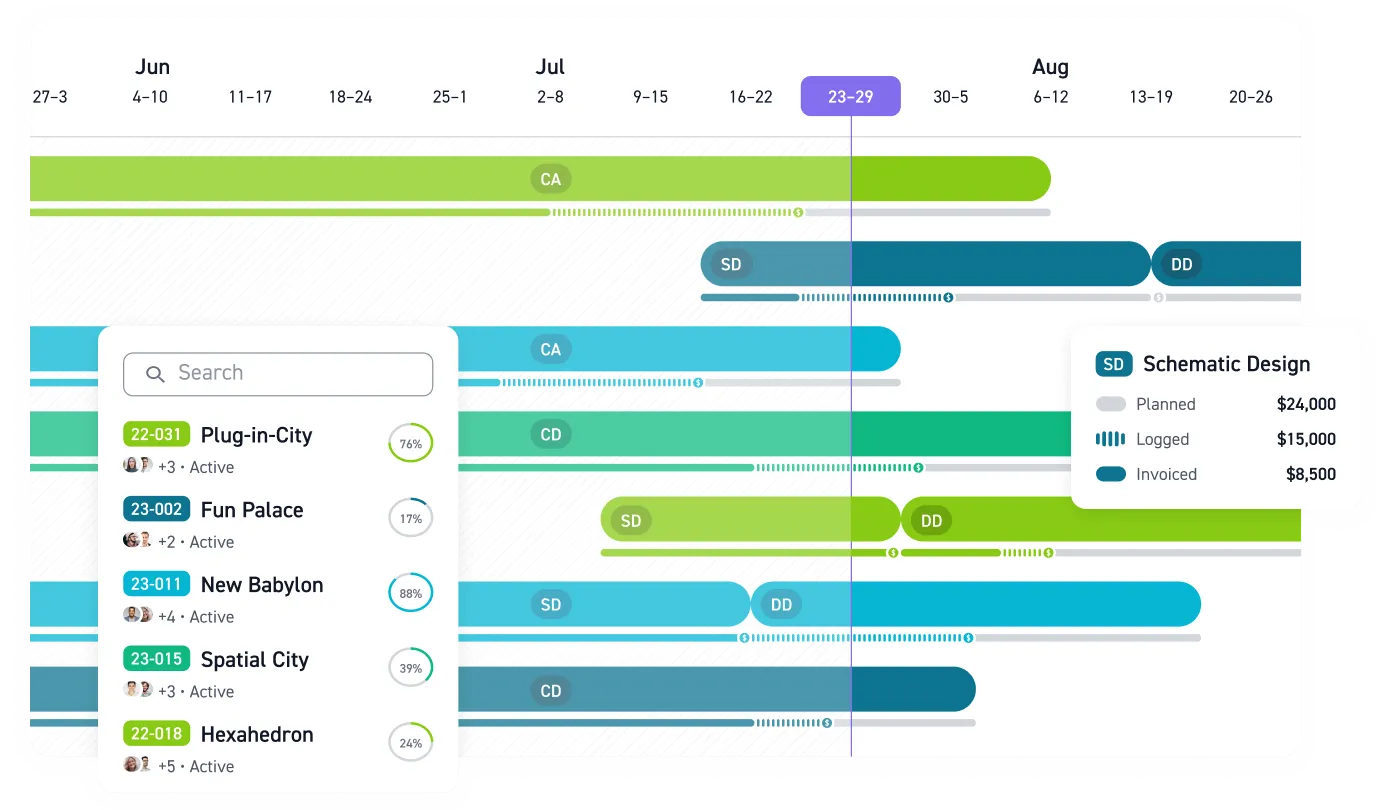
Monograph's MoneyGantt™ feature adds a financial layer to visual project timelines, showing phase-based budgeting and cash progression in one view. Instead of maintaining separate Gantt charts and budget spreadsheets, principals can see the relationship between schedule and money side by side.
The QuickBooks sync reduces double-entry by connecting invoices, expenses, consultant bills, and client data.
Firms Are Already Making the Switch
Woodhull, a 25-person firm in Maine, moved from fragmented manual processes to Monograph and cut admin time by 66%, while also accelerating their billing cycle by 50%. Dynamic Engineering, a 10-person firm in Florida, transitioned from Excel-based project tracking and reported 25% profit growth along with a 2x efficiency gain in their first year.
Workbench, a 30-person firm in California, reported 75% fewer unbilled fees, 8x faster staffing decisions, and a 4x faster billing process. For a small firm on fixed-fee contracts, catching unbilled work before it becomes a permanent loss changes the economics of every project. You can explore more results from firms of all sizes at the success stories site.
The shift goes beyond individual firms. The Deltek Clarity 2025 study found that 74% of A&E firms expect to reach digital maturity within three years, with operating profit on net revenue hitting a 10-year high of 21.4%. Deloitte's 2026 outlook reinforces the point, noting that technology investment could be essential for maintaining a competitive edge as the industry shifts toward digitally enabled workflows.
Firms that close the gap between thinking a project is profitable and knowing it is profitable carry that advantage into every decision that follows.
Run Your Firm With Clarity, Not Guesswork
Monograph brings project reporting, staffing visibility, cash flow insight, Monograph's MoneyGantt™ timelines, and QuickBooks Online integration into one A&E-focused workflow. Your firm's next step is getting the numbers you need without the spreadsheet hunt. Get started with Monograph.
FAQ
What does project reporting software do for an A&E principal?
It pulls together the numbers principals already need to run the firm. Utilization, phase budgets, billing status, cash flow, and profitability are available in one place, without requiring hours of spreadsheet work each week.
Why aren't generic project management tools enough?
They track tasks, but they do not understand phase-based fees, billable time, utilization, or project margin in the way A&E firms need. Firms using generic tools typically discover budget overruns after the financial impact has already landed.
Which metrics matter most day to day?
Weekly and monthly visibility usually starts with utilization, net multiplier, budget versus actual by phase, and days sales outstanding. These are the numbers that tell you whether a project needs attention now or can wait.
What makes purpose-built reporting different?
Purpose-built reporting gives principals one operating picture across projects, staffing, billing, and firm performance. Problems surface while there is still time to act, not months after the fact.
How does Monograph help?
Monograph brings reporting, staffing visibility, cash flow insight, Monograph's MoneyGantt™ timelines, and QuickBooks Online integration into one A&E-focused workflow built by practitioners who understand how firms run.