

Most A&E firm principals hear about AI daily but struggle to separate vendor hype from practical reality. The gap between what's promised and what's proven is significant, and for leaders responsible for project quality and firm profitability, getting this wrong has real consequences.
The good news is that data from AIA, ACEC, and Zweig Group paints a clearer picture than the trade press suggests. Most firms are earlier in this journey than you might think.
Where the Profession Actually Stands
If you feel behind on AI adoption, you probably aren't. Only 6% of architects regularly use AI for their work, and just 8% of architecture firms have formally implemented it at the organizational level. On the engineering side, an ASCE-reported survey found only 27% of AEC firms actively using AI, with most deployments concentrated in pilots, experimentation, and limited operational rollouts rather than firm-wide use.
The strategy numbers look stronger on paper. Zweig Group data shows 29% of engineering firms have an AI strategy in place, and 63% report either having one in place or actively developing one. Having a policy and using AI in daily operations are very different things, and most firms are still on the policy side.The AIA's Strategic Council has identified competitive risk for firms that don't engage, including loss of relevance to other professions as clients demand more technology-driven delivery.
AI will matter for A&E firms. The immediate question is where it delivers value now and where it still falls short.
Where AI Delivers Real Value Today
The strongest guidance points in one direction: start with structured, repetitive administrative work. This is the work that keeps principals, PMs, and operations leaders bouncing between spreadsheets, timesheets, invoices, and meeting notes.
Documentation workflows show firms capturing meeting notes automatically, building searchable knowledge bases, and reducing repeated mistakes that come from poor institutional memory.
The practical applications with the strongest evidence behind them include:
- Time tracking and invoicing: Hours logged flow into draft invoices automatically, reducing billing friction and invoice errors
- Budget tracking: AI-assisted tools analyze historical labor and change-order data, flagging cost overruns before they become losses
- Contract parsing: AI surfaces flagged provisions so principals spend less time reading, a use case AEC leaders have flagged as delivering measurable returns
- Proposal generation: Purpose-built tools show firms producing proposal drafts up to 70% faster with AI assistance
These applications share a common thread. They leave design and engineering judgment with your team and handle admin work that pulls attention away from design, coordination, and client work.
Benchmark data from 527 A&E firms shows a meaningful gap between average utilization and top performers. If you can't see where time goes, AI tools have little to improve.
The ROI Picture Is Real but Conditional
The productivity evidence is strongest at the task level. Stanford's AI Index Report shows productivity gains of 14% to 26% in structured tasks like customer support and software development. ACEC member firms also describe proposal formatting and specification drafting that once took hours now being completed in minutes.
The broader findings tell a consistent story:
- Structured, repetitive tasks show the clearest productivity gains, while gains are smaller or can turn negative on judgment-intensive work
- Most organizations achieve satisfactory AI ROI within two to four years
- Only 6% of executives reported AI payback in under a year
- BCG research finds 70% of AI value comes from people and process changes, with just 10% from the algorithms themselves
For A&E firms, that means the near-term wins are in proposals, specs, meeting minutes, and report drafting, not core design or engineering analysis.
The Billing Question Nobody Has Answered
AI compresses task time. Hourly billing assumes a direct relationship between time and fees. When AI breaks that relationship, firms face a decision that no industry association has resolved.
ACEC research names this disruption directly. Nine out of ten engineering firms surveyed believe AI will transform the industry's business model within three to five years, yet neither ACEC nor AIA has issued prescriptive guidance on how to adjust fees when AI reduces actual hours spent.
For A&E principals, a defensible near-term posture is straightforward: capture efficiency gains as improved margins, avoid billing hours that weren't expended, and develop an internal policy on AI use disclosure before clients start asking.
Getting Started Without Overcommitting
A clear sequence emerges from the guidance cited here. Define a specific business problem before selecting any tool. Audit what structured data your firm actually maintains. Paper-based workflows are still common at many firms, with more than half using paper during design and nearly half during planning, and that limits AI's usefulness regardless of platform. Then run a short pilot on one low-risk use case with success criteria defined upfront.
Platforms built for A&E workflows can narrow the gap between experimentation and operational value. One 25-person firm in Maine reported 66% time saved on admin, a 50% faster billing process, and 66% less budget overage after switching from a legacy tool. If you're toggling between spreadsheets for budgets, a separate system for time tracking, and manual invoice assembly, that's the problem to solve first.
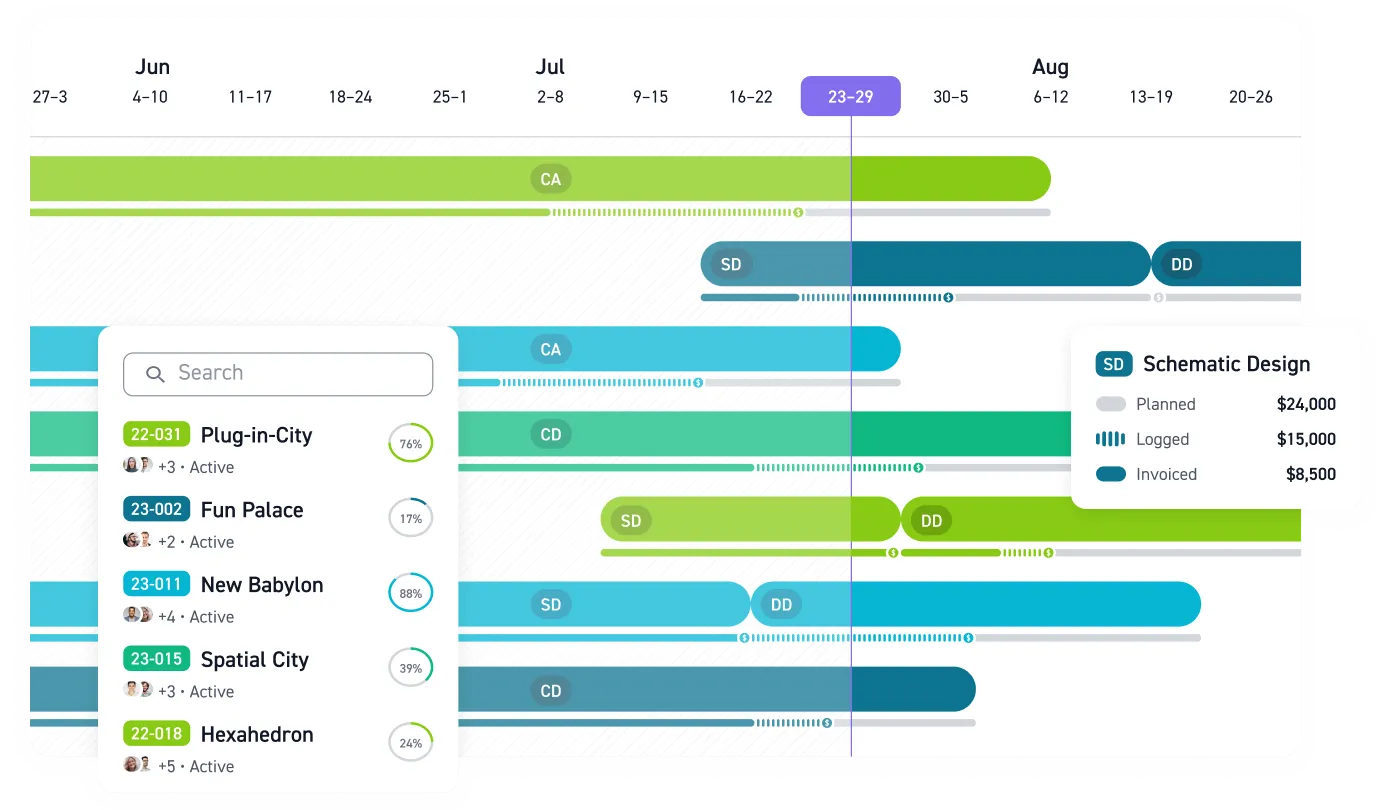
When contracts parse into phases, budgets, and staffing requirements, you replace the fragmented workflow that already consumes your week. Monograph's MoneyGantt™ is its signature visual tool for seeing budget-to-cash progression and spotting off-track phases faster. Monograph also connects timesheet management with invoicing and integrates with QuickBooks Online, payment processing, and reporting.
Small-firm guidance from ACEC offers one useful observation: smaller firms face tighter resource constraints, but they can often move faster in decision-making and implementation once a path is chosen.
Start With the Work That's Already Slowing You Down
If your firm is still piecing together budgets, timesheets, and invoices across disconnected systems, AI alone won't fix that. Start where the evidence is strongest: administrative workflows, structured data, and the repetitive tasks that pull principals, PMs, and operations leaders away from billable work.
Monograph helps A&E firms connect those workflows in one place. When time tracking feeds invoicing, contract information shapes project phases and budgets, and Monograph's MoneyGantt™ gives teams a visual read on budget-to-cash progression, it becomes easier to spot what needs attention in day-to-day practice. Firms that move first on operational clarity will be in a better position when AI adoption catches up across the profession.
Pick a platform built for architects and engineers. Book a demo.
Frequently Asked Questions
Where should a small A&E firm start with AI?
Start with structured, repetitive administrative work. The strongest evidence points to time tracking, invoicing, budget tracking, contract parsing, proposal generation, documentation, and meeting notes. Define one specific business problem, audit the structured data your firm already maintains, and run a short pilot on a low-risk use case with success criteria set in advance.
Should we use AI for design or engineering judgment right now?
The evidence says no. The clearest gains show up in administrative and documentation work, while productivity gains weaken or can turn negative on judgment-intensive tasks. For A&E firms, that makes proposals, specs, meeting minutes, and report drafting better near-term candidates than design work or engineering analysis.
How should firms think about billing when AI saves time?
There isn't a settled industry answer yet. The near-term guidance is practical. Capture efficiency gains as improved margins, avoid billing hours that weren't expended, and create an internal policy on AI use disclosure before clients start asking.
How long does AI ROI usually take?
Longer than most firms expect. Deloitte research shows most organizations achieve satisfactory AI ROI within two to four years, while only 6% of executives report payback in under a year. That's why workflow discipline, data quality, and a realistic pilot matter more than chasing fast results.