



Firm management made easy

Partners and principals at small and mid-size architecture firms spend more than half their working time on non-billable activities: general management, business development, chasing down time entries, assembling invoices, and coordinating consultants. That split hits your bottom line directly.
AI tools built for A&E practice management are starting to change that work. Useful tools can build project budgets from signed contracts and flag phase overruns early. They can also turn invoicing from a multi-day process into a review step. Adoption gets harder when firms have to separate tools that deliver from tools that create new problems.
Where Architecture Firms Stand with AI Right Now
Adoption numbers depend on what counts as implementation. Current research on architecture firms found that only 8% of firms have implemented AI tools into their practices, while more are working on implementation. Among architectural professionals broadly, regular use remains limited, while experimentation is much more common.
Compared with the broader economy, AI use in architecture remains early, especially in business operations.
Analysis from the AIA Community Hub points to back-office functions where adoption lags: finance, HR, marketing, and training. For principals and PMs, that means workflows like billing, budgeting, and resource planning still have low AI penetration and clear near-term opportunity.
The Operational Workflows Where AI Delivers Today
Practice leaders at the 2025 AIA Leadership Summit described common current AI tasks as writing assistance, rendering, sorting long text documents, generating meeting minutes, and materials research. Those are low-friction starting points. Purpose-built A&E tools go further by embedding AI into the operational workflows that consume principal and PM time.
The strongest documented time savings cluster in a few operational areas:
- Invoicing and billing. Garrison Architects, a 9-person New York firm, reported 1.5x faster billing and 2.5x faster time-to-payment using Monograph. BRNS Design, a 13-person Texas firm, reported 50% less admin time and 4x faster billing.
- Schedule and report generation. Woodhull, a 25-person design-build firm in Maine, reported 66% less admin time and a 50% faster billing process.
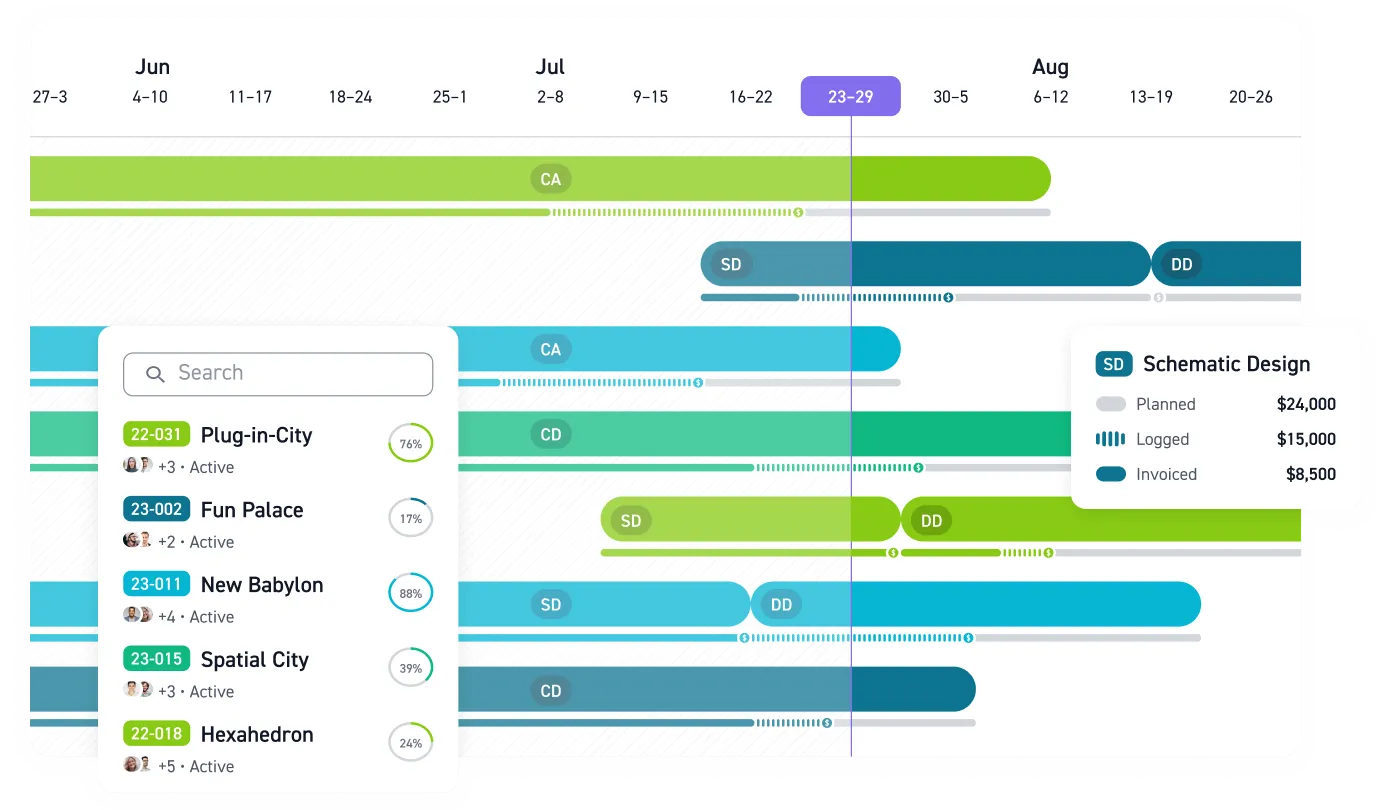
- Build budgets from contracts. AI contract parsers can read a signed agreement and build the project budget, schedule, and phase breakdown. That removes the manual copy-paste work that often starts a new project.
- Plan staff allocation. Resource-planning tools can speed up staffing and improve visibility into who is available.
Those are the workflows where firms can recover time fastest.
What the Data Shows About AI-Investing Firms
Monograph's 2026 Architecture & Engineering Business Benchmarks Report, built from platform usage across 13,000+ architects and engineers at 1,800+ firms, shows measurable differences between AI-investing firms and baseline firms.
The clearest differences are realization and operations staff utilization. Payment speed is included because it shows where AI does not change the underlying client behavior.
- Realization: AI firms average 100% realization and capture the full value of every hour worked. Baseline firms average 96% and lose margin to write-offs and scope creep.
- Operations staff utilization: Operations roles at AI firms log 84% utilization versus 81% at baseline firms.
- Payment speed: Time to payment is one of the few metrics with no cohort gap. AI helps firms earn and bill more efficiently, but it does not change client payment behavior on its own.
Taken together, those metrics show AI helps most when operational processes are already repeatable.
How to Adopt Without Adding Complexity
Regulatory uncertainty, data security, cost, and complexity create the biggest practical barriers to AI adoption in A&E. If your firm does not have dedicated IT staff, those concerns are real. A workable adoption sequence reduces risk.
Think of it like phasing a building project. You would not start construction without a complete set of documents. AI adoption follows the same logic.
- Identify an internal champion. Practical adoption guidance recommends a cross-functional team, ongoing internal support, and visible leadership sponsorship.
- Document your processes first. Another common prerequisite is that automation works best when a process is already clearly defined. If your team cannot articulate how work moves from start to finish, AI will only move the confusion faster.
- Fix the systems behind the tools. AI will not repair broken workflows or reorganize chaotic file systems, and it will not solve tolerated inefficiencies unless firms reshape the systems behind them.
Clear workflows make the payoff practical. Principals get hours back, and billing cycles move faster because project health gets easier to see. Adoption starts to feel useful.
Starting with What You Already Do
Firms seeing real returns from AI pick one workflow that already works, like invoicing or resource planning, and use AI to speed up the repetitive steps around it. Across the profession, adoption is still emerging, with AI features increasingly built into everyday tools and workflows.
For a principal already losing large blocks of time to non-billable work, even the conservative floor estimate from research on generative AI users can shift that balance. That is time back for design leadership, client relationships, or simply leaving the office earlier.
Tools like Monograph, built by architects and designed specifically for how A&E firms track time, budget phases, and bill clients, lower the adoption threshold because they fit the language and structure your practice already uses.
Start with One Workflow
Every extra week spent chasing time entries, rebuilding budgets, or assembling invoices by hand is a week your principals and PMs are doing admin instead of leading projects. Start with one operational workflow that already works in your firm, then use AI to remove the repetitive steps around it.
For most A&E firms, invoicing is the easiest place to start. Project setup and resource planning often come next. Those workflows already have documented results. Billing moves faster and admin time drops, with clearer project health without another layer of complexity.
Start with one workflow. Book a demo.
Frequently Asked Questions
Where should a small architecture firm start with AI?
Start with one operational workflow that already exists in your firm and already has a clear process behind it. Invoicing is often the easiest starting point. Project setup and resource planning are also practical because they consume a lot of principal and PM time and already show documented gains in speed and visibility.
Do we need clean processes before using AI practice management tools?
Yes. AI can accelerate a defined workflow, but it will not fix a process your team cannot explain, and it will not repair broken systems behind the work.
Will AI replace project managers or operations staff?
The strongest current use cases are administrative and operational: writing assistance, meeting minutes, billing support, contract-to-project setup, and resource allocation. Firms get less time spent on repetitive work and more time for project leadership, client communication, and visibility into project health.
How do we adopt AI without adding more complexity?
Identify an internal champion, document the workflow first, and fix the underlying systems before adding automation. Firms run into trouble when they treat AI like a shortcut around messy processes.
Data was collected as of June 2026.