

A major new research paper from Anthropic published in March 2026 contains a finding that should stop every architecture and engineering firm principal in their tracks.
AI in architecture, and the broader question of how artificial intelligence will reshape the profession, have been debated for years. Now there is real data. Of all the industries studied, architecture and engineering has one of the highest theoretical AI exposures of any occupational category, roughly 85% of tasks could theoretically be sped up by an AI.
But of all the industries with high theoretical exposure, architecture and engineering has the lowest observed AI usage. The ratio of actual to potential AI use in A&E is approximately 5%.
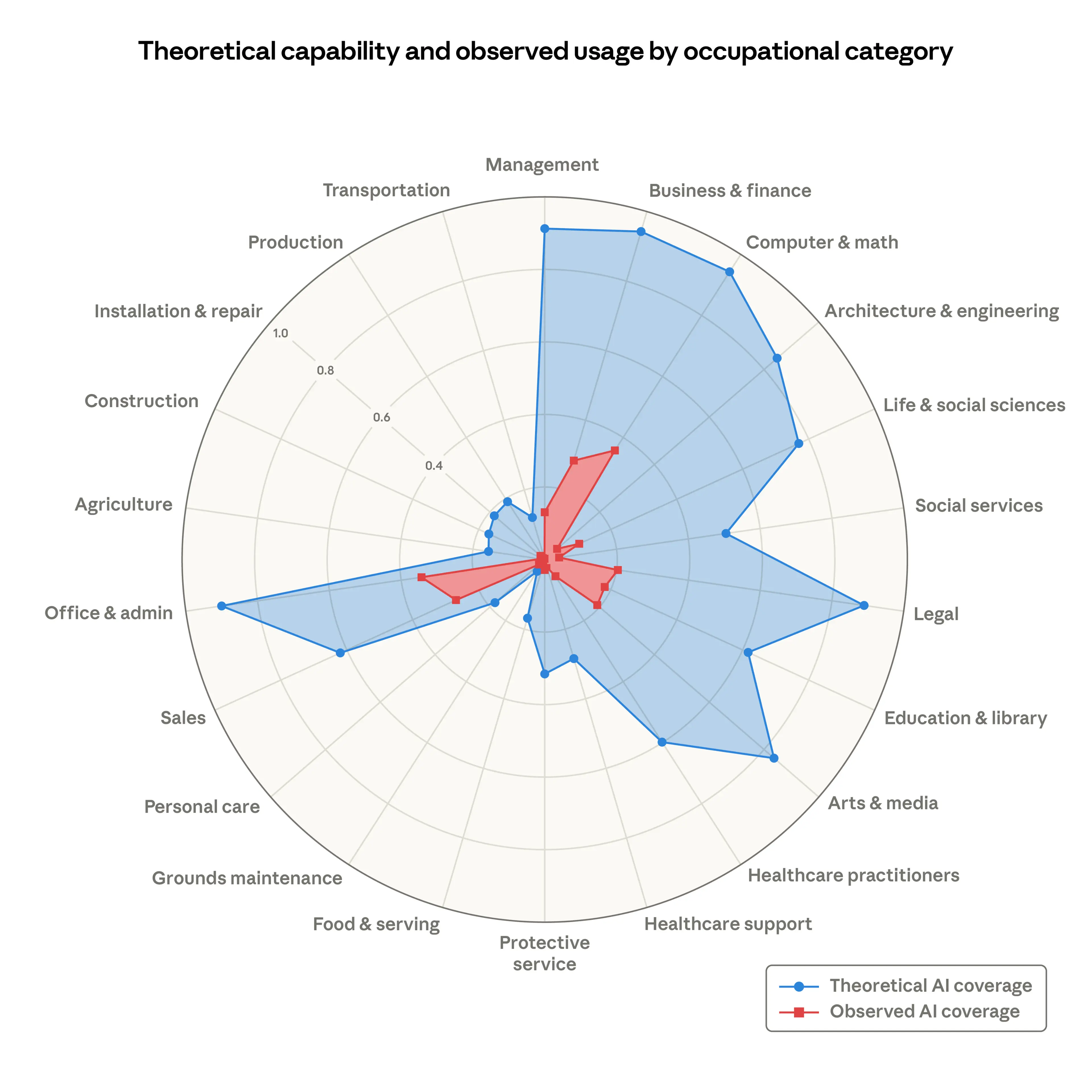
That is the biggest gap between what AI could do and what AI is actually doing of any major industry in the study.
And the profession's own data confirms it. According to the American Institute of Architects' 2025 Journey to Specification research study only 6% of practicing architects in the United States regularly use AI tools in their work. Just 8% of firms have implemented AI directly into their processes. Over 500 AIA-registered architects responded to the study.
That 6% number, sitting alongside Anthropic's finding of 5% observed exposure, is not a coincidence. It is a portrait of a profession that is theoretically among the most AI-exposed in the economy and practically among the least changed by it.
What the research actually measured
The Anthropic study, "Labor Market Impacts of AI: A New Measure and Early Evidence," introduces a concept called "observed exposure," designed to close the gap between theoretical AI capability and real-world adoption. Prior research, most notably the landmark 2023 paper by Eloundou, Manning, Mishkin, and Rock published in Science, established that roughly 85% of architecture and engineering tasks are theoretically feasible for an AI to speed up by at least 50%. That number has been widely cited and has generated considerable anxiety about AI displacing architects and engineers.
Anthropic's researchers asked something different: of those theoretically exposed tasks, which ones are architects and engineers actually using AI to perform right now? To find out, they mapped millions of real Claude conversations to specific O*NET job tasks, filtered for professional and work-related contexts, and weighted automated use more heavily than augmentative use.
The result for architecture and engineering: about 5% observed exposure against 85% theoretical.
What architects are actually doing with AI and what they are not
The AIA study fills in the picture with important detail. Of the ai architects and practitioners already using AI, the majority reported using chatbots like ChatGPT, grammar tools, and image generators. These are augmentation tools used for communication and visualization, not tools that touch the core technical workflows of the profession.
The study specifically asked architects where AI was most needed. The areas identified as highly inefficient, updating product lists, cost estimation, complex specification writing, and product research, had AI adoption rates below 10%. Meanwhile, tasks like client communications, which most architects considered already efficient, had AI adoption above 20%.
This is the adoption pattern of a profession reaching for AI in the easiest, most visible places while the highest-leverage applications remain largely untouched.
What the leading edge looks like
While the average architecture firm has barely touched AI, a small number of practitioners are testing what is possible at the frontier, and the results are worth paying attention to.
Designer Tim Fu, founder of Studio Tim Fu and formerly of Zaha Hadid Architects, unveiled plans in early 2025 for the Lake Bled Estate in Slovenia, which he claims is the first architecture project to use AI at every stage of the design process. The project used AI to analyze zoning laws, research the site's historical context, develop the masterplan, optimize energy efficiency, and generate material choices. Six villas with large arched windows were designed with AI as what Fu describes as "an active design collaborator." The project drew significant international coverage and represents one of the clearest demonstrations yet of what a fully AI-integrated architecture practice could look like.

This may not be representative of how architecture is being practiced at the 6% level the AIA measured. But illustrates what is already happening at the frontier. If this is what the leading edge looks like, what does it mean for a profession where the vast majority of firms are still using AI primarily for client emails?
Will architects be replaced by AI?
The Anthropic research offers the most data-driven answer to date: no, not yet, and not imminently.
The study found no systematic increase in unemployment for architects and engineers since AI tools became widely available in late 2022. The gap between what AI can theoretically do and what it is actually doing in architecture and engineering practice is the largest of any major industry, meaning the disruption that many predicted has not arrived in measurable form.
There is tentative evidence that hiring of workers aged 22 to 25 has slowed slightly in highly exposed occupations broadly, but no specific evidence this is affecting architecture and engineering at current levels of observed adoption.
That said, the question deserves a careful answer rather than a reassuring one. The BLS projects that jobs with higher observed AI exposure will grow more slowly through 2034. Architecture and engineering's current low observed exposure means it has not yet hit that headwind. But the theoretical exposure is high enough that when adoption does accelerate, the growth outlook for the profession could change.
The architects of AI's role in the built environment are not tech companies. They are the firm leaders deciding right now how to integrate these tools into practice and on what timeline.
Why the gap might be so large
But drawing on the research and what we know about how A&E firms operate, several explanations emerge.
The work is deeply visual and spatial. A significant share of architecture and engineering work involves reading drawings, interpreting spatial relationships, reviewing physical site conditions, and producing visual deliverables. Current AI tools are primarily text and code based. The most theoretically exposed tasks in A&E, writing specifications, drafting reports, performing calculations, are genuinely AI-accessible, but they may represent a smaller share of daily working time than the theoretical numbers suggest.
Liability and professional accountability create friction. Architecture and engineering are licensed professions. Stamped drawings and signed certifications carry legal weight. The standard of care in these fields creates a strong structural incentive to keep humans deeply in the loop. This does not make AI adoption impossible, but it raises the bar significantly compared to industries where errors are more easily corrected.
Project-based work with unique variables resists standardization. Every site is different. Every structural system is custom. Every client program is bespoke. AI handles repetitive, standardized, clearly defined tasks most effectively. Much of A&E work involves high-stakes judgment applied to novel situations.
Software ecosystems are fragmented and specialized. Architects and engineers work across Revit, AutoCAD, Rhino, ETABS, RAM, and dozens of other tools that do not yet have deep AI integration. Unlike industries where most work happens in a browser or general-purpose office suite, A&E professionals are working in environments where AI copilots and automation layers are still immature.
The profession has been slow to digitize generally. The profession moves deliberately with new technology, and that pattern is holding with AI.
What this means for your firm right now
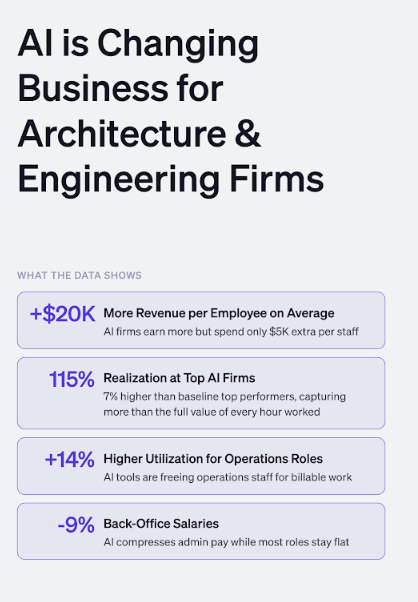
The Monograph 2026 benchmarks data shows the early performance gap is already measurable. Firms investing in AI today are generating $20K more per employee than baseline peers, running 14% higher utilization on operations staff, and compressing back-office costs by 11%. These gains are coming from relatively basic AI adoption applied to the financial and operational management side of the business, not from AI doing design or engineering work.
The implication: the easy wins from AI in A&E firms are available now and are already being captured by early movers. The more transformative applications, AI-assisted design review, automated code checking, generative structural optimization, AI-powered specification writing, are coming but have not arrived at scale.
The firms best positioned when that wave arrives are the ones that have already built the operational habits that make AI useful: tracking time accurately, measuring project performance, billing efficiently, and making decisions from data. AI amplifies good processes. It does not fix broken ones.
The question is whether your firm will be ready when it starts to close.
Sources:
- Massenkoff and McCrory, "Labor Market Impacts of AI: A New Measure and Early Evidence," Anthropic, March 2026: anthropic.com/research/labor-market-impacts
- American Institute of Architects, "Artificial Intelligence Adoption in Architecture Firms: Opportunities & Risks," Journey to Specification, March 2025: aia.org
- Eloundou, Manning, Mishkin, and Rock, "GPTs are GPTs," Science, 2024: arxiv.org/abs/2303.10130
- Anthropic Economic Index, January 2026 and March 2026: anthropic.com/economic-index
- Dezeen, "Tim Fu uses AI as design collaborator for Slovenian housing development," April 2025: dezeen.com/2025/04/03/lake-bled-estate-tim-fu-ai

.png)