



Firm management made easy

Architecture and engineering firms face a digital maturity paradox. While 25% are digitally advanced, 76% are still aspiring to maturity. This 51-point gap reveals why structured CRM implementation has become essential for A&E practices managing complex, relationship-driven business development.
The stakes couldn't be higher. With 80-85% repeat business, even marginal improvements in client relationship management create measurable results. We’ve seen this in practice: first hand: Workshop/APD, a New York architecture firm of about 50 people, structured their approach to business development processes and delivered improved financial management and operational efficiency.
The following implementation framework, grounded in industry best practices, will show you how to transform CRM from administrative burden into business advantage by connecting business development directly to project delivery and client retention.
Step 1: Secure Executive Leadership and Define Project Ownership
CRM implementation fails without principal-level commitment from firm leadership. In architecture and engineering firms specifically, technical professionals and project managers often resist administrative systems. Executive sponsorship is non-negotiable for adoption.
According to a framework for AEC firms, the solution is to identify and empower a project leader who understands both business development processes and possesses organizational authority to drive adoption across the firm. This leadership commitment is particularly critical in design firms where technical staff view CRM adoption as administrative burden rather than business advantage. Principals and owners must visibly champion the initiative and demonstrate its value to overcome this resistance.
Successful implementations require addressing the fundamental question: Why should architects and engineers embrace relationship management systems? The answer lies in demonstrating time savings and project win improvements rather than imposing additional administrative tasks. This emphasis on articulating clear value represents the critical foundation for adoption across architecture and engineering firms. Show technical staff how CRM systems reduce administrative burden while improving business outcomes.
Establish clear ownership structure from day one. Designate a CRM administrator with explicit responsibilities for data management, user support, and system optimization. Create a governance committee representing business development, project management, and firm leadership to ensure sustained commitment beyond initial deployment.
Step 2: Document Current Business Development Processes
Before selecting technology, map existing workflows. A&E firms operate fundamentally differently from sales-driven organizations. They require systems that accommodate Qualifications-Based Selection (QBS) processes used in public sector procurement. They need tools supporting multi-disciplinary team coordination across extended project timelines. They depend on relationship-based selling that prioritizes client fit over aggressive closing tactics.
Critically, A&E firms need project-centric systems that treat lead management as the first phase of continuous project delivery rather than a separate sales activity. Systems must connect business development data directly to project management and financial systems without losing context when opportunities transition to active projects.
Your documentation should capture these A&E-specific processes:
1. Qualifications-Based Selection (QBS) Pursuit Workflows
Specifically accommodate QBS processes used in public sector A&E procurement, including multi-phase qualification submissions (SF330 forms), shortlist tracking, interview preparation, and relationship-based selling that prioritizes client fit over aggressive closing tactics.
2. Multi-Disciplinary Team Coordination
Document how your firm manages complex, multi-year project pursuits with teams of technical professionals across multiple disciplines. Track multiple stakeholders coordinating across departments with long timelines and numerous touchpoints, ensuring centralized data access for technical teams working in silos.
3. Business Development to Project Delivery Integration
Establish processes that eliminate the gap between opportunity management and project execution. Map how opportunities transition from BD tracking to active projects without losing context or requiring manual data recreation, connecting business development data directly to project management and financial systems.
4. Client Retention and Repeat Business Management
With 80-85% repeat business as a standard, document structured tracking of existing client relationships, expansion opportunities with past clients, and proactive retention strategies rather than siloing relationships with individual principals.
5. Long-Duration Relationship Tracking
Capture processes for managing extended sales cycles spanning months or years from initial contact to contract, including structured lead tracking with numerous touchpoints across extended timelines, detailed client interaction history, and complete project history tracking.
6. Complex Project History and Stakeholder Networks
Document how your firm tracks detailed project performance across extended timelines, manages multiple stakeholders per project, and maintains complete interaction records when different team members engage with the same client at different project phases.
7. A&E-Specific Performance Metrics
Implement tracking for industry-relevant metrics including bid-to-win ratio, pipeline-to-revenue ratios (targeting 2.5-3x annual revenue in pending proposals), client lifetime value, project profitability by sector, and repeat business percentages.
Additional documentation considerations:
- How pursuit teams coordinate across disciplines during complex, multi-year opportunities
- Methods for tracking multiple stakeholders within single client organizations
- Workflows connecting initial client contact through project delivery and repeat business
- Current systems housing relationship data, project history, and proposal information
This mapping exercise reveals integration requirements and customization needs that generic CRM systems cannot address. Firms skipping analysis might select inappropriate systems designed for product sales rather than professional services.
Step 3: Establish Clear Business Development Goals
Define specific outcomes your CRM should enable. According to the research, architecture and engineering firms require fundamentally different success metrics than traditional sales organizations. They need systems that support relationship depth and client retention rather than transaction volume.
With 80-85% repeat business, A&E firms should prioritize client relationship management, project-based pipeline visibility, and long-cycle opportunity tracking as core outcomes.
Essential goals for A&E practices include:
- Pipeline visibility with opportunities totaling 2.5 to 3 times annual revenue
- Client retention improvements beyond the current 80-85% industry average
- Win rate tracking and analysis by market sector and client type
- Proposal automation reducing manual coordination across pursuit teams
Step 4: Select A&E-Appropriate Technology
Generic CRMs fail in architecture and engineering contexts. Traditional systems are built around sales funnels with contact-centric models that cannot accommodate complex, multi-year project pursuits with teams of technical professionals across multiple disciplines.
Prioritize systems offering project-centric architecture rather than contact-centric models. Your CRM should center on projects and opportunities, recognizing that A&E work involves collaborative teams serving multiple stakeholders with long timelines and numerous touchpoints.
For small-to-medium A&E firms, all-in-one platforms offer advantages over integrating separate specialized tools. This approach is specifically recommended for firms with limited IT resources and smaller budgets.
All-in-one platforms reduce the number of integration points requiring ongoing maintenance, data synchronization errors between systems, user training complexity, and overall system administration burden. More importantly, integrated systems align with how architecture and engineering firms actually work by treating projects as central to client relationships rather than separating sales activities from project delivery. This is a capability that generic, contact-centric CRMs fail to provide.
According to research on A&E CRM implementations, firms benefit most from consolidated solutions that eliminate the gap between business development and project execution while addressing adoption challenges that technical professionals face with administrative systems.
Step 5: Prepare and Cleanse Existing Data
Data migration represents a critical implementation bottleneck. A&E firms typically maintain relationship information across fragmented systems: spreadsheets, email files, project folders, and individual principal contacts.
Underestimating the effort required to clean and migrate existing data, can result in duplicate contacts, outdated information, and incomplete project histories. Dedicate specific resources to data audit and establish standards before migration begins.
Your data preparation should address these A&E-specific challenges:
- Consolidating contact information from multiple principals' individual networks
- Organizing project history and past client interactions across different delivery teams
- Standardizing firm and contact records with consistent naming conventions
- Removing duplicates while preserving relationship context
Step 6: Configure for A&E Workflows
Traditional CRMs are built around sales funnels with contact-centric models that fail for A&E firms. A&E practices require customization supporting Qualifications-Based Selection (QBS) processes, multi-stakeholder coordination across disciplines, and seamless transitions from opportunity management to project delivery.
Configure your system to accommodate these essential A&E functions:
- Multi-stakeholder tracking within complex client organizations (owners, facilities managers, procurement staff)
- Project phase management aligning with design and construction delivery schedules
- Subconsultant and consultant team coordination across disciplines
- Proposal automation linking to resume databases and project experience portfolios
Effective systems manage every single interaction your firm has with clients, prospects, and partners, providing detailed history and context for conversations that often span months or years.
Step 7: Plan Critical Integrations
Integration planning is critical to long-term success. A&E CRM systems must connect with project management tools, accounting systems, and document management platforms to provide unified visibility across the client relationship lifecycle.
Important integrations include tools such as LinkedIn, Outlook, Adobe InDesign/Word, accounting solutions, project management software, and document management systems, aligning with industry practices for A&E firms.
Prioritize these integration points:
- QuickBooks Online or your primary accounting system for unified financial visibility
- Project management platforms linking opportunities to delivery teams
- Document management systems housing RFPs, proposals, and project files
- Email integration capturing client communication history
The most successful integration architecture connects business development data directly to project management and financial systems to enable the transition from opportunity to project without losing context or requiring manual recreation.
Step 8: Develop Complete Training Strategy
Technical professionals require different training approaches than traditional sales teams. Address concerns about administrative burden by explaining the "why" to overcome resistance, demonstrating clear time savings and project win benefits, and creating implementation teams with good CRM understanding rather than imposing additional responsibilities.
Your training strategy should include:
- Role-specific sessions showing benefits for each user type
- Identification of CRM champions within each department
- Regular refresher sessions with documented standard operating procedures
Getting staff to actually use the CRM consistently represents one of the most common implementation failures, making robust training and change management critical success factors.
Step 9: Execute Controlled Pilot Testing
Begin with a pilot program launching to enthusiastic early adopters before firm-wide deployment. A phased approach can help address user resistance, including from technical staff, that is common in A&E firms.
A&E-specific testing should rigorously validate:
- Proposal generation workflows: Critical for design firms that depend on proposal automation as a core CRM function.
- Client interaction tracking across extended timelines: Recognizing that A&E projects often span months or years with multiple touchpoints and stakeholder changes.
- Integration functionality with technical software: Ensuring seamless connections with project management and accounting systems that are inseparable from client relationship management in A&E practices.
- Permission levels for different roles within pursuit teams: Accommodating the multi-disciplinary coordination across technical professionals that characterizes A&E business development.
This testing phase validates that the system accommodates the unique complexity of A&E workflows before requiring broader organizational adoption, increasing the likelihood of successful firm-wide implementation and user acceptance.
Pilot testing also reveals workflow gaps and technical issues before they impact firm-wide adoption. Use this phase to refine configurations and address user feedback from actual business development activities rather than theoretical scenarios.
Step 10: Measure Success and Optimize Performance
Track improvements using A&E-relevant metrics rather than generic sales KPIs. Monitor:
- Pipeline-to-revenue ratios (targets: 2.5-3 times annual revenue)
- Client retention rates and repeat business (80-85% industry average)
- Win/loss analysis by market sector
- Time reduction in administrative coordination (case study benchmarks: 25% reduction in administrative time)
Tech-forward A&E firms achieve measurably superior financial performance: 67% project profit rates of at least 20% within 12 months, compared to 52% of tech-static firms. That represents a 15 percentage point advantage. Your CRM implementation can contribute to closing this performance gap through structured relationship management and business development processes that tech-forward firms leverage to achieve these results.
Full organizational adoption typically requires three to six months beyond initial deployment in A&E firms. Firms should maintain momentum through regular performance reviews, user feedback sessions, and system optimization based on actual usage patterns rather than initial assumptions. This is critical for addressing the technical staff adoption resistance that commonly affects architecture and engineering practices.
The investment in structured CRM implementation delivers measurable returns for A&E firms through multiple channels. According to research on implementation outcomes, firms benefit from improved client relationships through centralized relationship tracking across long project cycles and reduced administrative burden. Firms also gain enhanced business development effectiveness.
These improvements are particularly significant given that the A&E industry generates 80-85% of revenue from repeat business. This makes structured client relationship management strategically essential. Research confirms that technology adoption directly correlates with superior financial performance: 67% of tech-forward firms achieve project profit rates of at least 20% within 12 months, compared to 52% of tech-static firms, demonstrating that structured CRM implementation helps firms compete more effectively in an increasingly relationship-driven market.
Stop Juggling Disconnected Systems
The reality is that most A&E firms struggle because their CRM lives in isolation from project management, time tracking, and financial systems. Every day you spend manually connecting business development data to project delivery is another day your team wastes on administrative coordination instead of winning work. When opportunities become projects, critical context disappears into spreadsheets. When project teams need client history, they're hunting through three different platforms.
Monograph eliminates this gap. Our integrated platform connects business development directly to project execution. Opportunities transition seamlessly to active projects without losing relationship context or requiring manual data recreation. QuickBooks Online integration provides unified financial visibility across client relationships and project delivery, while automated workflows handle the coordination that eats up your principals' time.
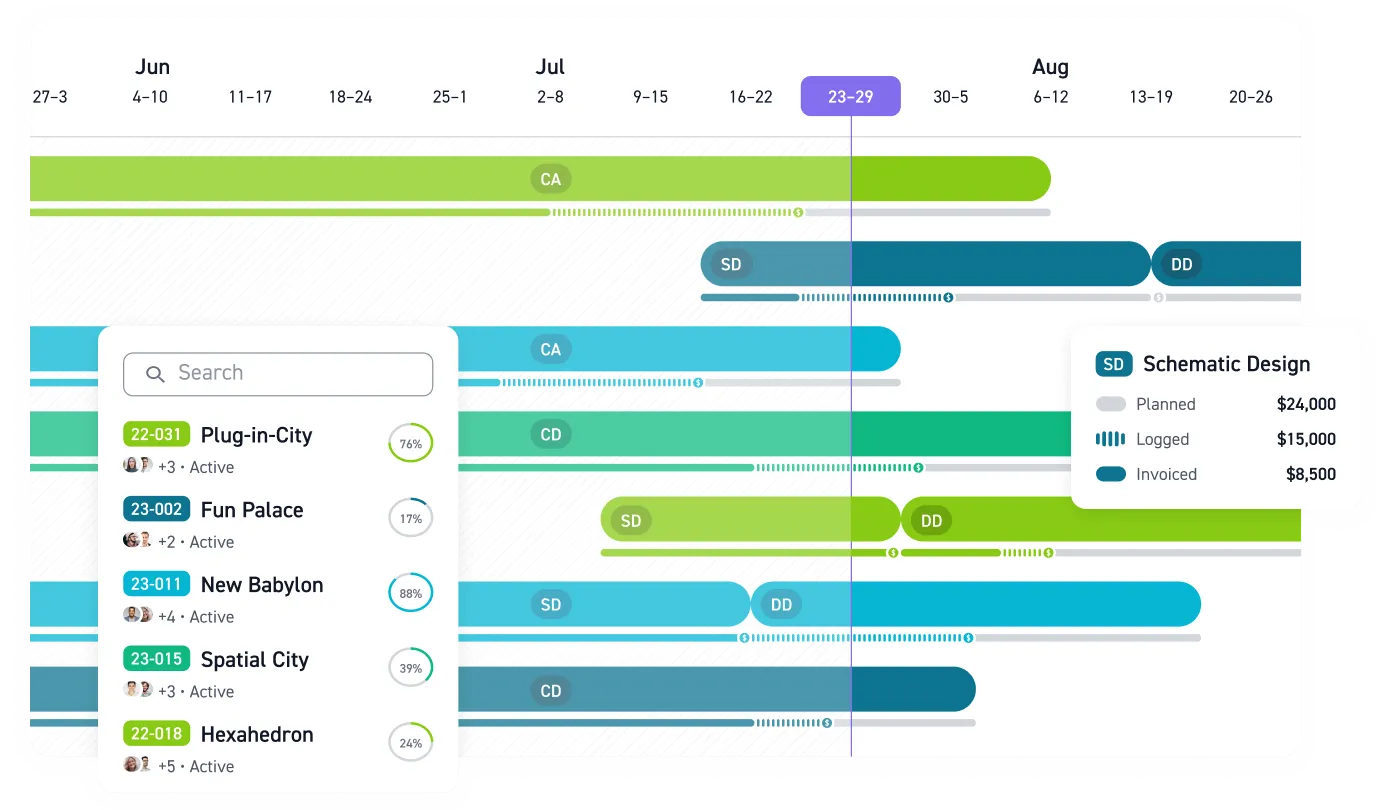
Built by architects who understand why relationship management must connect to project delivery, Monograph gives principals real-time visibility into pipeline health while project managers maintain client context throughout delivery. Monograph's signature MoneyGantt™ feature transforms complex project data into instant visual intelligence. It shows you which phases and projects are off-track in seconds. Operations managers get the consolidated view they need without maintaining multiple systems.
Over 13,000+ architects and engineers across 1,800+ firms use Monograph to work smarter, faster. Your competitors are building integrated systems while you're still copying data between platforms. See how Monograph connects business development to project delivery.
Frequently Asked Questions
How long does CRM implementation really take for A&E firms?
Expect 3-6 months for full organizational adoption beyond initial deployment. The timeline depends on your firm's size, data complexity, and existing system dependencies. Small firms with clean data can go faster, but don't rush training. Technical staff adoption makes or breaks implementation. Plan for a 2-4 week pilot, then phased rollout across departments. Most firms see measurable improvements in business development efficiency within 90 days if they maintain training momentum and executive sponsorship.
Should we choose an all-in-one platform or integrate separate specialized tools?
For firms under 50 people, all-in-one platforms win. Period. Integrated systems eliminate the gap between business development and project execution without creating integration maintenance nightmares. You're already stretched thin. Managing connections between separate CRM, project management, time tracking, and accounting tools will drain resources you don't have. Larger firms with dedicated IT support might justify best-of-breed integration, but most A&E practices benefit from consolidated platforms that treat projects as central to client relationships rather than separating sales from delivery.
How do we get technical staff to actually use the CRM?
Stop treating CRM as administrative overhead. Show architects and engineers how the system reduces their coordination burden instead of adding tasks. Run training sessions that demonstrate time savings on real pursuit scenarios: proposal automation, client history access, consultant coordination. Identify champions within technical teams who see the value early and let them evangelize. Most importantly, configure workflows that align with how your firm actually works rather than forcing generic sales processes. When technical staff see CRM making their lives easier instead of harder, adoption follows naturally.
What's the biggest mistake A&E firms make during CRM implementation?
Selecting systems built for product sales rather than professional services. Generic CRMs use contact-centric models that can't accommodate complex, multi-year project pursuits with teams of technical professionals. A&E firms need project-centric systems that connect business development directly to project delivery. Systems that understand QBS processes, multi-stakeholder coordination, and phase-based project management. Firms that skip the business development process mapping in Step 2 end up with inappropriate technology that technical staff reject because it doesn't match their workflows.
Do we need to hire someone to manage our CRM system?
Yes, but you're probably already paying them. Designate a CRM administrator from existing staff, typically an operations manager or business development coordinator who understands your workflows and has organizational authority. They don't need to be full-time, but they need explicit responsibility for data management, user support, and system optimization. Create a governance committee with representatives from business development, project management, and firm leadership to maintain strategic alignment. The mistake isn't failing to assign responsibility. It's treating CRM management as something people do "when they have time."