

.png)

Firm management made easy

Running a profitable A&E practice means balancing excellent technical work with systematic business development. If you're tracking prospects in spreadsheets while your team maintains an 81% utilization rate, you're fighting an uphill battle. Competing firms have solved the lead management puzzle.
The performance gap is striking. High-performing A&E firms generate nearly $98,000 more in net revenue per full-time equivalent than bottom-quartile firms, close to a full extra salary per employee left on the table. That gap correlates directly with systematic business development.
Generic CRM software built for widget sales won't get you there. Architecture and engineering firms require lead management systems that understand project-based pursuits, multi-stakeholder coordination, and the transition from opportunity to project delivery without losing context.
Why Generic CRM Software Fails A&E Firms
Most CRM platforms assume transactional sales cycles where individual sales representatives manage straightforward product purchases. This model breaks down completely for A&E firms managing complex, multi-year project pursuits with teams of technical professionals across multiple disciplines. These firms require fundamentally different lead management architecture centered on projects rather than contacts and integration with project delivery systems.
Generic CRM systems create three fundamental problems for architecture and engineering practices. First, they treat deal closure as the endpoint rather than the beginning of a multi-phase project relationship. This is a critical distinction since A&E firms require integration between opportunity management and project delivery.
Second, generic CRMs lack integration with project management systems that govern actual work delivery. This prevents the unified data continuity that professional services firms need to transition leads into executed projects. Third, they force technical professionals to adopt sales-focused interfaces that feel foreign to relationship-based professional services. This creates adoption barriers that undermine implementation success in firms where architects and engineers view their work through a client relationship lens rather than a transactional sales pipeline.
The disconnect becomes expensive when you're managing pursuit cycles that span 6-18 months across multiple stakeholders. You lose context about what was promised during business development the moment a project closes. Budget conversations from the proposal phase disappear into email archives. Client expectations discussed during pursuit meetings never make it into project documentation.
That gap between opportunity and execution costs firms thousands in scope creep, fee disputes, and relationship friction that could have been avoided with integrated systems.
Studio GWA struggled with this exact challenge while using BQE Core. The 17-person Illinois firm experienced a disconnect between opportunity management and project execution, which created administrative friction that undermined both efficiency and data confidence. After moving to an integrated system, they doubled their efficiency and grew profit 25%.
What A&E Lead Management Actually Requires
Architecture and engineering firms need lead management built around how you actually win work. That starts with understanding project-based pursuits where teams coordinate across disciplines, consultants weigh in on feasibility, and principals balance relationship management with technical oversight across months or years of pursuit activity.
Effective A&E lead management handles three critical workflows that generic CRMs miss entirely
- Tracking multi-stakeholder coordination where your structural engineer, MEP consultant, and landscape architect all contribute to pursuit strategy while you maintain a unified view of the opportunity.
- Preserving complete context from initial contact through project closeout. So conversations from the business development phase inform project execution without anyone hunting through old emails.
- Transitioning opportunities into active projects seamlessly, without manual data migration. So when you win that hospital expansion, your fee structure, scope agreements, and stakeholder contacts flow directly into project management without re-entering information across multiple systems.
The best lead management for A&E firms connects directly to practice management platforms that handle actual project delivery. This moves you beyond just tracking opportunities in isolation. Instead, you're building a continuous workflow from first contact through final invoice.
Lead Management Built Into Your Project Workflow
High and low performing A&E firms are separated by systematic infrastructure more than effort. Top firms connect opportunity tracking directly to project delivery without administrative friction, spending less time on manual coordination and more on the technical work that generates revenue.
Monograph handles the complete workflow from opportunity to invoice in one unified platform. Its Pipeline tools track pursuits with full visibility into proposal status, fee structures, and stakeholder coordination. You can transition closed opportunities into active projects automatically with preserved context about scope, budget, and client expectations. You can also monitor your project delivery with real-time visibility into phase progress, team utilization, and budget performance.
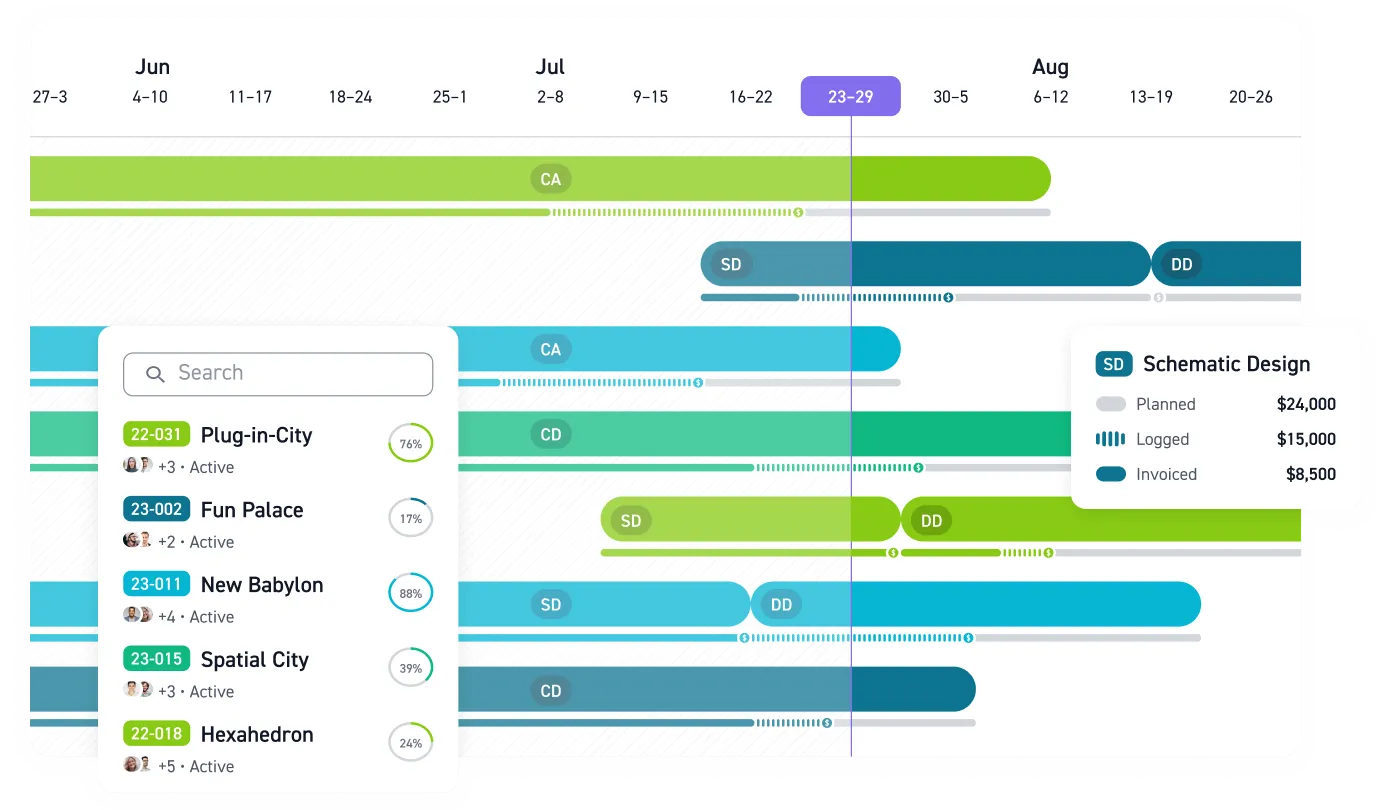
Monograph's signature MoneyGantt™ makes complex project financials instantly understandable. It shows budget-to-cash progression from planned to logged to invoiced to paid without requiring mathematical analysis. This visual approach helps teams identify which phases and projects are off-track in seconds rather than hours of spreadsheet work. Generate invoices that connect back to original fee agreements without manual reconciliation. The entire workflow operates as one continuous system rather than disconnected tools requiring manual bridges at each transition point.
Making the Transition From Spreadsheet Chaos
You know your current approach isn't working. Prospects tracked in spreadsheets lose context the moment you close a deal. Opportunity data maintained separately from project management means re-entering information multiple times. Generic CRM systems designed for product sales force you to adapt A&E workflows into transactional structures that don't match how you actually win work. The administrative overhead prevents your team from focusing on the technical work that generates revenue and the client relationships that drive repeat business.
The firms pulling ahead in your market have made a different choice. They're using integrated practice management that treats lead tracking as the first phase of continuous project delivery. They maintain complete context from initial contact through final payment without manual data migration across disconnected systems. They connect business development directly to project execution so nothing gets lost in transition. Most importantly, they're spending less time on administrative coordination and more time on the work that actually matters: delivering excellent projects and building lasting client relationships.
The firms managing their pipelines systematically aren't guessing which opportunities will close. They're tracking pursuits with the same rigor they apply to project delivery. Book a Monograph demo.
Frequently Asked Questions
Do we really need lead management software if most of our work comes from referrals?
Even if 80% of your work comes from referrals, you're still tracking those opportunities somewhere, probably spreadsheets or email. The real question is whether your current system gives you the visibility and efficiency you need, not whether you need tracking at all. Referral-based firms actually benefit more from systematic lead management because you're managing relationship-based pursuits that require preserved context across long timeframes. When a past client refers you to a developer contact, you need to track that relationship through months of pursuit conversations while maintaining visibility into your entire pipeline. Integrated systems help you manage those complex relationship dynamics without losing context or dropping opportunities.
How is A&E lead management different from regular CRM?
A&E lead management is built around project-based pursuits, not transactional sales. You're tracking multi-stakeholder coordination where multiple disciplines contribute to pursuit strategy. You're managing long sales cycles spanning 6-18 months with numerous touchpoints across principals, project managers, and technical staff. Most critically, you need to transition from opportunity to project delivery. When you close a deal, all that pursuit context needs to flow directly into project execution without manual data migration. Generic CRMs treat deal closure as the endpoint. A&E-specific systems treat it as the beginning of a multi-phase project relationship requiring continuous information flow.
What happens to our lead data when a project closes?
In generic CRM systems, your lead data essentially disappears into archived opportunity records once you close a deal. That's a fundamental problem for A&E firms because the conversations from business development need to inform project delivery. Purpose-built A&E practice management maintains continuous data flow. Fee structures from proposals become project budgets. Scope agreements inform phase planning. Client expectations discussed during pursuit guide project execution. When Workshop/APD integrated their opportunity tracking with project management, they eliminated the context loss that was creating expensive scope disputes and budget confusion. Everything discussed during business development remains accessible throughout project delivery.
Can lead management software handle our complex, multi-year pursuits?
Absolutely, if it's built for A&E workflows. The key is choosing systems designed for project-based professional services rather than transactional product sales. Purpose-built platforms understand that A&E pursuits involve multiple stakeholders coordinating across disciplines, long timelines with numerous touchpoints, relationship-based selling that prioritizes client fit over aggressive closing tactics, and transition from opportunity to multi-phase project delivery. Generic CRMs struggle with this complexity because they assume linear sales funnels with clear closing events. A&E-specific systems handle the reality that your sales process is actually the beginning of a years-long project relationship.
How do we get our technical team to actually use lead management systems?
Adoption succeeds when systems match how A&E professionals actually work rather than forcing them into sales-focused workflows. Choose platforms built by practitioners who understand project-based pursuits. Look for interfaces designed around relationships and projects rather than transactional pipeline management. Most importantly, select integrated systems where lead tracking connects directly to project delivery. When your team sees that pursuit context flows into the project work they're already managing, adoption becomes natural rather than forced. Studio GWA's team struggled with BQE Core because the disconnect between opportunity management and project execution created duplicate work. The best A&E systems eliminate that friction by treating lead management as the first phase of continuous project delivery rather than a separate sales activity.