

Every architecture and engineering (A&E) firm reaches a point where spreadsheets stop working. Project budgets live in one file, timesheets in another, invoices in a third, and nobody can answer a simple question: are we making money on this project? That's usually when the software search begins, and the first fork in the road is the ERP versus CRM decision.
Most advice on this topic comes from enterprise vendors selling to manufacturers and large companies. It doesn't translate well to a small architecture or engineering firm tracking phase budgets across active projects while keeping QuickBooks updated for an accountant.
What ERP and CRM Actually Do in A&E Practice
The split is straightforward. ERP runs the work you've already won, and CRM manages the work you're trying to win. The handoff between the two is contract award. In an A&E firm, every engagement is a project with its own scope, team, timeline, and budget, so both systems have to be project-centric. Generic CRMs built for product companies and manufacturing ERPs that track inventory instead of billable hours miss that requirement.
In an A&E firm, ERP handles the functions that keep projects profitable and the firm financially healthy:
- Phase profitability by phase, from Schematic Design through Construction Administration
- Invoicing and billing with the phase-coded, percentage-of-completion formats A&E contracts require
- Resource planning so principals know who's available and who's overloaded
- Project manager dashboards that surface time, billing, and budget data without waiting for month-end finance reports
Those are the controls that help a firm see the work in progress, catch problems early, and keep cash moving.
CRM, by contrast, manages the BD lifecycle:
- Pipeline tracking with win probability assigned to opportunities
- Go/no-go decisions to protect firm capacity from losing pursuits
- Client history that keeps communication and engagement records in one place
Time spent chasing a losing pursuit drains capacity on existing projects, which makes pursuit management an operations issue, not just a sales issue. That matters because CRM decisions can affect delivery capacity long before a contract is signed.
Most Small A&E Firms Need ERP Functions First
If you're running a small firm, the practical question is priority: which system do you need first?
Industry research on A&E practices shows many firms stall at key growth stages where outdated people, processes, and technology can no longer support scale. Early on, the pain is operational: getting invoices out, tracking project status, and collecting payment. Principals spend too much time on financial administration instead of billable work. The first system priority is usually A&E-specific billing tools and project financial tracking, which sits in ERP territory.
As firms grow, the question "What was my margin on project X?" becomes urgent. Leaders can no longer look across the room and know what everyone is working on. Resource forecasting, project-level profitability, and project manager dashboards move from helpful to necessary.
CRM usually becomes more important later, once business development is formal enough that pipeline tracking can no longer be managed informally. Practitioner analysis notes that many firms don't use a CRM at all, and maintaining one creates real overhead for small firms. For many smaller practices, the CRM conversation can wait.
The Adoption Problem Nobody Talks About
Cloud adoption across the industry has come a long way, yet annual benchmarks on A&E firms consistently show that many still rely on manual data entry for accounting and finance. That gap is where firms lose time and margin.
This creates a specific trap for small firms evaluating enterprise ERP platforms. Practitioners in industry forums have documented a frustrating cycle: some vendors told a small firm it was too small for the software to be cost-effective. Other platforms lacked QuickBooks compatibility, Mac support, or full feature sets at lower price tiers.
Platforms like Deltek Ajera are built specifically for small and mid-sized architecture, engineering, and consulting firms. When users find these systems difficult to navigate, they go manual, which undermines the investment. Meanwhile, QuickBooks does support project time tracking, but phase-coded cost tracking often requires workarounds or higher-tier features, and consultant billing may require additional setup.
A Decision Framework for A&E Firm Leaders
A buyer's framework for these platforms emphasizes three criteria that matter most to principals and CFOs: ease of conversion from prior systems, the degree to which leaders receive critical accounting data, and whether project managers get the financial information they need. Those dimensions are a practical standard for evaluating options.
Before evaluating any platform, answer these questions:
- Can you replace QuickBooks? Full A&E ERP platforms like Deltek Ajera are often positioned as a broader alternative to QuickBooks for A&E firms. A QuickBooks sync can avoid forcing a switch.
- What billing types do you use? Government contracts with FAR and DCAA compliance often favor accounting or ERP platforms configured for government-contractor requirements. Fixed-fee architecture practices have broader options.
- Where is your pain concentrated? If the pain is project delivery visibility, utilization, budgets, and phase progress, a project-management-first tool may solve it without a full ERP rollout.
- Do you have dedicated IT staff? Setup challenges vary dramatically, and conversion friction matters.
These questions help separate a real operational need from software overreach. The connection architecture of any platform you pick today also matters for future AI planning.
Where Practice Management Fits
For small and mid-sized A&E firms, the real choice is often between enterprise ERP and purpose-built practice management that works with the accounting system you already have.
Monograph is built for this scenario, a practice management platform for A&E firms that offers phase-based budgeting, time tracking, resource planning, invoicing, and profitability analysis, with a QuickBooks connection for syncing invoices, expenses, and consultant bills. That setup lets QuickBooks handle the general ledger and tax preparation while Monograph handles A&E-specific work such as project phases, staff utilization, consultant coordination, and phase-level financial tracking.
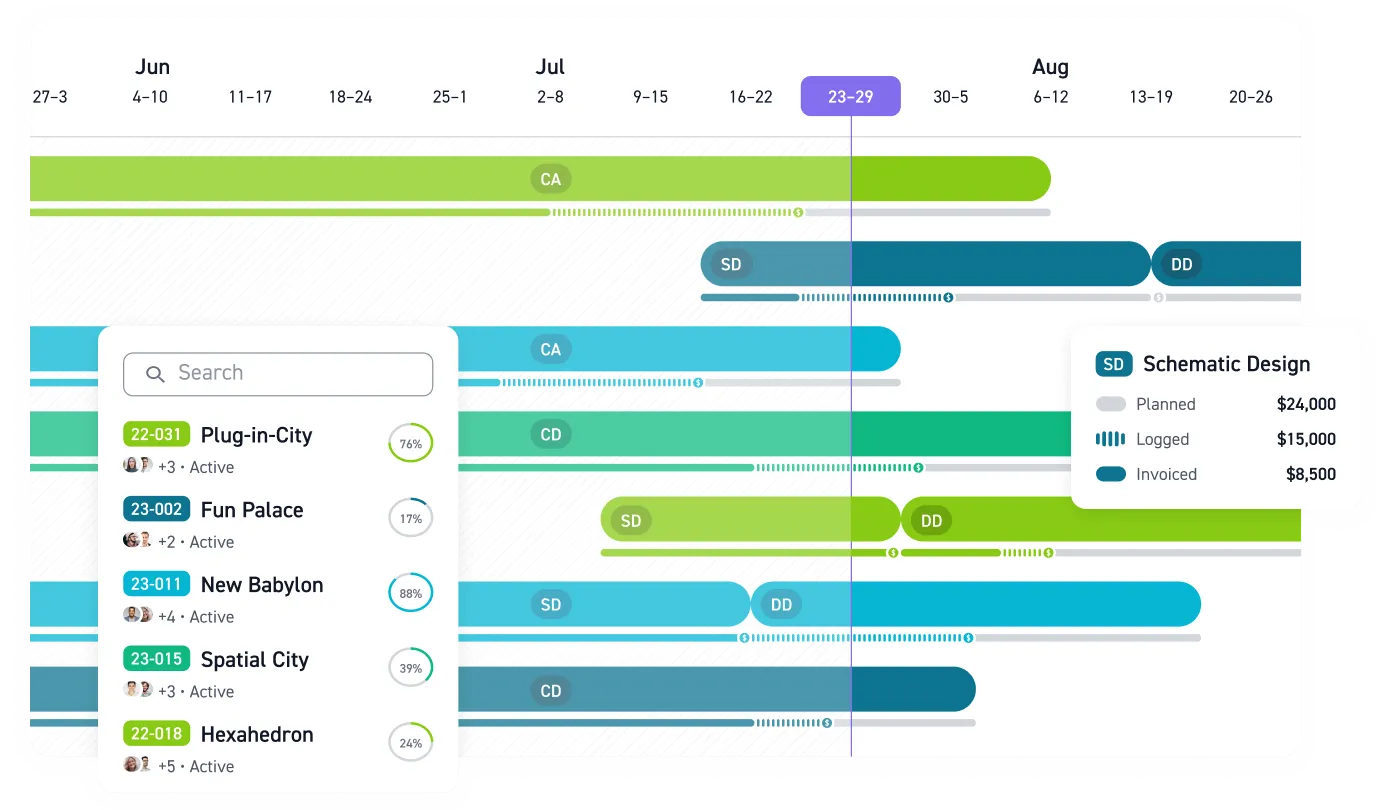
Monograph's MoneyGantt™ shows project budget versus actual spending in real time on the project timeline, so teams can see how planned fees move through logged, invoiced, and paid stages in one view. Woodhull, a 25-person Maine firm, reported 66% time saved on admin, a 50% faster billing process, and 66% less budget overage after switching to Monograph.
Get Project Visibility Before You Add More Software
Start with the operational pain. If your team can't see budgets, phase progress, utilization, and invoicing clearly, adding a CRM first will not fix the underlying problem. Principals, operations leaders, and project managers need visibility into active work before they add more overhead around future work.
For small and mid-sized A&E firms that want phase-based budgeting, time tracking, resource planning, invoicing, and profitability analysis without giving up QuickBooks, that usually means starting with project visibility and financial control before layering on another system. The result is fewer spreadsheets, less manual coordination, and a clearer answer to the question every firm owner eventually asks: are we making money on this project?
Don't wait for month-end to find out where the margin went. Schedule a demo.
Frequently Asked Questions
Do small A&E firms really need both ERP and CRM?
Usually not at the same time. For most smaller firms, ERP-type functions come first because the immediate pain is operational: invoicing, project financial tracking, utilization, and visibility into active work. CRM matters later, when business development becomes formal enough that informal tracking no longer works.
Can QuickBooks plus practice management replace a full ERP?
For many small A&E firms, yes. Practice management tools that connect with QuickBooks can avoid forcing a full accounting switch while still providing project phases, time tracking, consultant coordination, invoicing, and profitability visibility.
When should an A&E firm prioritize CRM over ERP?
Prioritize CRM when business development has become a real operating system of its own. If you're managing multiple pursuits, need structured go/no-go decisions, and can no longer track pipeline informally, CRM starts to matter more.
Will switching systems disrupt a small team?
It can, which is why conversion friction and setup complexity matter. Some enterprise platforms create adoption problems for smaller firms, especially when the software is hard to navigate or doesn't fit the firm's existing accounting setup. For small teams, the safer path is often a system that improves project visibility without replacing tools that already handle accounting well.