
Three projects running at once. A structural subconsultant double-booked during design development. One team member carrying too much of the load while others sit underused. A&E project managers see this pattern often, and the cause is usually the same: limited visibility into staffing demand and timing. A resource breakdown structure, or RBS, helps you map who is needed, where, and when before conflicts start.
What a Resource Breakdown Structure Actually Does
The RBS is a resource hierarchy model that organizes every resource your project requires, broken down by category and type until each element is specific enough to assign to work. The work breakdown structure (WBS) defines deliverables and scope under standard scope frameworks. The RBS maps the people, subconsultants, technology, and expenses required to produce those deliverables.
That distinction matters in daily practice. You already know what design development (DD) deliverables look like. The harder question is whether your consultant team and internal staff can support overlapping phases without creating bottlenecks.
Building a Practical RBS for Your Firm
Many RBS templates are built for broad project management or for contractors tracking labor, equipment, and materials. A&E firms need a structure that reflects phase-based design work. Drawing on general project planning principles and common A&E staffing practices, a practical resource breakdown structure is often organized by resource category, discipline, role, and named person or allocation:
- Resource category. Human resources, subconsultants, technology or equipment, and reimbursable expenses.
- Discipline or group. Architecture, structural engineering, MEP, civil, interior design, and administrative support. For subconsultants, each outside firm gets its own entry.
- Role. Principal-in-charge, project architect, BIM technician, lead structural engineer, or MEP coordinator.
- Named individual or allocation. The specific person, firm contact, license count, or budget amount tied to project work.
This structure only earns its keep when it maps cleanly to actual project work.
The step most firms skip is tagging each resource to standard phase definitions: schematic design (SD), DD, construction documents (CD), and construction administration (CA). Without phase tagging, the RBS reads like an org chart. Tag it properly, and you can see when demand spikes, where consultant coordination gets heavy, and which projects are competing for the same people.
Why Design Development Breaks Your Resource Plan
Most staffing plans tend to fall apart in DD, and that is no accident. AIA phase checklists describe DD as the primary production phase for design teams, where consultant coordination is actively happening and specialty consultants are entering the workflow. In SD, the work is more preliminary, with representative areas coordinated at a lighter level.
By DD, coordination compounds quickly. A few pressure points tend to show up at once:
- Multiple disciplines are producing at the same time.
- Plans are far enough along that changes ripple through everyone else's work.
- Ceiling space, structure, and systems all need alignment.
- If two projects reach DD close together and rely on the same outside consultants, the conflict shows up fast.
A static staffing sheet cannot keep up at that point. A phase-based RBS can.
Subconsultants Belong in the Same Plan
Many small A&E firms track internal staff carefully but treat subconsultants like a budget line. Industry guidance points the other way. Practitioner analysis recommends that firms forecast resource needs early, identify subconsultant tasks, manage them carefully, and communicate early about staffing issues.
The outside team is often broader than the formal staffing plan suggests. Industry design management guidance catalogs specialty consultant categories that touch design projects, including:
- Geotechnical
- Acoustics
- AV/IT
- Sustainability
- Envelope
- Vertical transportation
If those disciplines are missing from the plan, the plan is missing real project risk. Your RBS should include each outside firm as a named resource with phase allocation and capacity assumptions. If that information lives only in someone's head, the resource plan is incomplete.
Team Stability Beats Constant Reshuffling
There is also a management choice hiding inside resource planning. Analysis of top-performing A&E firms found that strong firms do not push utilization as high as possible by constantly moving people between teams. They put more emphasis on collaboration and coordination within stable teams.
That matters for your RBS. A perfectly balanced staffing sheet can still create project friction if people are bouncing between too many teams. Resource planning should protect continuity where possible, especially during coordination-heavy phases.
Turning Your RBS Into a Living System
A resource breakdown structure only works if it stays current. The firms that get the most value from resource planning usually share a few repeatable habits:
- review capacity before committing to new proposals
- track actual hours against planned hours by phase
- flag consultant conflicts before they become deadline problems
Those habits keep the RBS tied to real decisions rather than letting it drift into another stale spreadsheet.
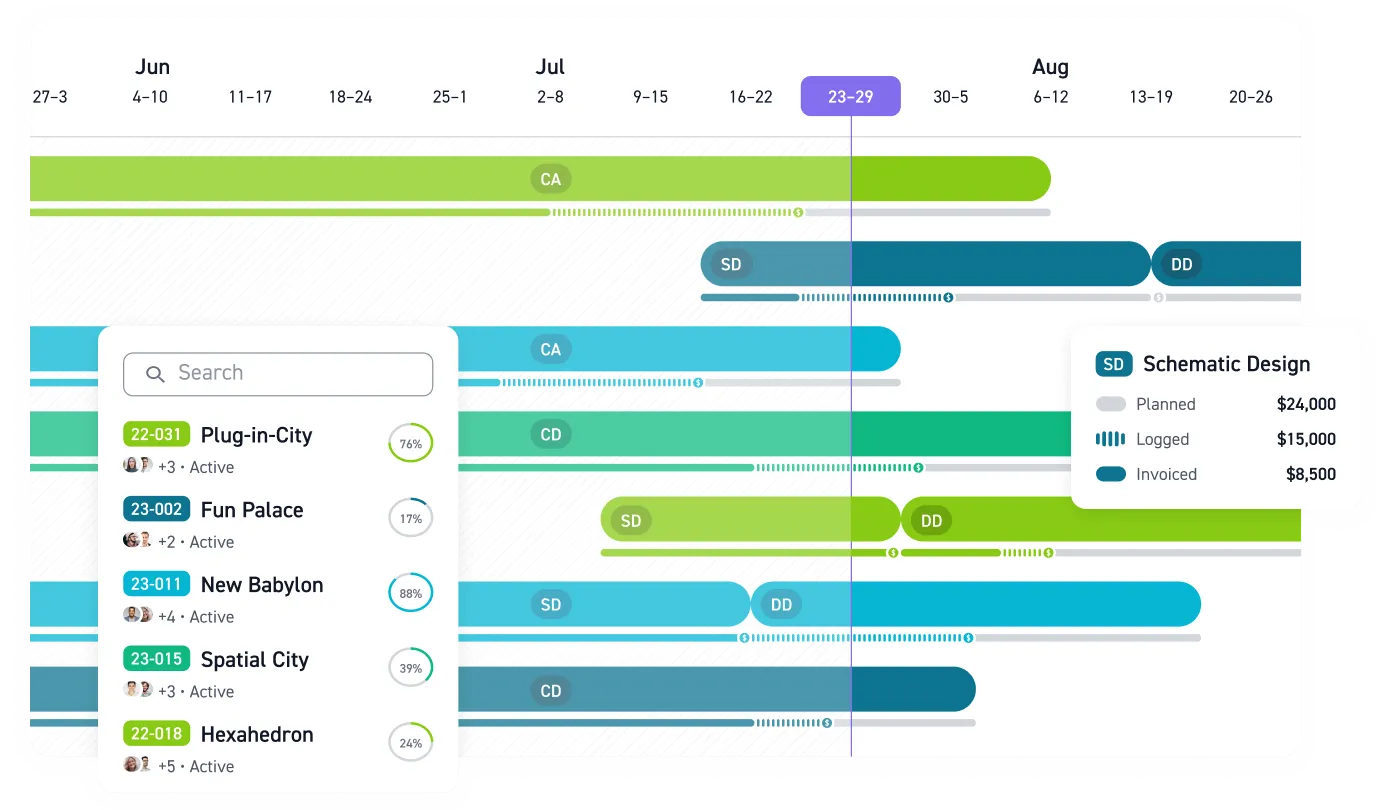
You can build the structure in spreadsheets, but the data goes stale fast. Tools built for A&E firms, like Monograph, map resources directly to phase-based staffing plans using SD, DD, CD, and CA terminology. Capacity views surface overallocated team members before the problem turns into burnout. Consultant budgets can be tracked by phase rather than as a single project total.
16,000+ architects and engineers use Monograph today. At Workbench, a 30-person California firm, better staffing visibility translated to 8x faster staffing, 4x faster billing, and 75% less unbilled fees.
Plan Staffing Before Phase Conflicts Hit
Resource conflicts compound fast. By the time a DD overlap is obvious, your consultants are already committed and your schedule is already under pressure. The fallout is rework, missed milestones, and burned-out staff.
A live RBS turns staffing from reactive scrambling into proactive planning. You can map every role to phases, review team capacity before proposals go out, spot overallocations early, and keep subconsultant budgets tied to the work actually happening.
Build a resource plan your firm can actually run. Book a demo.
Frequently Asked Questions
What's the difference between a work breakdown structure and a resource breakdown structure?
The work breakdown structure defines the deliverables and scope. The resource breakdown structure maps the people, subconsultants, technology, and expenses needed to produce those deliverables. In practice, the WBS tells you what must happen, and the RBS tells you who and what you need to make it happen.
How detailed should an RBS be for a small A&E firm?
Detailed enough to assign real work and catch conflicts before they become schedule problems. For most firms, that means organizing resources by category, discipline, role, and named individual or allocation. Going deeper than that without a clear use case usually slows you down rather than speeding you up.
Should subconsultants be included in the same RBS as internal staff?
Yes. Subconsultant conflicts can create the same schedule pressure as internal staffing gaps. If consultant capacity lives in a separate spreadsheet or in someone's memory, your resource plan is incomplete and your firm is one DD overlap away from a scheduling fire drill.
How often should we update an RBS?
Often enough to support proposal decisions, phase staffing, and consultant coordination. If updates lag behind active work, the RBS stops being useful and starts being a liability. A weekly cadence works for most firms running multiple active projects.
Can spreadsheets handle an RBS, or do we need software?
Spreadsheets can handle the structure, but they struggle once you need live visibility across multiple projects, phases, and consultants. If your team spends more time updating allocations than using them to make decisions, you have likely outgrown the spreadsheet approach.