


Firm management made easy

Most A&E project managers rely on spreadsheets with staff names and mental models of availability, so the formal resource management plan rarely exists as a working document. The pressure shows up when projects start competing for the same senior designer's calendar.
Resource management in A&E firms ties project phases and fee structures to revenue recognition. Getting it right means building a system that connects staffing decisions to financial outcomes, phase by phase.
Why A&E Resource Plans Don't Follow Generic Templates
Generic project management frameworks organize resources around tasks and milestones. A&E work often organizes around design phases: Schematic Design, Design Development, Construction Documents, and Construction Administration for architects. Each phase carries a different staffing intensity, a different fee allocation, and a different risk profile.
Fee allocation by phase determines how many staff hours at what billing rates can be assigned. Traditional private-sector fee allocation baselines run roughly 15% to SD, 20% to DD, 40% to CD, and 20% to CA. Public works guidelines from Washington State shift those numbers significantly: 31% to CD and 27% to CA. If your firm handles both private and public work, a single fee template will misallocate resources on one type or the other.
The critical failure mode that separates A&E resource planning from generic PM is over-earning in early phases, which burns fee that CD and CA will need. Without phase-level financial tracking, a resource management plan becomes a staffing schedule with no financial guardrails.
Core Components of an A&E Resource Plan
A strong resource management plan for an A&E firm covers more ground than headcount and hours. The core framework includes:
- Phase-based budget tracking: Revenue recognized by phase alongside the aggregate project total. When SD consumes more fee than allocated, the plan should flag it before DD starts.
- Role-to-phase staff assignments: Senior architects lead SD and design direction. Full technical teams expand for CD production. PMs and project architects scale back for bidding. Role definitions follow both licensure requirements and phase-appropriate expertise.
- Weekly labor tracking: High-performing A&E PMs track labor weekly, not at phase completion. They know their fee, their labor budget, their break-even point, and their current work-in-progress position.
- Explicit de-staffing plans at phase transitions: Staff released from a completing phase become available for incoming projects. A project team de-staffing plan that includes forecast release dates for each team member is one of six project closeout tools that separate organized firms from reactive ones.
- Work breakdown structure scaled to project size: Project fee alone doesn't determine how detailed your task breakdown should be. Larger projects need risk analysis, BIM setup budgets, and formal approval gates.
Taken together, these controls keep staffing decisions tied to fee and phase reality.
Setting Utilization Targets That Reflect Reality
The gap between target and actual chargeability across the AEC industry grew to 4.0% in the latest billing report, up from 2.9% the prior year. A firm running below its own chargeability target may be close to that recent benchmark gap, but that does not automatically mean it is performing well.
Monograph's 2026 Architecture & Engineering Business Benchmarks Report, built from real platform usage across 13,000+ architects and engineers across 1,800+ firms, identifies a healthy utilization range where firms stay profitable while preserving time for business development, training, and long-term investment.
One measurement detail trips up firms constantly: using different denominators can produce a materially different utilization result from identical underlying data. If different departments use different denominators, every internal comparison is unreliable.
Balancing Load Across Concurrent Projects
Managing multiple projects simultaneously is the standard operating condition for A&E project managers. Common gaps show up repeatedly in A&E workload management:
- SD, DD, CD, and CA phases carry different staffing intensity, so flat project timelines miss phase-specific pressure.
- Principals, PMs, and staff carry different billable targets and can't be treated interchangeably.
- Staffing decisions need to happen before projects ramp up, which requires accurate backlog data.
- Most A&E staff work across several projects at once, so a project-by-project view hides total individual load.
When two projects compete for the same person, resolution criteria should be defined in advance. Prioritize by deadline and contractual risk, pool resources across projects rather than siloing staff, and establish subcontracting triggers at specific utilization thresholds.
Protecting Profitability Under Fixed-Fee Contracts
Fixed-fee exposure concentrates at the firms least equipped to absorb overruns. The pattern is predictable: A&E professionals absorb expanded scope as "going the extra mile" when projects run over, but rarely retain savings when projects come in under budget. Repeated across a portfolio without renegotiation, this produces chronic under-realization.
Fee protection starts before execution through reinforcing practices:
- The AIA recommends building fees using a WBS that includes contingency hours to allow for variations from the plan.
- ACEC's lump-sum guidance emphasizes that detailed scope with documented assumptions at execution makes out-of-scope work unambiguous and eliminates downstream disagreements.
- When scope changes, PMs have a professional obligation to renegotiate the fee.
Those practices make scope drift easier to spot before it turns into silent fee burn.
Moving From Static Spreadsheets to Living Plans
Resource planning has shifted from a support function to an operational edge. Firms using real-time resource plans identify capacity constraints earlier and make hiring decisions with better data before they commit to new work. Workbench, a California firm, reported major gains in staffing speed, billing speed, and reduced unbilled fees after replacing disconnected systems.
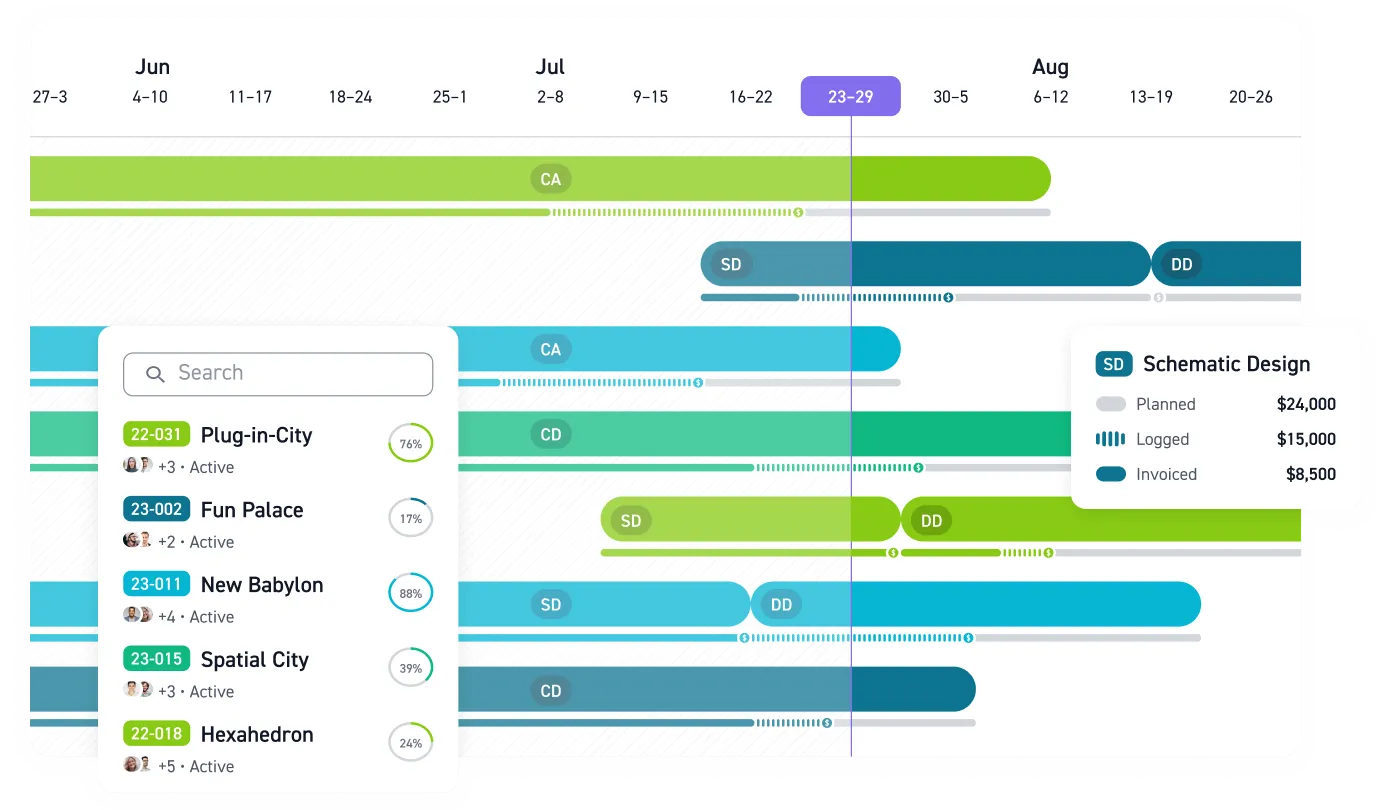
The transition usually moves from spreadsheets to an intermediate tool and then to a purpose-built platform. Monograph connects time tracking, budgeting, staffing, and invoicing in one system designed specifically for A&E firms. Monograph's MoneyGantt™ shows how scope and schedule affect cash, so you can see whether SD is burning through hours too fast or CA is drifting past fee before problems compound.
A resource management plan only works if it stays current. The firms pulling ahead are the ones whose plans update as time gets logged, where principals see capacity constraints emerging in real time, and where staffing decisions happen proactively instead of reactively.
Stop Staffing Projects on Outdated Information
When staffing decisions live in spreadsheets, phase budgets drift and paused projects scramble your week. Utilization targets stop meaning much.
Resource planning works when time, budgets, and staffing stay connected, so principals, PMs, and operations leaders can see the same picture before small problems turn into fee burn.
Monograph helps A&E firms connect staffing plans, utilization, phase budgets, and project financials in one place. Monograph's MoneyGantt™ shows how scope and schedule affect cash, while connected time tracking and staffing data make it easier to see overload, phase-transition availability, and projects starting to outrun their fee.
See the conflict before it costs you margin. Book a demo.
Frequently Asked Questions
Do small A&E firms really need a formal resource management plan?
Yes. Small firms have less room to absorb phase overruns, utilization swings, or fixed-fee mistakes. Even if the plan starts simple, it should still connect staffing decisions to phase budgets, current workload, and forecast availability.
How often should we update a resource management plan?
Weekly is the practical baseline in this article's framework. Labor needs to be tracked weekly, and staffing plans need to reflect phase transitions, new backlog, and paused work before those changes create downstream problems.
What's the difference between a staffing plan and a resource management plan?
A staffing plan shows who is assigned where. A resource management plan goes further by tying those assignments to fee allocation, phase performance, utilization, and de-staffing timing. Without those financial guardrails, staffing plans look organized while projects still drift off budget.
How should we handle resource planning when a project pauses unexpectedly?
Treat de-staffing and release dates as part of the plan, not an improvised response. When a project pauses, the immediate job is to make staff availability visible, rebalance active work, and keep forecast capacity current so the pause doesn't distort every other project decision.