



Firm management made easy

You already know which projects eat your time without generating profit. The question is whether you have the data to prove it, catch it early, and fix it before a billing period closes. For project managers and operations leaders at A&E firms, the utilization rate formula is the starting point for that data.
The Formula and What Goes Into It
Most A&E resources define utilization as Utilization Rate = Billable Hours ÷ Total Available Hours × 100. Architecture and engineering firms also call this chargeability, and the terms are used interchangeably in practice. Using that formula, 30 billable hours out of 40 total hours equals 75%. The denominator, total available hours, means all hours worked by staff, billable and non-billable.
For annual capacity planning, a common baseline is 2,080 hours per full-time employee. That denominator should include the full staff mix. Excluding principals, part-time staff, or support roles can make the firm look more utilized than it really is.
Some non-billable time is unavoidable. Industry guidance on budgeting indicators identifies marketing, accounting, administration, human resources, professional development, and management time not tied to projects as indirect labor. Practice management standards also cap targets at no more than 90%, since vacation, holidays, and sick time consume part of paid labor.
Two Calculation Methods Lead to Different Benchmarks
Before comparing your number to any benchmark, confirm how that benchmark was calculated. The method changes the result.
- All-staff payroll method: Divides direct labor charged to projects by total firm labor across all staff, including non-billable roles. Many firm-wide industry benchmarks rely on this approach.
- Technical staff hours method: Divides billable hours by total hours worked for technical and professional staff only. Role-level benchmarks generally use this approach.
Both methods are legitimate, but they answer different questions. The comparison breaks down when the method does not match the benchmark you are reading.
Benchmarks by Role and Discipline
Firm-wide averages help you spot trends, but staffing decisions happen at the role level. Industry benchmarks show a clear pattern.
- Project Architects and Designers typically rank among the most utilized roles in production phases.
- Job Captains and Staff Architects also operate near the top of the range.
- Project Managers sit below core production staff.
- Principals sit below project managers and production staff.
Principals run lower because their time is supposed to go toward business development, client relationships, and firm management. Targets applied evenly across the org chart distort performance at both ends.
On the discipline side, slightly higher utilization shows up in engineering firms than architecture firms under an all-staff methodology, though the gap is small.
Utilization Alone Will Not Tell You If You Are Profitable
A staff member can be highly billable and still lose money for the firm if fees are too low or scope creep goes unbilled. Think of it like producing construction documents that never get built. The labor happened, but the value was not captured.
Practitioner analysis of top-performing firms supports that disconnect. High-performance firms keep small, stable teams for dynamic client response rather than constantly shuffling staff to maximize utilization.
You need a wider view of performance, including:
- Utilization: how much labor goes toward billable project work
- Realization: how much billable work turns into collected revenue
- Net Multiplier: how many revenue dollars the firm collects for each dollar of direct labor cost
High utilization paired with low realization means you are busy but losing revenue through write-offs, under-billing, or uncollected invoices. Looking at utilization by itself hides that problem.
How to Improve Utilization Without Burning Out Your Team
Cleaner staffing and better visibility improve utilization without adding pressure to the team. Several practical moves help performance at smaller firms.
- Track in real time, not monthly. Monthly snapshots arrive later than teams need for corrective action. Platforms that track time across phases, budgets, and team members in real time make it easier to catch burn-rate shifts during phase transitions. Workbench reported 8x faster staffing, 4x faster billing, and 75% fewer unbilled fees after consolidating into integrated tracking.
- Review labor regularly. Project managers who watch labor weekly can spot overruns early and adjust staffing or scope before losses harden.
- Match staff seniority to the task. When junior staff sit underused while senior staff burn through fixed-fee budgets, the firm loses money two ways. Monograph's real-time capacity heatmaps help surface those gaps earlier.
- Reduce non-billable overhead deliberately. Faster billing cycles, fewer redundant internal meetings, and administrative support can free licensed staff for higher-value work.
- Catch scope creep through timesheets. Early signals in time data help teams convert extra work into additional services fees instead of absorbing it.
- Use historical profitability to shape pursuit decisions. If one project type repeatedly delivers stronger margins, that pattern should influence what work you chase.
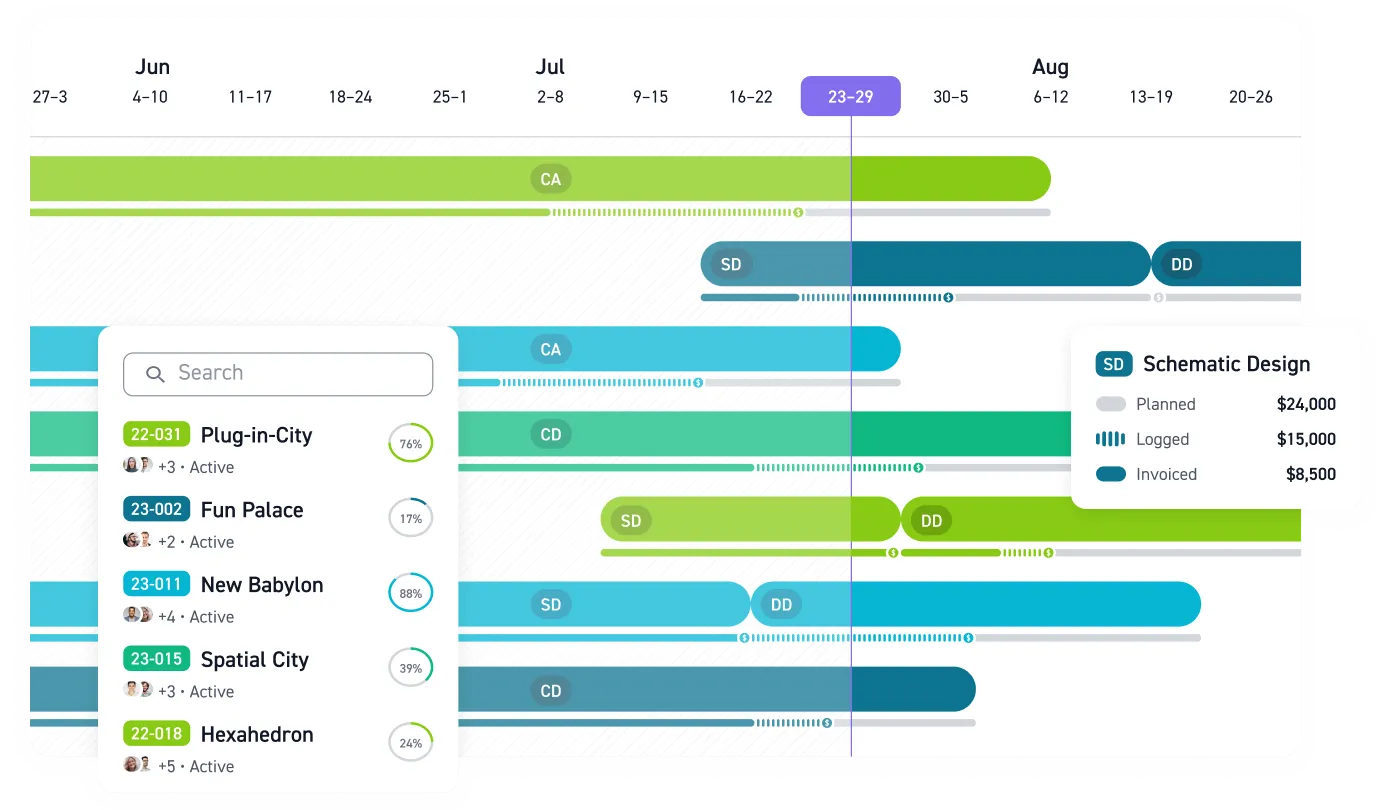
- Make targets visible to the team. Staff cannot adjust toward a target they cannot see. Monograph's MoneyGantt™ combines project timelines with budget-to-cash progression so teams can see planned, logged, invoiced, and paid work in one view.
These habits work because teams repeat them every week, not just when a project starts slipping.
Turn Utilization Data Into Better Staffing Decisions
Act sooner. If utilization shows up only in a monthly report, you are already late.
Project managers, operations leaders, principals, and owners need more than a percentage. They need to see how utilization connects to staffing, project phases, budgets, and profitability while there is still time to rebalance workloads, catch scope creep, and protect the team from preventable burnout.
Monograph brings time tracking, staffing visibility, and financial context into one place, so your firm can review labor weekly, spot gaps earlier, and make better decisions with less spreadsheet hunting. When utilization ties directly to budgets and phase-level performance, the number becomes useful.
See utilization tied to budgets and phases. Book a demo.
Frequently Asked Questions
What is a good utilization rate for an A&E firm?
That depends on the calculation method. An all-staff payroll method produces a lower firm-wide number than a technical staff hours method because it includes non-billable roles in the denominator. Before setting targets, make sure your formula matches the benchmark you are using. Comparing an internal all-staff number to a technical-staff benchmark will always make the firm look underutilized.
Should principals and project managers have the same utilization target as production staff?
No. Production staff run highest, project managers run lower, and principals run lower still because they carry business development, client relationship, and firm management responsibilities. Applying one number across every role overcharges principals for time they are expected to invest in pursuits and overstates capacity for staff already at the ceiling.
How often should we review utilization?
A regular operating cadence is more useful than waiting for a monthly snapshot. Monthly reporting often arrives too late for corrective action, especially when labor drift, overruns, or scope issues are building inside an active billing period. Weekly reviews give project managers room to adjust staffing or rebalance phases before a small overrun becomes a big one.
Can high utilization still hide unprofitable work?
Yes. A person can be highly billable and still lose money for the firm if fees are too low, scope creep goes unbilled, or invoices are never fully collected. That is why utilization needs to be read alongside realization and net multiplier. Together, those three numbers show whether billable hours actually convert into revenue the firm keeps.
How do we improve utilization without burning out the team?
Start by matching staff seniority to the work, reducing unnecessary overhead, and tracking labor in real time instead of pushing people harder. Better visibility improves utilization by supporting cleaner staffing decisions, earlier scope control, and fewer preventable overruns. Aim for fewer unbilled hours rather than more hours per person.