


Firm management made easy

A&E projects go over budget often enough to make profitability a recurring process problem. The median architecture firm bills only 61% of its total staff hours to projects, and the gap between target and actual chargeability widened 38% in the most recent survey. Every one of those numbers hits project profitability directly.
Benchmark Your Utilization Before You Try to Fix It
Firm-wide utilization benchmarks at 60–65% of total labor dollars. Define your denominator first: all staff including principals and admin, or billable staff only.
Monograph's 2026 Architecture & Engineering Business Benchmarks Report lays out utilization ranges that tell most of the story:
- Higher utilization can support profitability while still leaving room for business development and training
- Extremely high utilization risks burnout and underinvestment in firm growth
- Low utilization signals unfilled capacity that compounds into cash flow pressure
Those ranges are useful, but they do not tell you whether a project is actually making money. A fully utilized team can still lose money on a poorly scoped contract, which is why utilization alone is a misleading measure of profitability.
Shorten Your Billing Cycle
Slow collections put avoidable pressure on working capital. If invoices sit too long between issue and payment, your firm ends up financing the work before the client does.
Use these tactics for compressing the billing cycle:
- Standardize invoicing schedules with automatic delivery dates
- Offer electronic payment options, including credit card and EFT, to reduce check-based delays
- Use OCR-based expense capture to remove manual data re-entry
- Connect your AR platform with your project management tools to eliminate export-import cycles
Fewer handoffs mean faster invoices and fewer delays.
Tighten Scope Definition at Project Kickoff
Projects exceed budget all the time, and much of that overrun traces back to the moment the contract was signed, with fees set too low or scoped too loosely. Carry the same phase structure you use in proposals into the project plan. Define deliverables by phase and assign hours to each deliverable. Document exclusions from basic services before work starts.
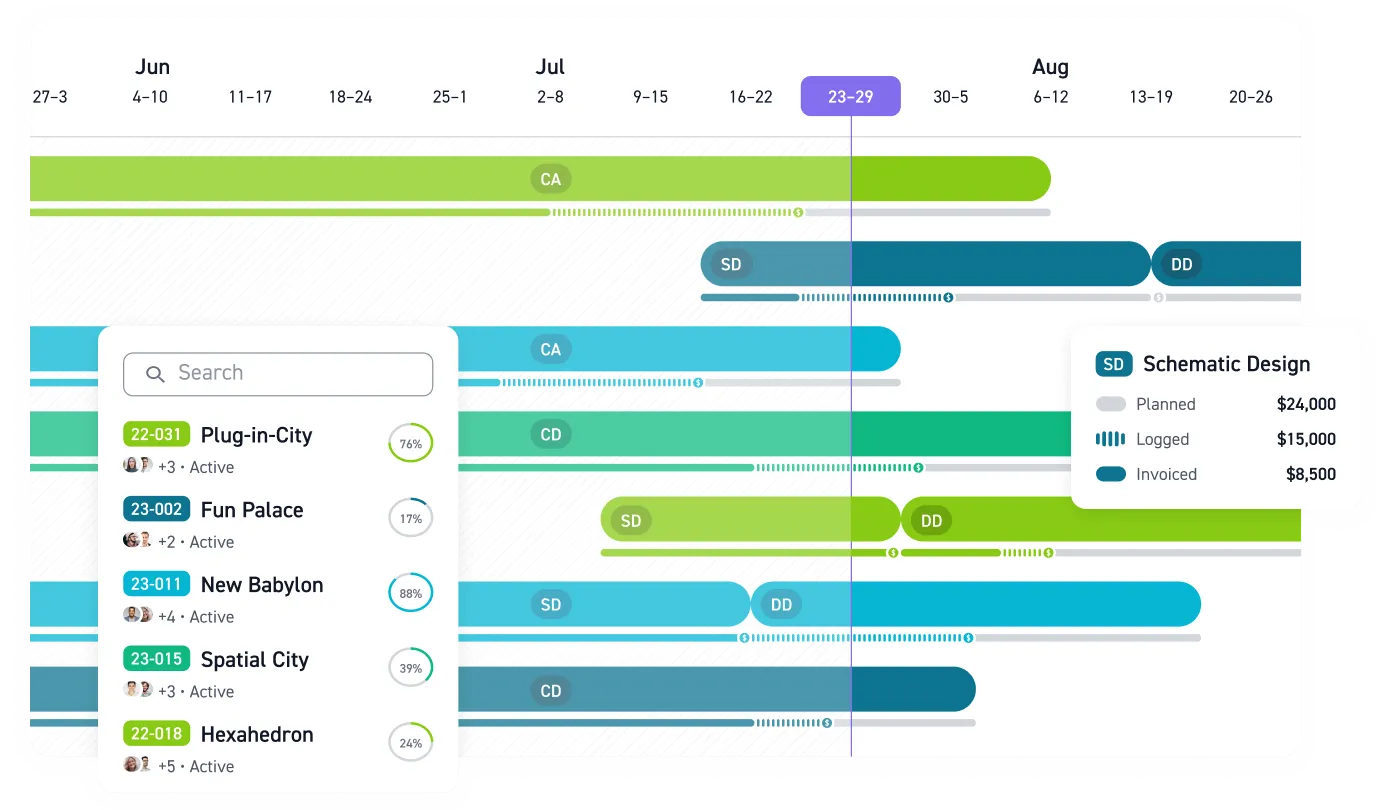
If you know SD requires design time and coordination time, you can assign the right people at the right billing rates before the phase starts. When the client's program changes mid-SD, you open a change order conversation with hours and dollars on the table.
Run Weekly Project Financial Reviews
Monthly financial reviews catch problems too late. By the time a monthly report shows a project trending over budget, you've already burned unbillable time. Weekly check-ins, even brief reviews of hours-to-date against budget by phase, give you time to course-correct.
Use each weekly review to compare hours-to-date against the phase budget first. Then note scope changes since the last review. If a billing event is due in the next two weeks, name the preparation required before the invoice goes out.
Those checks keep the review focused on what needs action now. Putting even basic tracking systems in place can improve visibility over time.
Close the Chargeability Gap with Daily Time Entry
The gap between target and actual staff chargeability increased in the most recent industry survey. That gap widens the longer teams wait to log time. Memory degrades, non-billable hours get assigned to projects, and billable hours get forgotten.
Daily time entry is unpopular, but same-day logging feeds every downstream process: project budgets, utilization reports, invoicing, and realization tracking. If your team logs time weekly or at month-end, every financial decision rests on stale information.
Track Realization at the Project Level
Utilization tells you how many hours your team billed. Realization tells you how much of that work you actually collected revenue for. Write-offs on fixed-fee contracts and uncollected change orders erode realization before an invoice is ever sent.
Use project-level KPI guidance to track the net multiplier: net operating revenue divided by total direct labor. Then roll it up by PM, department, and firm. Realization problems become visible where the work is happening.
Increase Billing Rate Transparency Across the Firm
Share billing rate information internally so PMs can staff within the fee. When PMs can see that assigning a principal to a task bills at $250/hour against a budget built around $120/hour staff, they make that trade-off consciously rather than discovering it at invoicing.
A code review that requires principal judgment gets principal hours. A door schedule update that a job captain can handle stays at a job captain rate. Start by giving PMs a simple rate sheet and adding a billing-rate column to your staffing plan.
Front-Load Fee Collection to Match Effort
Fee allocation and billing practices vary by firm and project phase. In many firms, fee collection lags behind the point of highest effort and risk exposure.
Monthly billing tends to be an easier negotiation with clients than a front-loaded milestone schedule, because predictable invoices work for both sides. This is a contractual change, but it has an outsized impact on cash flow stability.
Run Structured Post-Project Reviews
If your firm skips the debrief, gather the project team after substantial completion and write down what worked, where the project missed the plan, the cost of those misses, and the change you would make on a similar project.
That gives you a usable record instead of a vague sense that the project was hard. It also makes the next similar project easier to scope and manage.
Tie Your Project Accounting Together
A&E firms need connected technology for stronger project accounting controls, automated invoicing and payments, user-friendly adoption, and interactive analytic tools that let PMs drill into KPI data at the project level. The common thread is connection. When time tracking, budgeting, and invoicing live in disconnected systems, every handoff introduces delay and error.
Firms using Monograph have seen results like 2.5x faster time-to-payment and 1.5x faster billing process in a small-firm billing case study, and 25% profit growth in an engineering firm case study. Those outcomes come from removing manual friction between tracking work and getting paid for it.
Start with your billing cycle. Pull your last six months of invoices and calculate your actual days-to-payment.
See Where Profit Slips Out of Your Process
Every delay between time tracking, budget updates, and invoicing gives margin away. If your team is still piecing together project financials from spreadsheets, disconnected systems, and month-end reports, you already know how hard it is to catch problems before they turn into write-offs or cash flow pressure.
Monograph connects time, budgets, staffing, and invoicing in one place, so project managers, operations leaders, principals, and owners can see what is happening while there is still time to act. That means cleaner weekly reviews, faster billing, better visibility into realization, and fewer surprises at the project level. Book a demo.
Frequently Asked Questions
Which process fix should an A&E firm start with first?
Start with your billing cycle. Pull your last six months of invoices and calculate your actual days-to-payment. That gives you a measurable baseline and shows where time entry, invoicing, and collections are slowing down.
How often should project financial reviews happen?
Weekly. A short review of hours-to-date against phase budgets, scope changes, and upcoming billing events gives PMs time to course-correct before overruns become permanent.
What if the team resists daily time entry?
That resistance is common, but end-of-week logging creates bad data. Same-day logging improves project budgets, utilization reports, invoicing, and realization tracking because it reduces forgotten billable hours and misassigned time.
Do small firms really need project-level realization tracking?
Yes. Small firms have less room to absorb write-offs, under-scoped work, and uncollected change orders. Tracking realization at the project level makes those problems visible early.
Data was collected as of June 2026.