
Nearly half of A&E firms provide no PM training to their project managers, and 76% rely on learning by doing. That leaves project performance up to habit instead of system. These 15 project management best practices give mid-level PMs at small and midsize firms a practical framework for protecting profit.
Lock Down Scope Before You Start Drawing
Most fixed-fee problems start before the work does. If scope is loose at kickoff, later decisions get harder and margin starts leaking long before anyone sees it in a report.
1. Get scope, fees, and expectations in writing before work begins. Written agreements that clarify roles and scope, with non-negotiable terms called out, are the baseline. If it is not in writing, it will be reinterpreted later.
2. Define lump-sum scope at the task level. When scope lacks specificity, unanticipated costs fall on one party or the other. Define design iterations, comment rounds, and client meetings as countable deliverables.
3. Establish formal change control at kickoff. Scope change needs a documented protocol with cost and schedule impact analysis. Build that protocol before the first request lands.
Build Your Fee from Both Directions
If you inherit a fee without the assumptions behind it, you usually discover the problem after the hours are gone. Good fee building works in both directions so the math holds up under project pressure.
4. Use bottom-up and top-down fee analysis together. A multi-method approach to fee development uses both directions. Bottom-up builds from task-level hours and dollars, while top-down works backward from the gross fee to available hours by phase.
5. Turn your WBS into your budget baseline. The WBS is a practical framework for fee-setting and estimating. Use the same structure as your budget tracking tool throughout the project.
A simple fee baseline should answer three questions:
- What tasks are included in each phase
- How many hours each task can consume
- Where contingency exists for plan variations
When those three answers are clear, the fee has a usable structure for managing the work.
Separate What You've Spent from What You've Finished
Fixed-fee projects lose margin when charged hours move faster than finished work. Accounting reports show spend, but they do not show whether progress matches fee consumption.
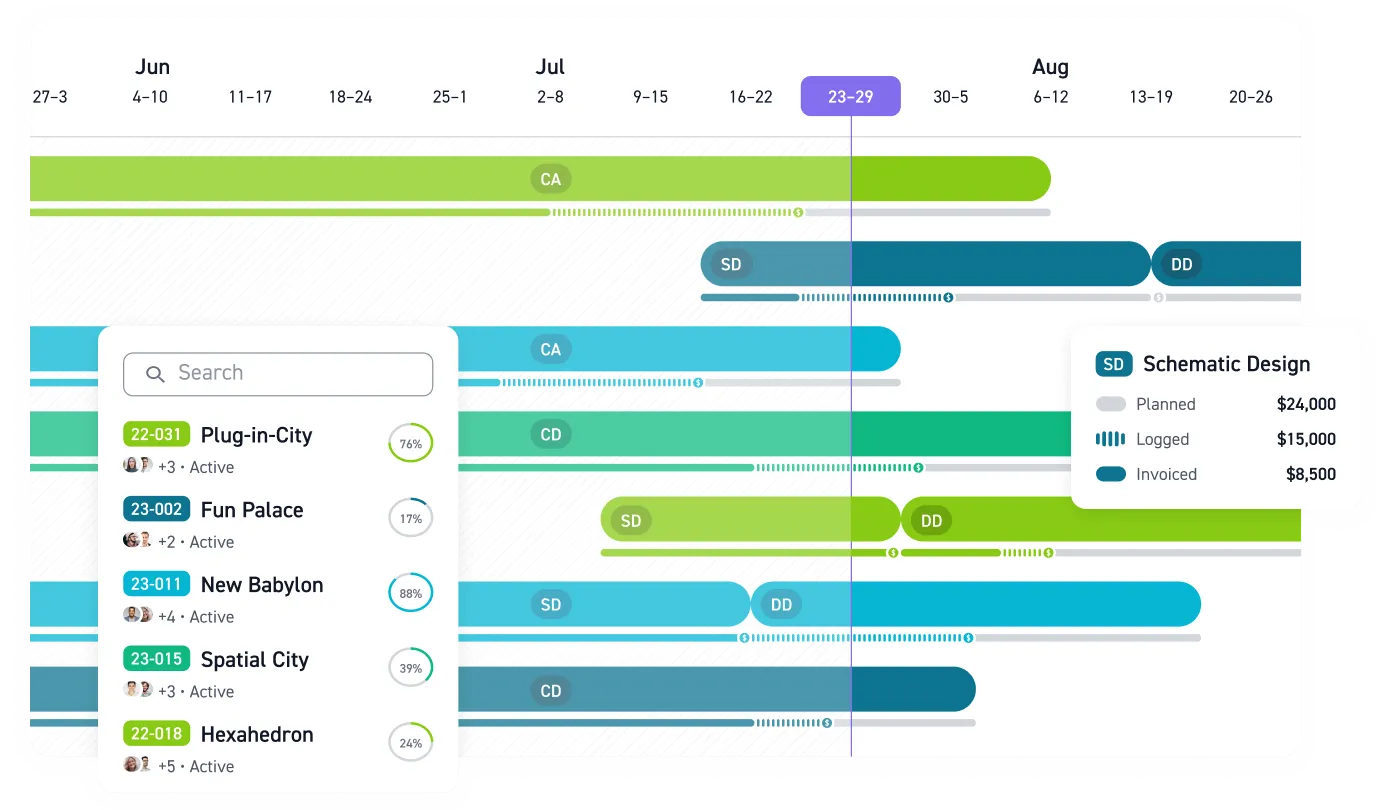
6. Track percent spent and percent complete as two distinct metrics. This is the core discipline of fixed-fee project control. Percent spent tells you how much of the budget is gone. Percent complete tells you how much of the deliverable is finished.
7. Watch labor charges weekly and forecast overruns early. High-performing PMs watch labor weekly, forecast overruns early, and adjust staffing or scope before losses lock in. A weekly check should cover:
- Compare hours charged and percent complete against phase budgets
- Flag phases where fee burn is outrunning deliverable progress
- Forecast completion costs for at-risk phases and decide on scope or staffing adjustments
That review gives you a chance to intervene while the project is still recoverable.
Plan the Work Before You Open the Tool
Teams lose time when production starts before the work is planned. A clear review rhythm and basic schedule logic keep a well-scoped project from drifting.
8. Schedule regular project reviews at defined intervals. Regular project reviews are a regular review discipline for maintaining project performance and financial visibility. Use those meetings to decide what needs to change.
9. Build schedule logic before opening any software. Define task dependencies and resource constraints on paper first, then build the schedule in software. If you compress duration without changing resources, the budget absorbs the hit.
10. Maintain a skills inventory and match projects to development goals. Build a skills map across your team, then use that map for staffing decisions. Better matching improves team development and protects the budget. BRNS Design reported a 4x faster billing process and 50% less budget overage.
Staff and Benchmark with Intention
Staffing decisions shape project margin long before invoicing does. Internal comparisons help, but they rarely tell you whether performance is strong.
11. Define PM accountability by role level. A published engineering grades framework assigns responsibilities at each career stage, with increasing responsibility as engineers advance from mid-level to senior roles.
12. Benchmark against independent industry KPIs. Industry-wide conditions and independent benchmark surveys help you evaluate metrics such as direct labor multiplier, utilization, revenue factor, and financial performance benchmarks. External reference points keep you from mistaking noise for improvement.
13. Establish collaboration protocols before work begins. Poor collaboration leads directly to wasted time, budget overruns, design errors, change orders, and rework. Protocols defined on day one should cover:
- Meeting cadence and agenda ownership
- Document sharing platforms and version control
- Governance and dispute resolution processes for unresolved coordination issues
- A single point of contact for each discipline or consultant
These ground rules reduce coordination friction before it turns into rework.
Build Relationships and Quality Into Every Phase
Relationship management and QA/QC are often the first things squeezed when schedules get tight. They also prevent some of the most expensive failures.
14. Map all stakeholders with communication owners assigned. Successful PM is linked to relationships, going beyond scope, schedule, and budget. At project start, list stakeholder groups, assign a relationship owner, define update cadence, and revisit the map at each phase gate.
15. Start QA/QC at scoping, not as a final-phase activity. Federal and industry QA/QC guidance for engineering work commonly describes elements such as design reviews, QA/QC checklists, process documentation, and detailed records of quality-related activities. Assign separate staff to prevention and detection, and keep distinct checklists for both functions on every project.
If you want one place to start, begin with Practice 6: track percent spent and percent complete as separate numbers on every active phase, every week. That one habit gives you earlier warning and better decisions.
See Problems Before They Turn Into Write-Downs
A&E project profitability slips when scope changes go undocumented, hours outrun progress, and weekly review never happens. Better visibility into phases, budgets, staffing, and financial performance helps project managers course-correct sooner instead of explaining losses after the fact. Book a demo.
Frequently Asked Questions
What's the best way to stop scope creep on fixed-fee A&E projects?
Get scope, fees, and expectations in writing before work begins, then define lump-sum scope at the task level. A formal change control process at kickoff turns scope changes into managed decisions.
Why track percent spent and percent complete separately?
Because hours charged and work finished are not the same thing. When those numbers drift apart, you get an early warning that a phase is headed for trouble.
How often should project managers review labor and project performance?
Weekly. A weekly review gives you time to compare hours charged against phase budgets, spot phases that are burning through fee too quickly, and forecast completion costs before losses lock in.
How can small A&E firms apply these practices without adding more admin work?
Start with a few operating disciplines that directly affect margin: written scope, task-level fee assumptions, weekly labor review, and phase-by-phase tracking of percent spent and percent complete.
Where should QA/QC start on an A&E project?
At scoping. QA/QC works best when prevention and detection are built into the project from the beginning, with separate responsibilities and clear checklists for both.