


Firm management made easy

A 10% budget overrun on a single project doesn't sound catastrophic. But when your firm's median operating profit margin sits around the industry benchmark, that overrun just consumed half your expected profit on that engagement. And if you're running fixed-fee contracts, there's no change order to recover the loss.
This is the math that keeps A&E firm principals up at night. AI project forecasting changes that math by identifying budget problems weeks before they show up in your monthly reports.
The Overrun Problem Is Bigger Than Most Firms Admit
Across A&E firms, budget overruns are more common than most principals want to admit. The primary drivers follow familiar patterns: scope creep leads the list, followed by underquoting and poor tracking systems. Too many firms still manage resourcing through manual processes like spreadsheets and recurring meetings.
The financial impact compounds quickly under fixed-fee agreements. A&E firms typically achieve an 81% realization rate on billable time, meaning roughly 19-20% of earned fees get written off. For a firm with a $500,000 annual project portfolio at that realization rate, that equals about $95,000 in lost revenue. One problematic project can eliminate an entire quarter's profit for a small firm.
An industry survey on project overruns identifies specific root causes that repeat across firms:
- Unforeseen site conditions: 53% of respondents
- Design errors: 45% of respondents
- Poor communication between stakeholders: 37% of respondents
Those drivers follow repeatable patterns, and pattern recognition is exactly what AI is built to do.
How AI Project Forecasting Actually Works
Traditional budget tracking is backward-looking. AI project forecasting provides a forward-looking projection of where your budget will land based on current production signals. The distinction matters because by the time a monthly financial review reveals a budget overrun, your options for course correction have narrowed dramatically.
The core mechanism is straightforward. Machine learning models analyze your firm's historical project data, including timesheets, budgets, actual costs, and phase completion rates, to identify patterns that precede budget problems. Peer-reviewed benchmarks on construction cost forecasting show ensemble ML models achieving R² values above 0.98, meaning these models can explain nearly all variance in actual cost outcomes when trained on sufficient historical data.
In practical terms for an A&E firm, this means the system learns which project phases routinely exceed budgets, which team configurations produce the best utilization rates, and which types of scope changes signal escalating costs. You get alerts while intervention is still feasible, before an overrun hardens into a write-off.
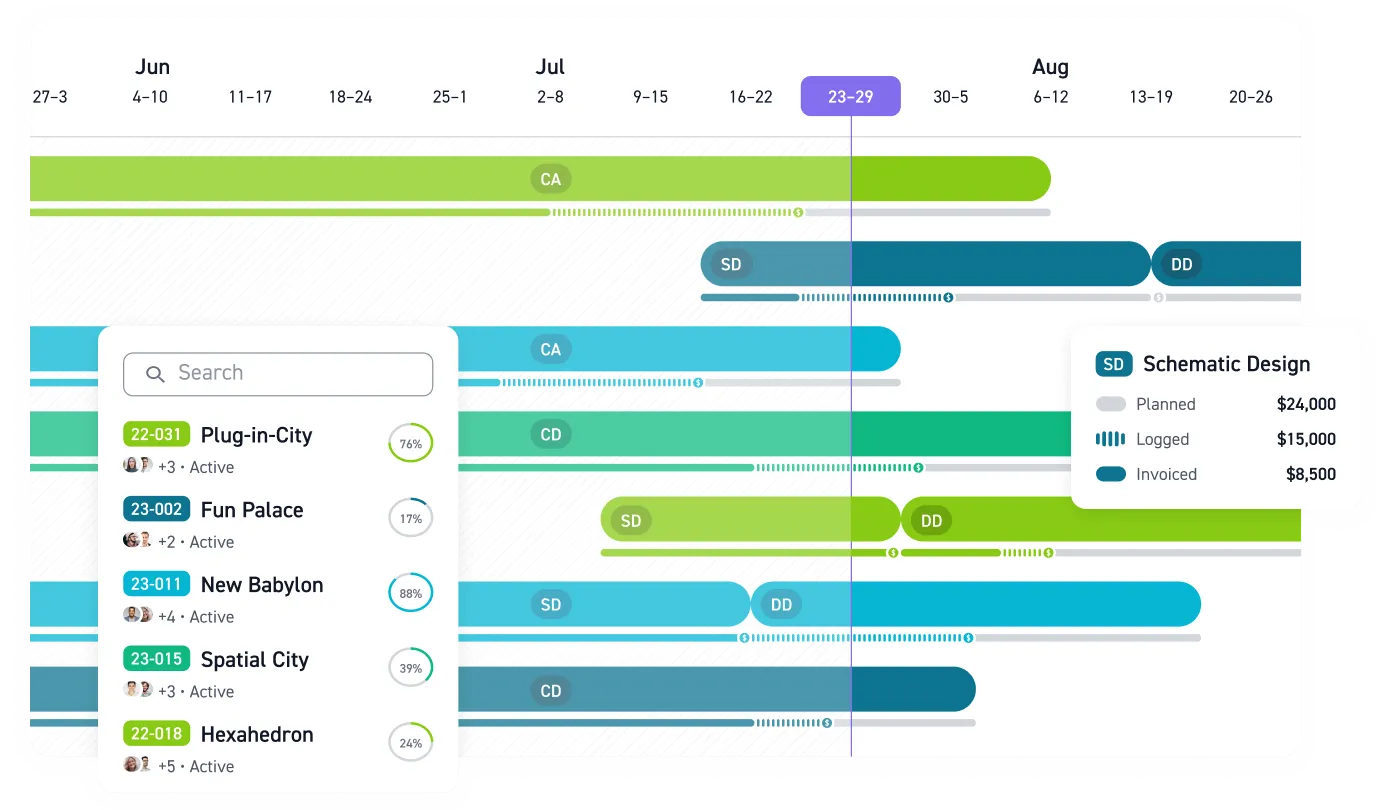
Monograph's approach distinguishes between baseline budgets, the initial plan showing where you hope to finish, and living forecasts, real-time projections showing where projects are actually heading as hours, expenses, and scope shift week by week. Its AI studies your historical projects and flags phases that routinely blow their budgets, giving you the pattern recognition that would take years of manual analysis. Monograph's MoneyGantt™ visualizes this in real time, overlaying your budget baseline against the living forecast so you can see exactly where a project is drifting before the numbers hit your monthly report.
When firms replace fragmented spreadsheets with a connected system for time, budgets, and forecasting, the operational impact can show up fast. Brunton Architects & Engineers, an 18-person structural, MEP, and architecture firm, reported 25% time saved on admin, 2x faster billing, and 25% less budget overage in a published firm case study after moving off disconnected tooling.
The Metrics AI Monitors Behind the Scenes
AI forecasting systems track a specific set of earned value indicators that serve as early warning signals. Understanding these helps you interpret the alerts and make better decisions:
- Cost Performance Index, or CPI: Calculated as earned value divided by actual cost. A CPI below 1.0 means you're spending more than you're earning on a project.
- Schedule Performance Index, or SPI: Measures timeline health. An SPI of 0.80 means the project is 20% behind schedule, which in a fixed-fee environment translates directly to budget pressure.
- Utilization rate by role: Tracks billable hours as a percentage of total hours. Industry benchmarks from an ACEC-commissioned study show that indirect labor costs make up a large share of engineering payroll, with average utilization hovering around 60%. AI flags when utilization drops during active project phases.
- Realization rate trends: Monitors whether the gap between logged hours and billable hours is widening, a signal that scope creep is consuming hours you can't bill for.
These metrics matter most under fixed-fee contracts because revenue is locked. When AI detects declining CPI alongside falling utilization on a specific project phase, it can alert you before those trends become unrecoverable losses. The compound metric, called the Critical Ratio (CPI × SPI), triggers immediate intervention warnings when it falls below 0.8.
Making AI Forecasting Work at Your Firm
AI forecasting works best with a deliberate, phased approach that respects your existing workflows:
- Start with one project type. Select your most repeatable work, whether that's commercial tenant improvements, residential additions, or site civil projects, and run a 90-day pilot.
- Get your data house in order. AI forecasting accuracy depends on historical data quality. Firms with 12-18 months of clean, standardized project data see productivity gains within weeks. Focus on standardizing three elements across all projects: phase definitions, time tracking categories, and cost codes.
- Pair technology with training. A survey of 223 firms found that only 37% train project managers formally. The same dataset shows the strongest budget performance among firms that train all PMs. AI tools deliver maximum value when your team understands PM fundamentals.
- Designate an AI champion. This person doesn't need to be a programmer. They need to understand your firm's financial processes and be curious enough to develop prompt templates for budget forecasting queries. The AIA's AI Task Force emphasizes that responsible AI adoption starts with practical, firm-level guidance, treating AI as a tool that supports professional judgment rather than replacing it.
The fastest ROI comes from treating implementation as an operational discipline that continues after go-live. That lines up with broader sentiment too: an ACEC survey found 68% of engineering firms believe they can automate 10-29% of current work tasks through AI, with cost savings topping the list of expected benefits.
The Real Cost of Waiting
If principals at a small firm spend 10 hours per week on manual budget tracking at a billing rate of $200/hour, that represents roughly $104,000 per year in lost billable time. That figure alone often exceeds the subscription cost of A&E-specific platforms like Monograph, which varies by plan and firm size.
The competitive window is narrowing. The same ACEC industry report found that 74% of engineering firms believe AI will allow them to maintain current staffing levels while increasing output. Early adopters are building data foundations and operational advantages that compound over time. Every month of clean project data you collect now makes your AI forecasting more accurate six months from now.
Budget overruns become predictable with the right data and a weekly forecasting cadence. The question is whether you'll see them coming.
Stop Guessing About Your Next Budget Overrun
Catching an overrun early is the only way to fix it. When you rely on monthly spreadsheet reviews, you're always managing in the rearview mirror.
Monograph connects your timesheets, budgets, and project phases into a single system. Our AI analyzes your firm's actual performance history to flag at-risk phases before they consume your margin. With Monograph's MoneyGantt™, you get a real-time visual of your budget-to-cash progression, so you can course-correct while you still have options.
Don't wait for the write-off. Your project data is already telling you where the next overrun will come from. Book a demo.
Frequently Asked Questions
Do we need years of perfect data to start using AI forecasting?
No. More history improves accuracy, but you don't need a flawless archive to start getting value. Begin by standardizing how you set up phases and track time on your active projects, then keep it consistent going forward. The most important shift is getting out of disconnected spreadsheets so your new data actually compounds in value.
Will AI forecasting replace our project managers?
No. It gives them their time back and makes their decisions better-informed. AI can handle the repetitive work of spotting variance patterns and burn-rate risk, but PMs still have to manage scope, client expectations, and team performance. Forecasting supports judgment; it doesn't replace it.
How does AI handle projects that get paused or delayed?
Paused projects are a normal part of A&E work, and they can wreck a forecast if your system treats everything like a linear schedule. Practice management platforms built for A&E workflows can account for pause states and shifting timelines. The forecast adjusts as the plan changes, so a delayed start doesn't quietly distort the rest of your quarter.
Is AI forecasting reliable for fixed-fee contracts?
It's often most valuable for fixed-fee work because your revenue is capped and the risk sits entirely on your side of the ledger. AI forecasting helps by watching early indicators like CPI, SPI, and the Critical Ratio as the project moves phase by phase. When those signals start slipping, you get a chance to intervene while there's still budget left to save.