



Firm management made easy

Engineering firms sell expertise. They win pursuits, manage long client relationships, and assemble teaming partners for competitive proposals. A CRM built for retail sales or SaaS pipelines will not account for go/no-go scoring, SF-330 submissions, or the reality that many of your best business developers are also your best engineers. Most principals already know client relationships are one of their most valuable assets. The hard part is finding a system that fits how engineering firms actually work.
Recent industry research lists client relationship management as a top priority for A&E firms in 2025. Yet only 43% of engineering firms currently use CRM software. Most available tools simply do not match how engineering work happens.
Why Engineering Pursuits Need a Different Workflow
Generic CRMs track leads, deals, and close dates. Engineering firms track pursuits, qualifications, teaming strategy, and proposal submissions. When the tool does not match the workflow, teams fall back on spreadsheets and knowledge that lives in a few inboxes. The A&E industry is too specialized for a general CRM to map cleanly to project-based work without heavy customization.
A CRM for an engineering firm needs to support a few core workflows:
- Go/no-go decision workflows with weighted scoring criteria tied to each pursuit.
- SF-330 data management for firms pursuing government contracts, including staff resumes and project experience records.
- Capture rate analytics that track wins against dollars pursued rather than raw win counts. The capture rate shows whether the work you are winning aligns with the work you should be chasing.
- Client relationship history linked to both contacts and projects so knowledge stays with the firm.
Without those pieces, you are forcing engineering work into a tool designed for someone else.
Platform Options by Firm Size
The A&E CRM market is segmented by firm size. Deltek positions Ajera for smaller A&E firms and Vantagepoint for broader professional services needs and existing Vision customers. The right fit depends on headcount, client mix, and whether you have dedicated BD staff.
- For small firms doing mostly private-sector work, general-purpose tools like HubSpot or Pipedrive can handle basic pipeline tracking. Industry coverage notes that free CRM plans are already in use at many A&E firms. You will not get SF-330 support or built-in go/no-go workflows, but you may get stronger adoption.
- For firms with active BD operations, dedicated A&E CRM functionality covers opportunity tracking, go/no-go scoring, SF-330 support, and pipeline visibility. Smaller firms may still find these systems hard to maintain.
- For growing firms, Deltek Vantagepoint is often considered because CRM, project accounting, resource planning, and time tracking share a database. The tradeoff is complexity, and the CRM is not sold on its own.
Some purpose-built A&E platforms still require direct vendor conversations before you can compare pricing.
The Seller-Doer Problem
Many A&E firms rely on seller-doers alongside dedicated BD staff. Your engineers and project managers are doing client work and BD at the same time. If the CRM adds administrative overhead to people who are already stretched thin, it will not get used.
Principal and seller-doer data entry resistance is a significant adoption risk for small firms. The people with the most client knowledge are often the least likely to enter data. A few practices help reduce that friction:
- Email and calendar integration so relationship data is captured without another manual step.
- Mobile access so field staff can log activity after visits without going back to a desk.
- Role-based dashboards so principals see useful summaries instead of data-entry screens.
Training matters too. Underinvestment in training often drives the gap between buying a tool and getting value from it. Training on real proposals and real projects produces better adoption outcomes.
Where Practice Management Connects to CRM
Many small engineering firms face a more basic decision. Should CRM live inside the practice management system or beside it? The answer depends on how much of your work is government-facing and how complex your BD process has become. For firms serving private-sector clients with simpler pursuit workflows, a practice management tool with pipeline tracking may be enough.
Monograph addresses that connection with Pipeline, a lead, proposal, and revenue forecasting module built for A&E firms. Pipeline connects pursuit data to project delivery by linking leads, proposals, and forecasts in one place. It also connects capacity planning with BD decisions, so teams can see how potential work affects utilization before committing. For firms that need deeper contact management or email logging, Pipeline works alongside those tools while serving as the planning layer for future work.
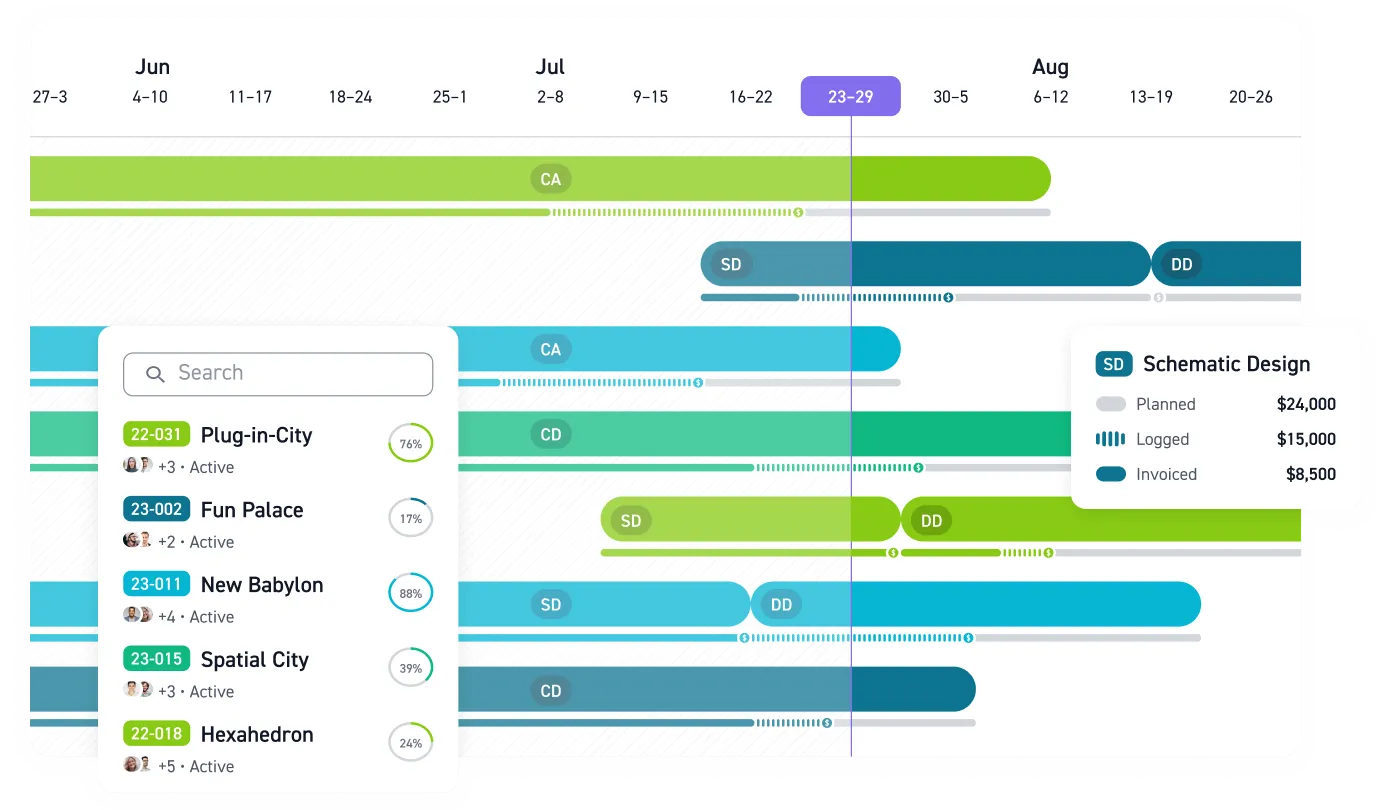
Dynamic Engineering, a 10-person firm, reported 25% profit growth and a 2x efficiency gain after moving from Excel. Combined with QuickBooks Online integration and Monograph's MoneyGantt™ visibility into budget-to-cash progression across project phases, the platform gives small firms a stronger practice operations system. More small firm results are documented in the success stories library.
AI Is Arriving, But Data Quality Comes First
AI is showing up across A&E software, including Deltek's Ask Dela assistant and Unanet's ProposalAI module. A widely cited analyst warning flags that some vendors label simple AI assistants as autonomous agents before the product truly works that way.
Firms with clean CRM data will get more useful proposal drafts, client summaries, and opportunity scoring. Firms with messy data will get weak output faster. If AI-powered BD tools are on your roadmap, start with data hygiene:
- Audit contact and project records for completeness and accuracy.
- Standardize how your team logs pursuit outcomes and client interactions so data is structured and usable.
- Assign data quality ownership to one person so maintenance does not get ignored.
Clean data compounds over time. It also makes every other workflow in the system more useful.
Stop Running Pursuits in Spreadsheets
Engineering firms outgrow generic CRM when relationship history, pursuit planning, and delivery forecasting need to connect. If your team is still piecing together BD decisions across inboxes, spreadsheets, and disconnected project tools, growth gets harder than it needs to be.
Monograph helps A&E firms connect pipeline visibility, project planning, and operational clarity in one place. You can see upcoming work, understand capacity before you commit, and make better decisions without forcing your team into a generic sales workflow.
Your next pursuit should start with better visibility. Book a demo.
Frequently Asked Questions
What's the difference between a CRM and practice management software for an engineering firm?
A CRM tracks relationships, pursuits, contacts, and BD activity. Practice management software connects project planning, staffing, budgets, and delivery. For some small engineering firms, pipeline tracking inside a practice management tool is enough. Firms with more complex BD workflows usually need stronger CRM functionality.
Can a small engineering firm use a general-purpose CRM successfully?
Yes, if the firm's needs are simple. General-purpose tools can handle basic pipeline tracking, but they usually lack SF-330 support, built-in go/no-go workflows, and other A&E-specific features.
When do we need A&E-specific features like SF-330 tracking or go/no-go workflows?
You need them when your pursuit process depends on them. If those workflows already live in spreadsheets, inboxes, or individual memory, you have likely outgrown a generic CRM.
How do we get seller-doers to actually use the system?
Reduce manual work. Email and calendar integration, mobile access, and role-based dashboards all make adoption easier. Training on real proposals and projects helps too.
Should CRM live inside our ERP or alongside it?
That depends on how tightly BD and delivery need to connect. An all-in-one system can offer more visibility, but it also brings more complexity. Smaller firms often do better with a lighter setup that matches how they already work.