

If you're juggling active projects and a stack of timesheets that came in late, you already know the spreadsheet isn't cutting it. The gap between how A&E firms plan projects and how they actually deliver them keeps widening. The 2026 AEC fee and billing data shows the chargeability gap between target and actual staff utilization grew to 4.0%, up from 2.9% the year before. If you've tried to course-correct a budget using outdated timesheet data, you know how that ends.
Choosing the right project planning software closes that gap when the system matches the way architecture and engineering work actually happens. The wrong tool creates more admin and less trust in the numbers.
Why Generic PM Tools Break Down for A&E Firms
A&E projects don't move in straight lines. They pause for permitting or restart when funding clears, and different phases of the same contract can carry different fee structures. Generic project management platforms built on linear task lists have no native way to handle that reality.
The problem is structural. Architecture and engineering work is organized around sequential design phases, with budgets and billing tied to each phase independently. Treating a later phase as just another folder is like designing a building with no structural grid: the financial logic underneath disappears. A generic task board pushes phase budgets and consultant markups into separate manual work, which leaves client billing disconnected from the project plan.
Scope creep makes that worse. Firms often recognize expansion only after delivering unbilled services that should have been tracked earlier, because teams without real-time scope tracking default to client accommodation rather than contract enforcement.
What to Prioritize When Evaluating Software
Every vendor claims to support A&E workflows. These criteria separate tools that actually do from ones that need months of configuration to approximate it. Before scheduling vendor demos, test each platform using a recent project with phased billing and consultant coordination, because sample data won't surface the gaps your real project structures will.
- Phase-based budget tracking: Can you set phase-level budgets at proposal stage, log time directly to phases, and see fee burn in real time without exporting to a spreadsheet?
- Non-linear resource planning: When a project pauses, does the system free up capacity automatically? Can you model what happens if that paused project restarts soon?
- Accounting integration depth: Does the QuickBooks sync push phase-level cost codes, or does it flatten everything to the project level?
- Subconsultant and reimbursable management: Can you keep consultant fees inside individual phase budgets and bill reimbursables separately from labor, with markup handled during invoice generation?
If the answer is fuzzy in a demo, it will be worse in practice. Manual processes are where budget visibility goes to die. PSMJ identifies Earned Value Management as a best practice for A&E project control, so your software should support tracking percent complete against fee spent as a baseline.
The Best Project Planning Software for A&E Firms
The market breaks into three categories: purpose-built A&E tools, adapted professional services platforms, and general PM software. For many small and mid-size firms, purpose-built tools perform better because their structure already matches the way A&E teams work.
- Purpose-built A&E tools align with phased budgets and the billing structures A&E teams use to manage consultant work.
- Adapted professional services platforms can work for some firms, but often bring more complexity than smaller teams want.
- General PM software can support task management, but phase-based billing and consultant workflows usually require workarounds.
The platform's underlying structure determines whether your team trusts the data once real projects start moving.
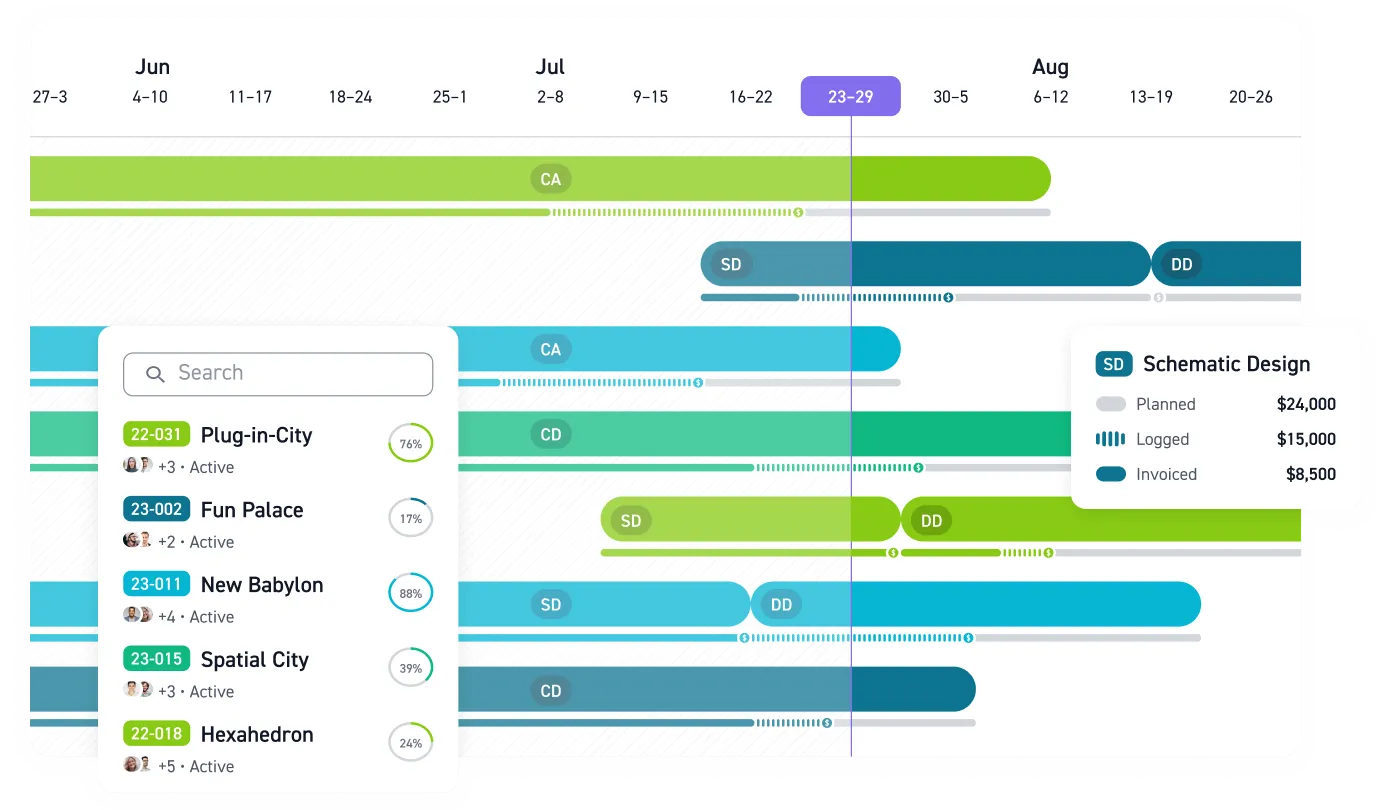
Monograph is built for architecture, landscape architecture, and engineering firms. Every time entry flows into profitability calculations, billing, staffing, and reports, with support for fixed-fee and hourly structures, including hybrid work, at the phase level. Monograph's MoneyGantt™ layers budget data across project phases so teams can see budget status as logged hours affect the budget. Supporting features include capacity heatmaps and QuickBooks Online integration, with consultant coordination in the same workflow.
BQE Core combines back-office operations with project management for A&E firms. It covers time and expense tracking, billing, accounting, and reporting. Deltek Ajera also combines project management with accounting for A&E firms. Both can fit mid-size firms, though their complexity can exceed what smaller teams need, and a dated interface can create adoption friction.
Other purpose-built options serve narrower needs. Total Synergy aligns stage-based delivery to architectural phases with integrated invoicing. CMAP emphasizes financial forecasting and utilization tracking for engineering-led firms and consultancies. Factor AE combines planning, tracking, billing, and reporting in one platform.
General PM tools can approximate A&E workflows, but phase-based billing, consultant markup, and A&E-specific invoicing usually require heavy manual setup. They can work, but only if your team is willing to maintain the workaround.
The Financial Case for Better Tools
The distance between firms with modern PM infrastructure and those without is growing. Firms with stronger growth metrics are more likely to invest in purpose-built systems, and proper tracking directly supports utilization and project profitability monitoring.
The 2026 Monograph benchmark report, drawn from platform data across more than 13,000 architects and engineers at 1,800+ firms, reinforces that pattern. At the firm level, one California practice reported 75% fewer unbilled fees and 8x faster staffing decisions after switching from BQE Core.
How to Run a Real Evaluation
A focused evaluation process will save you from buying software nobody uses:
- Involve your accounting team early. Financial visibility only holds up if accounting trusts the data. If they don't, you'll end up maintaining two systems.
- Test timesheet friction. If staff can't complete a daily entry quickly, adoption will collapse. Auto-populated timesheets from project assignments can reduce that friction.
- Map your pain points before features. A firm that needs real-time budget oversight has different priorities than one drowning in consultant coordination. Start with your operational bottleneck, then evaluate features.
The best tool is the one your team opens every day. That starts with how it handles the first minutes of a Monday morning timesheet.
See Your Projects Clearly, Phase by Phase
Start with one recent project and run it through your evaluation using the criteria that matter in A&E: phased budgets, consultant coordination, accounting depth, and timesheet friction your team can live with. If a platform can't handle the way that project was staffed, billed, paused, and restarted, it won't hold up across the rest of your firm.
Use a recent project with real staffing, billing, pauses, and restarts. Bring in your accounting team early, pressure-test daily entry speed, and ask direct questions about phase-level visibility in QuickBooks and invoicing. If you want to see how a purpose-built system handles those workflows, book a demo.
Frequently Asked Questions
What makes project planning software different for A&E firms?
A&E firms need software that reflects phased work, non-linear schedules, consultant coordination, and billing structures tied to each phase. Generic PM tools can manage tasks, but they usually break down when you need to track fee burn by phase or handle consultant markups cleanly through invoicing and accounting.
Can a small firm justify purpose-built software over spreadsheets or generic PM tools?
Purpose-built tools often outperform the alternatives because their structure already matches how A&E firms work. Small teams feel manual workarounds faster than anyone else. When one person is reconciling consultant invoices in Excel or chasing timesheets every week, the admin burden lands directly on a team that already has no extra capacity.
What should we test in a software demo before choosing a platform?
Use a recent project with phased billing and consultant coordination. Check whether staff can log time directly to phases, whether the system shows fee burn in real time, whether paused work affects capacity planning, and whether reimbursables and consultant fees can be billed correctly. Pre-configured sample data won't show where your actual workflow breaks.
How important is accounting integration when evaluating project planning software?
Critical. The PM platform's financial visibility is only reliable if accounting trusts the data flowing from it. Ask whether the QuickBooks sync preserves phase-level cost detail or flattens everything to the project level. If accounting has to maintain a second version of the truth, your reporting will drift and the system will lose credibility fast.
Data was collected as of April 2026.