



Firm management made easy

Payroll hits every two weeks. Rent hits every month. Insurance premiums don't care whether your client signed off on that SD milestone or put the project on hold for six months. But your invoices? Those wait for percentage-complete approvals, milestone reviews, and AP departments that move at their own pace.
This mismatch between when costs land and when revenue arrives is the central financial challenge of running an A&E practice. U.S. architecture firms collect payment in an average of 73 days, while high-performing firms hit a 34-day benchmark. That gap means most firms are financing two to three months of client work with their own working capital before seeing a dollar.
That gap between average and top-performing firms is closeable. Here's how.
Understand Where Cash Gets Stuck
Before fixing cash flow, you need to see where it breaks down. Three structural problems compound in A&E firms.
First, fee structures are back-loaded by design. Billing data shows that only 23% of project fees are collected by the end of Schematic Design, with the bulk deferred to CD and CA phases. The phases that consume the most labor generate the least near-term cash.
Second, market conditions are amplifying the pressure. The AIA Architecture Billings Index fell to 43.8 in January 2026. Client indecision, budget shortages, and stalled projects are compounding. Construction sector surveys found that 63% of respondents had a project postponed, scaled back, or canceled within the past six months.
Third, fixed-fee contracts cap your revenue while leaving costs open-ended. Every unplanned coordination hour on a fixed-fee project cuts into margin. There's no automatic adjustment when scope grows.
These problems require a systematic approach across billing, contracts, collections, and forecasting.
Step 1: Invoice Within 24 Hours of Milestone Completion
The single highest-impact change most firms can make is eliminating the lag between completing work and billing for it. Calendar-based billing cycles, where you invoice on the 1st or 15th regardless of project progress, guarantee that completed work sits unbilled for days or weeks.
Switch to event-driven invoicing. When a milestone is signed off, the invoice should go out within 24 hours. Set up automated invoice triggers on milestone approval rather than monthly cycles.
This matters more than it sounds. Collections research has documented that inconsistent billing practices and confusing, poorly detailed invoices give clients legitimate grounds to request clarification before paying. The longer an invoice sits in draft, the more likely details get fuzzy and disputes arise.
Step 2: Structure Contracts That Protect Your Cash Position
Your contract is your first line of defense. Four provisions make the biggest difference:
- Require retainers before kickoff. Size them to cover at least the first project phase, or 15–25% of total project value. Do not begin work without the retainer in hand. Upfront fees fund initial expenses before your first milestone invoice and signal genuine client commitment.
- Set Net-15 payment terms. Net-30 or Net-60 terms persist in A&E because of industry convention, trade leverage, and relationship considerations. Negotiate Net-15 terms in all new contracts and restate terms at every progress meeting. For smaller projects, push for due-upon-receipt.
- Use milestone billing tied to AIA phases. The AIA B101-2017 framework divides services into five phases with payment triggered at each phase's completion. Each milestone should specify deliverables, fee percentage, and invoicing criteria.
- Require written authorization for additional services. The B101 standard requires written authorization before architects proceed with additional services. This shifts the burden of proof on scope creep from you to the client.
For engineering-led projects, EJCDC documents provide frameworks with standardized payment application forms, and other ACEC publications offer resources like customizable collection and stop-work letter templates.
Step 3: Run Weekly A/R and WIP Reviews
Invoices age because nobody is watching them systematically. A 10-minute Monday morning A/R review with defined escalation protocols changes this entirely.
Build your escalation sequence around clear triggers:
- 15 days past due: Same-day follow-up email to the client's AP contact
- 30 days past due: Phone call from the project manager or finance lead
- 45 days past due: Project manager involvement and formal discussion about pausing work
- 60+ days past due: Formal demand letter and legal consultation
Performance benchmarking confirms that tracking A/R aging as a KPI helps you predict cash flow problems before they become crises. Document all collection activity in your project management system so nothing falls through the cracks.
Equally important: track work-in-progress weekly. WIP represents completed but unbilled work, cash locked inside your operations. AEC business data confirms that finishing 90% of a project but waiting months to bill creates serious cash flow problems regardless of work quality. Establish a firm-wide policy: convert WIP to invoices within 48 hours of milestone completion.
Step 4: Replace Your Annual Budget with a 12-Week Rolling Forecast
Annual budgets are snapshots. They tell you what you planned in January but nothing about what's actually happening in September. For project-based firms where revenue arrives in unpredictable bursts, a 12-week rolling forecast updated weekly provides the visibility you actually need.
Each weekly forecast should include four columns:
- Expected invoices by project and milestone
- Anticipated collections based on your actual DSO patterns, not your contract terms
- Planned expenses including payroll, subconsultants, and overhead
- Net cash position showing your real runway week by week
Update the forecast every Friday. Variance analysis over time reveals patterns you can act on: delayed invoicing from specific PMs, slow-paying client types, seasonal dips. Industry performance data indicates that firms implementing proper tracking systems for utilization, project profitability, and productivity metrics improve performance by 15–20% within the first year.
Step 5: Embed Financial Controls into Daily Workflows
The biggest barrier for small-to-midsize A&E firms is having the infrastructure to do it consistently. A 12-person firm doesn't have a dedicated finance department running enterprise-level controls.
Technology closes that gap. McKinsey research on digital transformation in engineering and construction found that firms adopting integrated digital tools can achieve productivity gains of 14–15% and cost reductions of 4–6%. For small and midsize practices, the payoff is even more direct: software that embeds billing workflows, budget tracking, and cash flow forecasting into daily operations replaces the need for a dedicated finance team. New York-based Garrison Architects, for example, implemented an integrated practice management system and sped up their time-to-payment by 2.5x, directly improving their cash flow cycle.
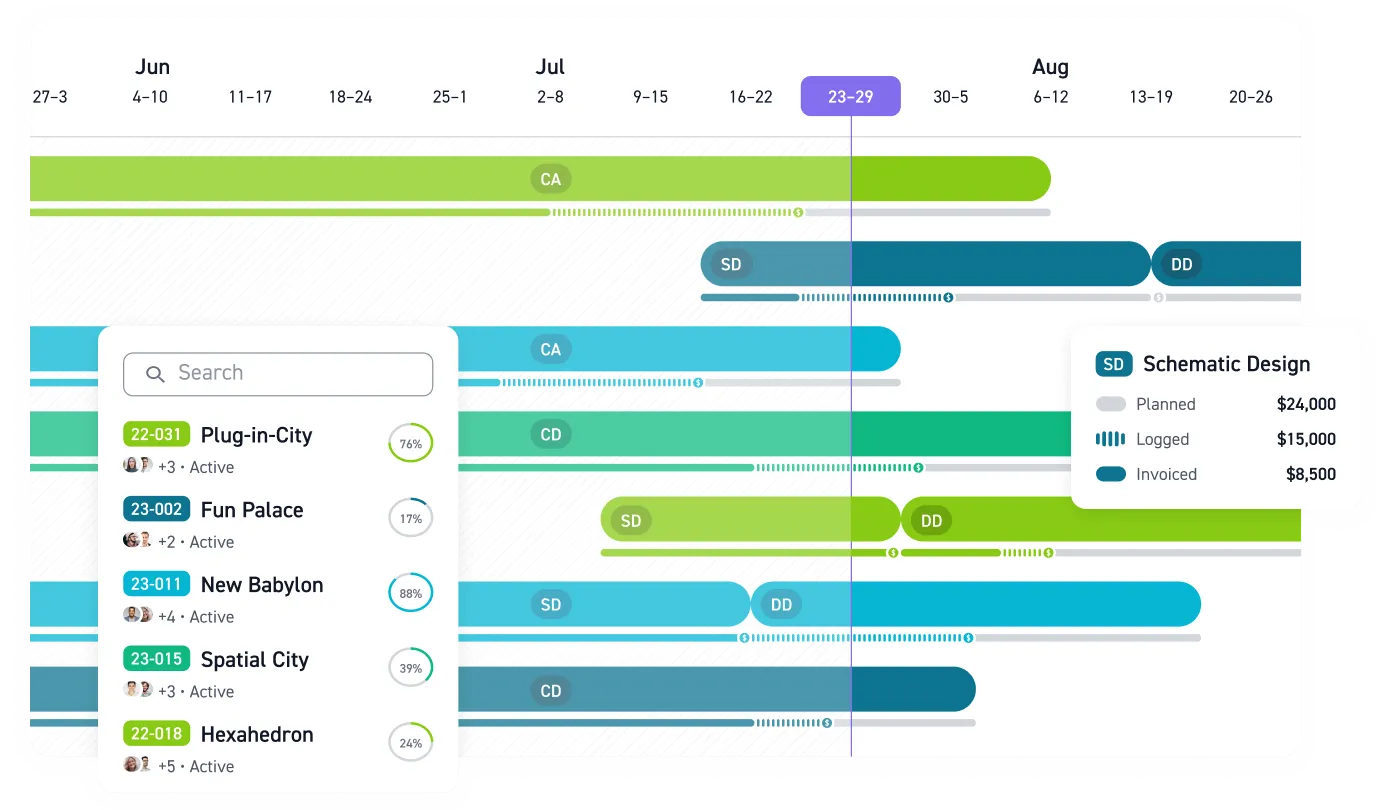
Monograph's signature MoneyGantt™ overlays real-time budget status on project schedules, showing whether phases are consuming fees faster than progress warrants. Invoices connect directly to project phases with integrated Stripe payment processing, so clients pay by credit card or ACH straight from the invoice. Time entries flow into draft invoices synced with QuickBooks Online without manual reconciliation.
The result: the financial discipline that used to require enterprise infrastructure becomes accessible to any firm willing to use it.
Close the Gap Between Invoicing and Getting Paid
Most cash flow problems in A&E firms aren't caused by a lack of work. They come from small disconnects that compound: time logged in one system, budgets tracked in another, invoices built at month-end, and collections handled ad hoc when someone has a spare minute.
The firms that consistently outperform don't rely on heroic effort from one principal or one bookkeeper. They build a repeatable system: event-driven invoicing, contract terms that protect cash, weekly A/R and WIP reviews, and a rolling forecast that shows the runway before it disappears.
Take control of cash flow with Monograph and connect budgets, time, invoicing, and payments in one workflow. Book a demo.
Frequently Asked Questions
Our clients are large institutions that mandate Net-60 terms. How can we still improve cash flow?
You can't always change the terms, but you can shrink everything around them. Invoice within 24 hours of milestone approval, require a kickoff retainer, and keep WIP conversion tight so work doesn't sit unbilled for weeks before the Net-60 clock even starts. If a client won't budge on terms, your leverage is speed, clarity, and consistency.
Is requiring a retainer before starting work realistic without hurting the relationship?
Yes. A retainer is normal in professional services, and it sets expectations early that your firm runs on clear deliverables and clear payment triggers. Clients who resist any upfront commitment often become the same clients who delay approvals and payments later.
What's the single most important change a small firm can make if we can't do everything at once?
Move to event-driven invoicing. If you finish a milestone on Tuesday but don't invoice until the next billing cycle, you're giving up weeks of cash flow for no reason. Getting invoices out within 24 hours is the fastest way to reduce DSO without renegotiating every contract.
How do we implement a 12-week rolling forecast without a dedicated finance person?
Start simple and make it a weekly habit. Use a basic spreadsheet with expected invoices, realistic collection timing based on your actual DSO, fixed overhead, payroll, and known consultant bills. The accuracy improves quickly once you review it every week and update it based on what actually happened.