
Every engineer knows the feeling: a design looks perfect until the structural consultant asks about load paths, the client cuts the budget, and code review flags a missed clearance. Optimizing a design solution turns that first workable idea into the best possible one within real constraints. For project managers and firm leaders, it is where margin lives or dies.
Design optimization is a decision-making process, often iterative, that applies engineering science to convert resources optimally to meet stated needs. The steps below give you a repeatable structure. The management practices around them determine whether that structure holds up under a real project load.
Step 1: Define the Problem and Constraints Before Anything Else
Optimization has no meaning until you know what you are optimizing for. The design process begins with defining the problem and project requirements. That means identifying the client, their real needs, the functions the design must perform, and the constraints that bound every decision.
Engineering problems are usually ill-defined at the start, so scoping is itself an engineering task. Name the constraints upfront so a finished design does not violate a code or business limit:
- Regulatory and code constraints: ASCE/SEI 7-22 is the nationally adopted loading standard for structural design, referenced by the International Building Code and others.
- Safety as a hard gate: Engineers must hold paramount the safety, health, and welfare of the public. Safety bounds the design space. It is never a variable you trade against cost.
- Project constraints: Cost, schedule, constructability, and sustainability all shape what counts as feasible.
Get these written down before you generate a single alternative. Scope creep, the uncontrolled expansion of a project's scope without matching timeline or budget changes, starts precisely where problem definition ends too early.
Step 2: Generate and Evaluate Multiple Alternatives
Strong teams consider diverse concepts early, holding off on heavy evaluation until the field is wide. Once you have candidates, evaluate them against your criteria.
Most real design problems are multi-objective, with several goals competing at once and no single perfect answer. Structured decision tools help teams compare alternatives without letting the loudest opinion in the room win:
- Weighted decision matrix: Assign weights to each criterion by importance, score each option, and sum the weighted scores.
- Pugh matrix: Pick a strong baseline design and score every alternative relative to it. Selecting a strong datum concept improves both the alternatives and the convergence toward a winner.
- Pareto trade-off analysis: Multi-objective optimization yields a set of trade-off solutions where no objective can improve without another getting worse.
One caution: weighting introduces the risk of amplifying bias when a single person sets the weights instead of the full team. Run these as cross-discipline exercises, and treat safety compliance as a gate that alternatives must clear before scoring begins.
Step 3: Iterate Through Analysis and Synthesis
Engineering design is iterative by nature. Analysis predicts performance; synthesis creates the system.
In practice, this looks like a preliminary CAD model, finite element analysis to map stress and displacement, then refinement that trims material from parts not carrying their load.
Topology optimization of a suspension bracket reached a 72.6% weight reduction while keeping safety factors above standard. The catch for A&E firms is that undisciplined iteration burns margin.
Step 4: Front-Load Coordination to Kill Rework
The rework you avoid is worth far more than the rework you fix. Direct field rework averages 5% of total project costs, with a range from 2 to 20%. Design-related errors alone account for 1 to 9% of total project cost. In a firm where median operating profit runs around 14.3% of net revenue, a few points of rework wipes out a meaningful chunk of what you earned.
Early multi-discipline coordination is the strongest lever you have. One documented ASCE project team found that early iterations let them refine layouts, reduce member quantities, and cut cost. Integrated Project Delivery produces measurable gains: a survey of IPD professionals reported 62% better cost control, 76% better schedule control, 62% higher quality control, and 71% significant reduction in change orders versus other delivery methods.
BIM-based clash detection lets engineers resolve design conflicts before construction starts. Model changes are cheaper than field changes, especially when they prevent late coordination surprises.
Step 5: Manage the Optimization Loop With Real-Time Visibility
Optimization methods work when constraints and criteria stay stable. That stability comes from project management, not the algorithm. Formal methods need well-defined inputs, and a disciplined PM process produces them.
Three practices keep the loop productive rather than expensive:
- Dynamic resource allocation: Top A&E project managers review staffing often enough to catch problems before they compound.
- Milestone and phase-gate control: Define exit criteria early because slipping milestones are the earliest signs of a distressed project.
- Real-time budget visibility: Many A&E firms have weaker financial visibility than leadership realizes, missing utilization and profitability during execution.
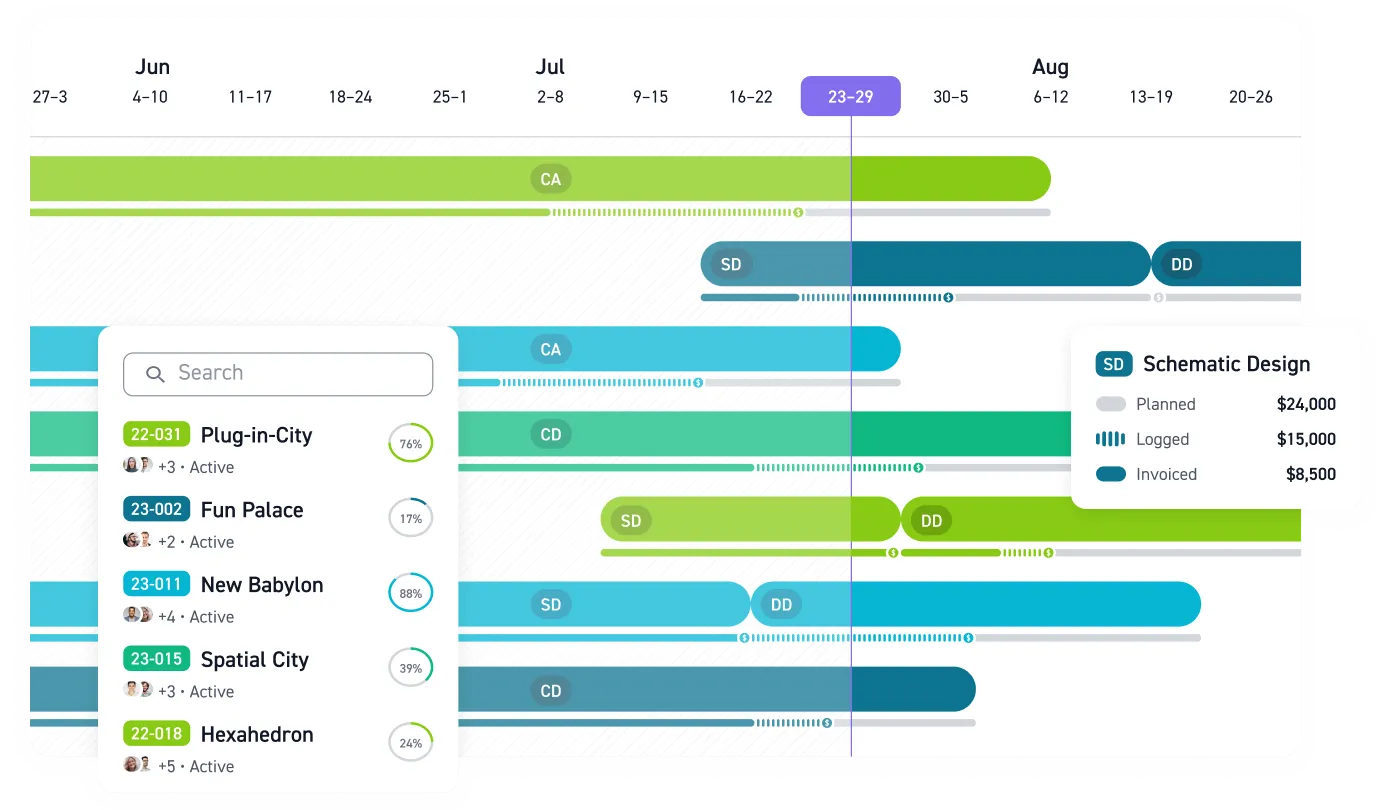
Monograph's signature MoneyGantt™ makes budget-to-cash progression visual, so you see how design iteration eats into the fee before it becomes a write-off. One 30-person California firm reported 8x faster staffing, a 4x faster billing process, and 75% fewer unbilled fees. Firms using integrated phase-based resource planning report 25% less administrative time, faster billing, and better project margins.
Monograph's 2026 Architecture & Engineering Business Benchmarks Report shows engineer utilization at AI-investing firms reaches 96%, above the 90% baseline ceiling. Those firms hit 100% average realization, while baseline firms lose 4 cents on every billable dollar to write-offs and scope creep. Top AI firms reach 115% realization against 107% for top baseline performers.
Systematic optimization is how good engineers do their best work without giving the margin back in rework. The method gives you better designs. The management discipline lets you afford to run it.
Keep Design Iteration Profitable
Design iteration only works when the business side can keep up. Without real-time budget burn, staffing pressure, and phase progress, good technical decisions become unpaid work.
Monograph gives A&E teams one place to track project budgets, staffing, timesheets, invoices, and phase-level health. Principals and PMs can see when optimization work consumes the fee, rebalance staffing, and catch overruns before write-offs.
Iteration costs money. See where it goes before it becomes a write-off. Book a demo.
Frequently Asked Questions
How early should optimization start in an engineering design project?
Start during problem definition, before one concept takes over. Clarify the objective, constraints, stakeholders, and decision criteria first so alternatives are compared against fixed targets.
How do you balance optimization with code compliance and safety?
Treat code compliance and safety as gates, not weighted criteria. Reject any design that fails them, then compare cost, schedule, constructability, sustainability, and performance.
What is the biggest risk of over-iterating a design?
Spending fee without improving the project enough to justify the time. Use exit criteria, an owner, and a shared definition of the next decision.
How can project managers keep design optimization from hurting profitability?
Track optimization hours against the project fee in real time. Use staffing reviews, cross-discipline decision matrices, and phase gates to know when to keep testing and when to move forward.