


Firm management made easy

Most engineering project managers learn their trade through trial, error, and whatever their mentor happened to do. Research analyzing more than 100 A&E firms reveals something uncomfortable: the most commonly used project management practices aren't always the most effective for meeting budget performance and client satisfaction goals.
This disconnect explains why only 31% of A&E projects finish within 10% of their budgets. For firms operating on 10-20% net margins, that level of budget variance can eliminate profitability entirely.
The gap between "industry standard" and "actually effective" creates an opportunity for project managers and operations leaders willing to challenge conventional approaches. Here's what the evidence says works.
The short version: engineering project margins hold when budget review is weekly instead of monthly, staffing is planned by phase instead of headcount, and coordination starts in schematic design. The benchmarks to measure against: a median EBITDA margin of 19.2% on net service revenue with top-quartile firms in the low 20s, and 81.9% median utilization.
Budget Control Starts Before Project Kickoff
Scope creep represents the single biggest cause of lost money on A&E projects. When a client asks for "just a few more options" mid-project it takes up hours even before the work begins.
Successful firms set clear scope management protocols at kickoff, covering how clients request changes, how teams estimate modifications, and what approval workflows look like. Write the extra services policy while goodwill is highest, before project pressure strains the budget conversation.
Weekly budget monitoring makes the difference between catching problems and discovering disasters. According to Monograph's analysis, firms that review planned versus logged hours every week spot issues while they can still be fixed. Monthly reviews? By the time variance surfaces, projects are often already over budget.
Five key metrics for weekly budget monitoring
Effective budget control requires weekly profit emails to principals and project managers every Monday morning tracking:
- Current margin: Where does the project stand right now against its fee?
- Percent complete: How far through the work are you relative to budget consumed?
- WIP balance: What work has been completed but not yet billed?
- AR aging: How long have invoices been outstanding?
- Dashboard snapshots: Visual indicators of project health trends
Firms implementing systematic profitability management often report 15-25% margin improvements within their first quarter. The industry spread is wide. Zweig Group data puts median EBITDA on net service revenue at 19.2%, with top-quartile practices pushing into the low 20s, and the gap between those two numbers traces back to when leaders find out a project is slipping.
Resource Allocation That Actually Responds to Reality
Traditional resource planning treats projects as static entities. But projects shift phases, permits stall, clients need redesigns, and that spreadsheet you built three weeks ago stays frozen in time.
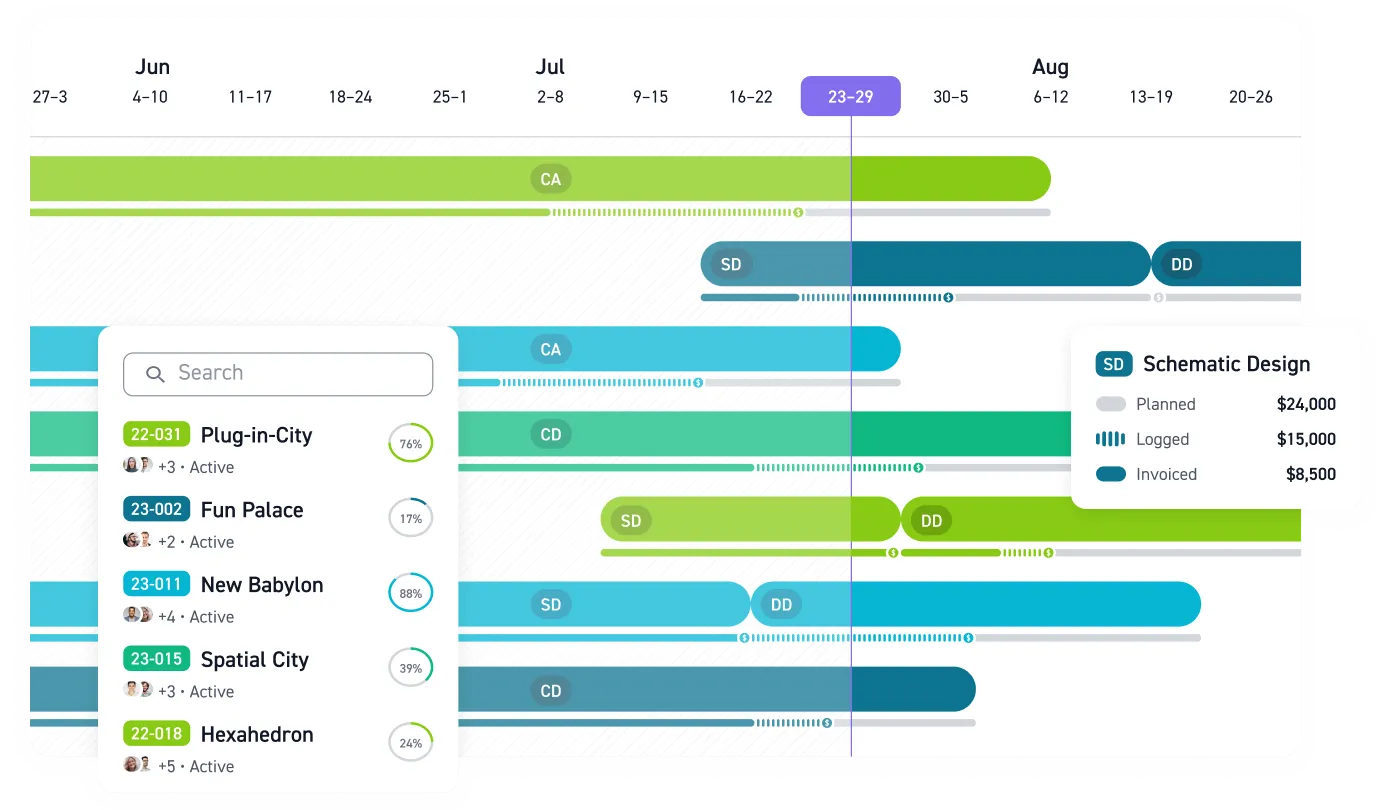
Phase-based resource planning solves this by connecting staffing decisions directly to project phases. Staffing decisions are a direct part of phase budgets, so the hours you assign should instantly update fee burn and capacity views across all projects. Monograph's MoneyGantt™ makes this connection visible, so when you assign hours to schematic design versus construction documents, you see immediately how that decision affects fee burn across your entire portfolio.
The stakes have risen. ACEC's Q3 2026 study found nearly half of engineering firms carrying a year or more of work on hand, median backlog steady at 12 months, and 88% with at least one open position. Reallocating existing capacity beats waiting on a req you cannot fill.
The cadence matters as much as the method. Top-performing A&E project managers recalibrate resources weekly rather than monthly, which keeps schedule changes, paused projects, and pipeline work reflected in the same capacity picture.
Recalibration works better against a benchmark. Median utilization in Monograph's benchmark data sits at 81.9%, with a healthy firm-wide range of 80% to 85%. That firm-wide number hides what matters for staffing: job captains and architects commonly land near 91%, project managers around 88%, and principals closer to 72% once business development comes out of the billable column. One target for every role either burns out the staff delivering work or makes leadership look idle.
Paused projects deserve special attention. Establishing a "paused project protocol" prevents resource availability issues when projects suddenly restart. Define how to handle resource reallocation, budget tracking, and restart procedures before you need them.
Multi-Discipline Coordination That Prevents Expensive Rework
Poor coordination costs money. Rework consumes approximately 12% of project value, and half of all rework stems from poor communication and project information management.
On a $500K project, that's $60K in lost profit. For firms operating on thin margins, uncoordinated design work can eliminate all profitability. But when MEP teams are brought in after architecture progresses through schematic design and structural systems are largely fixed, rework becomes inevitable especially around sleeves, openings, and riser allocations.
Effective multi-discipline coordination requires structured systems:
- Early engagement: Bring all disciplines into coordination during schematic design or earlier, before major design decisions lock in constraints
- Structured milestones: Hold coordination meetings with clash detection at defined completion points (30%, 60%, 90%) rather than ad-hoc reviews
- Clear ownership: Create RACI matrices for system interfaces at project kickoff so teams don't assume someone else is managing conflicts
- Centralized coordination: Use Common Data Environment platforms so design changes approved in one location don't create conflicting model versions elsewhere
Progressive design-build is no longer a niche route. It accounts for roughly one-third of all design-build procurements, and design-build overall is projected to pass 47% of U.S. construction spending by 2028. These collaborative approaches bring construction expertise into design phases, helping identify coordination issues when solutions are least expensive.
Reducing the Administrative Burden
Administrative work quietly eats project team productivity. Research quantifies that inefficient project management wastes 159 hours of engineering time annually. That's nearly an entire month of productive capacity lost per professional. For a 20-person firm, that equals 1.5 full-time employees lost to admin.
The fix is not collecting timesheets less often. It is making entry take seconds. Zweig Group found the gap between target and actual staff chargeability widened to 4.0%, up from 2.9% a year earlier. Daily entry against project phases closes more of that gap than any change to submission frequency.
Automated time tracking takes this further. AI-assisted time capture now ships inside mainstream A&E practice management platforms rather than sitting on a roadmap, and firms using it are capturing 20-30% more billable hours while reducing administrative burden. Every site visit, CAD sprint, and consultant call gets logged automatically.
Real-time visibility also replaces the manual status compilation that consumes roughly 30% of PM capacity. Instead of assembling budget variance and utilization reports by hand each week, project managers open dashboards that already show current project health.
Firms coordinating these approaches have achieved 44% reduction in budget overruns, 50% reduction in invoicing time, and 2.6x faster payment collection, according to Monograph's analysis of managing engineering projects.
Start Managing Engineering Projects With Better Systems
Monthly budget reviews, static spreadsheet planning, and ad-hoc coordination meetings are common because they are familiar, not because they perform. While you are manually compiling budget reports, firms down the street are reading real-time dashboards and catching problems before they become disasters.
Small-to-mid-size A&E firms have inherent advantages in implementing evidence-based approaches. Faster decision-making, closer client relationships, and unified culture mean process changes face less resistance than in larger organizations. Brunton Architects & Engineers, a Minnesota structural, MEP, and architecture firm, cut admin time 25%, doubled billing speed, and reduced budget overage 25% after leaving its legacy practice management system. More results sit in Monograph's customer stories.
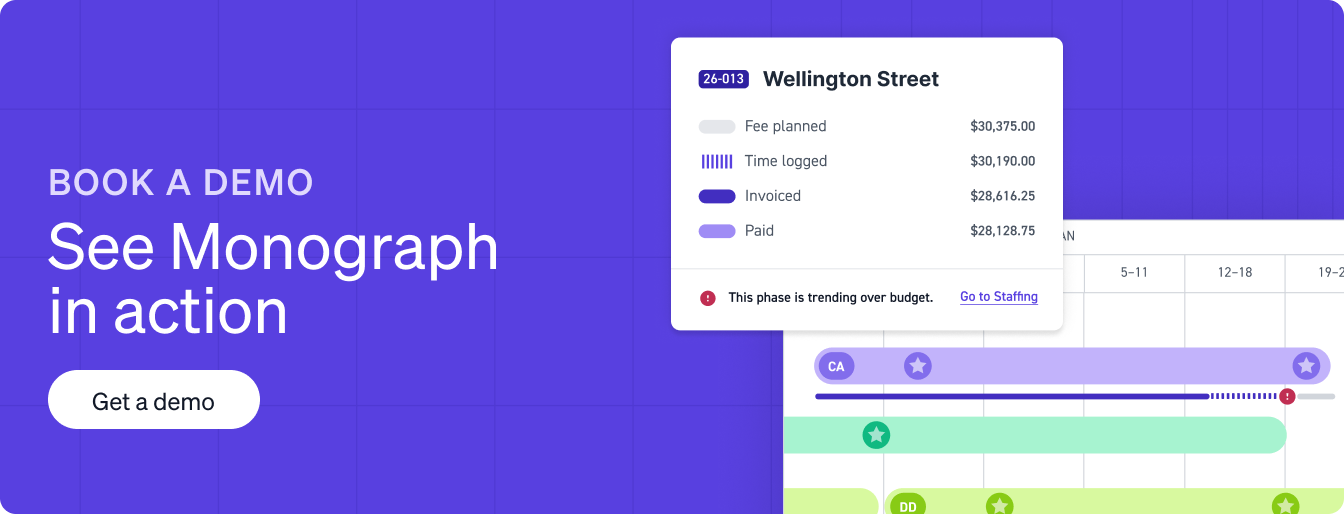
Every week without budget visibility is profit walking out the door. Monograph gives engineering firms one place to plan phases, track time, watch margins, and bill, so problems surface while there is still fee left to protect. Book a demo.
Frequently Asked Questions
How quickly will weekly budget monitoring show results?
Most firms see meaningful improvements within 4-6 weeks. The first few weeks establish baseline patterns. You'll start noticing which projects consistently run hot and which team members underestimate phase budgets. By week six, you'll have enough data to make proactive adjustments rather than reactive scrambles. The 15-25% margin improvements typically materialize within the first full quarter.
What if our firm doesn't have dedicated project managers?
Many small engineering firms operate with principals or senior engineers handling project management alongside technical work. The key is building systems that reduce PM overhead, not increase it. Start with automated dashboards that surface problems without manual compilation. Weekly budget alerts take five minutes to review versus hours of spreadsheet work. The goal is making better decisions faster, not creating another administrative burden.
How do we transition from monthly to weekly reviews without overwhelming the team?
Start with one project type where you have consistent data. Keep the weekly review to 15 minutes. Just review the five key metrics and note any projects requiring action. Don't try to solve problems in the review itself; flag them for separate follow-up. Once the team sees how early warning prevents fire drills, weekly becomes faster than monthly because you're addressing small issues instead of large crises.
What's the first step for firms currently using spreadsheets for everything?
Focus on time tracking first. Accurate time data feeds every other metric: utilization, project profitability, resource allocation, and billing. Get your team logging time daily (even if you only review weekly), then connect that data to project budgets. Once you can see planned versus actual hours in real time, the other improvements become much easier to implement.