
Most engineering firms don't hit a software wall all at once. You start with QuickBooks, add a spreadsheet for project tracking, and bolt on a time-tracking app you reconcile each month. As the team grows, reports take too long, nobody agrees on which project is profitable, and you're deciding on stale numbers.
That's when firm leaders start asking about ERP. This guide covers what an ERP system does, where the financial payoff comes from, and whether it fits your firm.
What ERP Means for an Engineering Firm
ERP stands for enterprise resource planning: connected applications that pull project management, resource planning, time tracking, billing, and financial reporting into one shared database. When someone logs a transaction in one module, every other module reflects it in real time.
For engineering firms, project-based ERP matters most. It's built around the reality that your business runs on projects, not products. The feature that separates a real professional services ERP from generic accounting software is project accounting: tracking costs, revenue, and profitability at the project level.
Here's how ERP differs from the tools most firms use today:
- vs. accounting software: QuickBooks and Xero manage financial activity but require manual intervention to update other business functions.
- vs. standalone project tools: Connecting a PM tool to accounting through a third-party bridge means changes in one system can break the other.
- vs. entry-level tools: QuickBooks and Xero work for smaller teams, but most firms outgrow them once they pass 5 to 10 employees.
One system replaces the disconnected stack. Estimating, scheduling, job costing, and payroll data live in one place.
Where the Financial Payoff Comes From
The financial case for ERP is measurable. Firms on project-based systems generate $231K per project against $140K for firms without one, and run billable utilization of 71.7% versus 66.0%.
The mechanisms are concrete:
- Real-time cost tracking makes every hour and dollar traceable to a project, so overruns surface while you can still fix them.
- Automated revenue recognition ties revenue to time registration instead of manual month-end calculations.
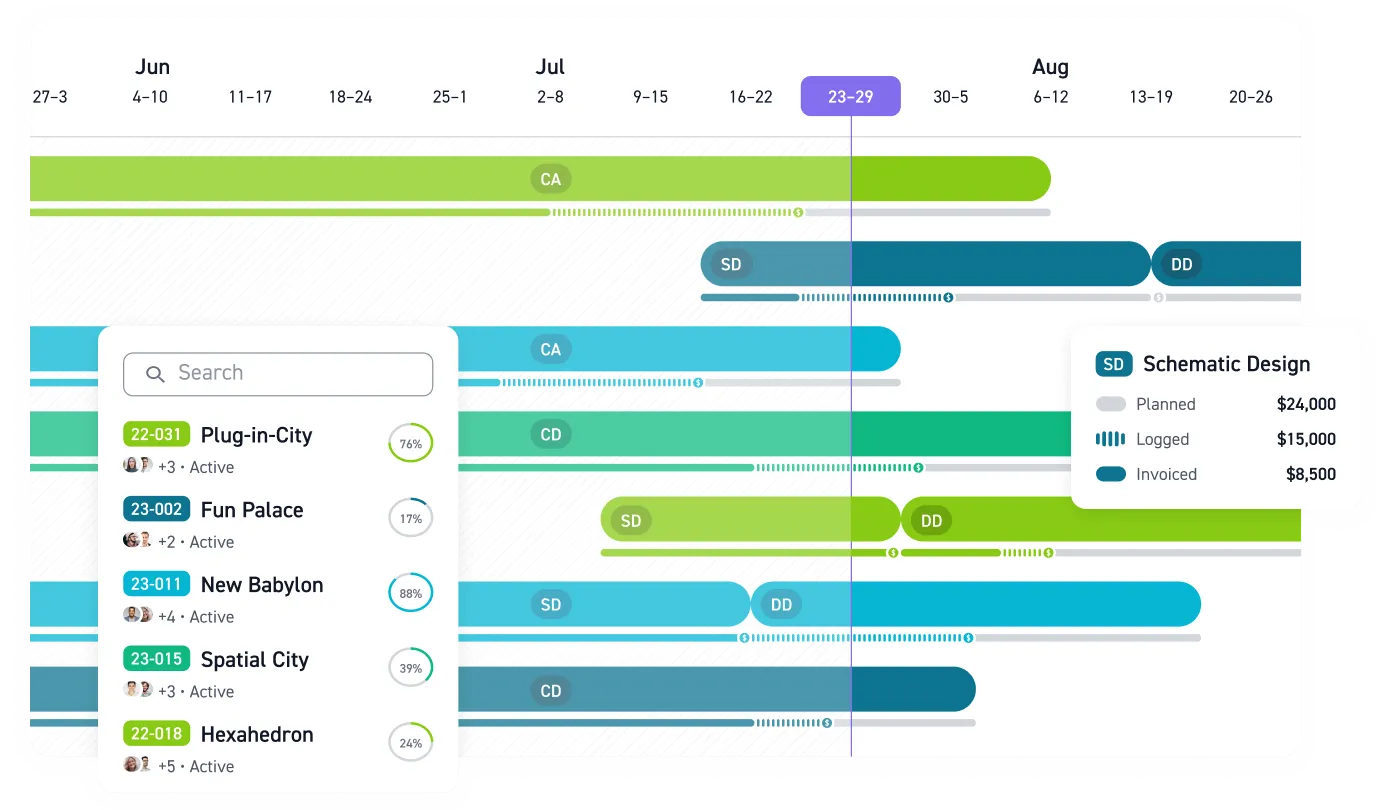
- Connected dashboards let project managers watch fee burn by phase while principals track utilization and WIP.
Emerson Chapelle, a small engineering firm, moved from Excel to Monograph and saw 25% profit growth, 2x gains in efficiency, and double the confidence in their project numbers.
The Problems ERP Is Built to Solve
ERP exists because standalone tools can't handle recurring firm problems.
Cash flow is the sharpest pain. Labor costs eat 60 to 70% of expenses at A&E firms, and it typically takes 80 to 110 days from doing the work to collecting the cash. When invoicing falls behind, the damage is real. One architecture firm forgot to invoice a major client for over six months. The win comes from billing on time and never letting work slip through unbilled.
Delayed reporting is quieter. As firms grow, the gap between what's happening on projects and what leadership can see grows wider. Scope creep works the same way. On fixed-fee contracts, over-servicing clients without billing adjustments chips away at margin, and without phase-level tracking, nobody sees it until the fee is gone.
Then there's the spreadsheet problem. Most business spreadsheets contain at least one data error, and in complex financial workbooks a significant mistake is nearly inevitable. When project financials live in scattered files, you're steering with bad data.
The Modules That Matter Most
Not every ERP capability earns its keep at a small firm. Engineering leaders should insist on these:
- Project accounting with phase-level tracking. Without it, scope creep stays invisible on fixed-fee work, and subconsultant invoices and pass-through billing can't live alongside your prime contract financials.
- Revenue recognition and WIP management. Engineering firms carry T&M, fixed-fee, cost-plus, and retainer contracts, and need auditable recognition compliant with revenue recognition standards.
- Time and expense capture. Time tracking is the foundation of billing, utilization, costing, and revenue recognition. Mobile entry with approvals and a direct flow to project P&L keeps it accurate.
- A&E-specific billing. Your system should handle progress billing, milestones, retainers, and not-to-exceed contracts so invoices match contract billing terms without manual reconciliation.
The strongest systems show fee burn by phase as hours are logged, so principals see budget-to-completion at a glance. Monograph's MoneyGantt™ turns that view into a single visual across a project.
Choosing a System That Fits Your Firm
ERP is no longer only for big firms. For small and midsize firms, the cost and timeline of enterprise platforms often outweigh the benefits, which is where purpose-built A&E platforms like Monograph, BQE Core, and Ajera win. At this size, purpose-built beats general-purpose. Built by architects and engineers for A&E firms, Monograph today serves 13,000+ architects and engineers across 1,800+ firms.
Before evaluating vendors, answer four questions: staff count, active projects, project duration, and whether your firm requires FAR compliance. FAR audits demand compliant overhead rates and specific reporting.
Adoption is the biggest risk. People and change management is the single largest category of recommendations for improving ERP outcomes, and firms that avoided a post-launch productivity drop credited executive commitment above all else.
Small A&E firms can typically go live in 6 to 12 weeks with a cloud platform and minimal customization. Keep configuration lean and get principals bought in early. Firms pulling away from the pack committed to running their business on a single source of truth and stuck with it.
Stop Running Your Engineering Firm on Yesterday's Numbers
Disconnected tools slow every decision. By the time reports are reconciled, the project has already burned more fee, the invoice is already late, and the staffing problem has already turned into a margin problem.
Monograph gives engineering firms one place to track budgets, phases, time, invoices, and profitability. Monograph's MoneyGantt™ shows budget-to-cash progress in real time, so principals, project managers, and operations leaders can see where projects stand before small issues become expensive ones.
Your next overrun is already forming somewhere in the data. Catch it early. Book a demo.
Frequently Asked Questions
When should an engineering firm move from QuickBooks to an ERP system?
Move when project decisions depend on data QuickBooks cannot show without spreadsheets. If you cannot see profitability by phase, utilization, WIP, and fee burn in real time, accounting alone is no longer enough.
Do small engineering firms need a full ERP platform?
Not always. A small structural, MEP, or civil firm usually does not need a heavy enterprise ERP built for much larger teams. A purpose-built A&E practice management platform often fits better.
Will ERP replace our accounting software?
Many firms need project budgets, time, invoices, and profitability connected to their accounting workflow rather than another spreadsheet between project work and financial reporting.
What ERP feature matters most for fixed-fee engineering projects?
Phase-level budget tracking. Fixed-fee work looks profitable until one phase quietly burns through too many hours, and phase tracking gives project managers a chance to adjust before the margin is gone.
What is the biggest risk in ERP implementation?
Adoption. ERP only works if principals, project managers, and staff use it consistently. Start with the workflows that cause the most pain, usually time tracking, project budgets, and invoicing.