

For many engineering firms, ERP sounds like software built for someone else. The term came out of manufacturing, but the need behind it is familiar: utilization, realization, and cash flow all depend on data moving between systems that usually do not talk to each other.
Every firm needs project management tools that share a common data layer. The real question is whether your current tools actually do that.
What ERP Means in an Engineering Context
Across A&E firms, ERP means different things to different people, but the appeal is consistent: fewer disconnected systems and a clearer view of project operations. A&E-focused ERP sources describe these systems as integrated platforms that support project-based operations. Generic enterprise systems from Microsoft, SAP, or Oracle serve manufacturers well but usually need industry-specific customization before they fit A&E workflows.
Engineering firms have operating requirements that generic software often misses. Every dollar earned or spent ties back to a project, phase, and task, with each project treated as an independent financial unit. Each project also carries its own billing schedule, collection cycle, and working capital profile. A purpose-built platform allocates resources efficiently across concurrent work and gives teams phase-level visibility that a retrofitted manufacturing module usually cannot.
The Cost of Disconnected Tools
Most smaller firms run some version of the same patchwork setup. Think of disconnected tools the way you'd think of uncoordinated disciplines on a set of construction documents: the structural drawings do not match the MEP layouts, conflicts stay hidden until they hit the field, and the cost of resolving them grows with every delay.
Common signs of that patchwork look like this:
- Excel for budgets. Budget-vs.-actual visibility lags without manual updates.
- A standalone app for time tracking. Hours are logged apart from project budgets, billing, and utilization.
- QuickBooks for accounting. Project-level financials require manual reconciliation against time and budget data elsewhere.
- Email for everything in between. Scope changes and approvals get trapped in inboxes with no audit trail.
That setup makes small problems harder to spot and more expensive to fix.
Each tool creates its own silo, and the gaps between them are where margin disappears. Direct labor multiplier, utilization, and salary-to-expense ratio compound quickly when process gaps erode them. Every unbilled hour is unrecoverable margin. Dynamic Engineering reported 25% profit growth, 2x efficiency gain, and 2x confidence boost after moving off Excel.
The same pattern shows up at the industry level. The widening chargeability gap reached 4.0% in 2026, up from 2.9% the year before. Firms without real-time tracking are falling further behind their utilization targets.
What to Look For in a Project Management Platform
The largest A&E ERP software review, based on 198 A&E firms, evaluates platforms on two dimensions: whether project managers get the information they need, and whether principals and CFOs receive critical accounting data.
For engineering firms, these capabilities matter most:
- Phase-level budgeting with real-time alerts. On fixed-fee contracts, scope creep stays invisible without phase-level tracking. The system should show fee burn by phase as hours are logged.
- Time tracking tied directly to billing. Time entries disconnected from project budgets and invoicing do not help operations.
- Flexible invoicing across contract types. Engineering firms carry multiple contract types, including T&M, fixed-fee, cost-plus, and retainer, sometimes within the same project.
- Subconsultant management. Subconsultant invoices and pass-through billing need to live in the same system as prime contract financials.
- Role-appropriate reporting. A project manager needs fee burn by phase. A principal needs utilization and WIP. An owner needs cash flow and AR aging.
Connection to your accounting system matters as much as standalone capability. Firms should prioritize documented APIs and test the connection before switching off any existing system.
Where the Industry Is Heading
Two shifts are changing how engineering firms buy project management software. ERP investment is rising: 43% of organizations invested in ERP systems in 2025, up from 35% the year before. At the same time, ERP is moving toward a lighter-weight, modular approach, away from unwieldy platforms that do not fit dynamic project environments.
For smaller engineering firms, that trend usually shows up in a few practical ways:
- Start with project operations first. Firms can focus on budgeting, time, and invoicing before expanding further.
- Keep the accounting system in place. The article already points to platforms that connect to QuickBooks instead of replacing it outright.
- Avoid all-or-nothing rollouts. A modular approach fits firms that have outgrown spreadsheets but do not need a full enterprise suite.
That direction gives smaller firms more room to improve without taking on unnecessary system weight.
Monograph's Approach
Monograph is a cloud-based firm management platform built for architecture and engineering firms. It connects with QuickBooks Online for accounting and covers budgeting, time tracking, and invoicing rather than payroll, HR, or general ledger. Monograph is founder-led and venture-backed, built by former architectural designers rather than assembled from acquired legacy products.
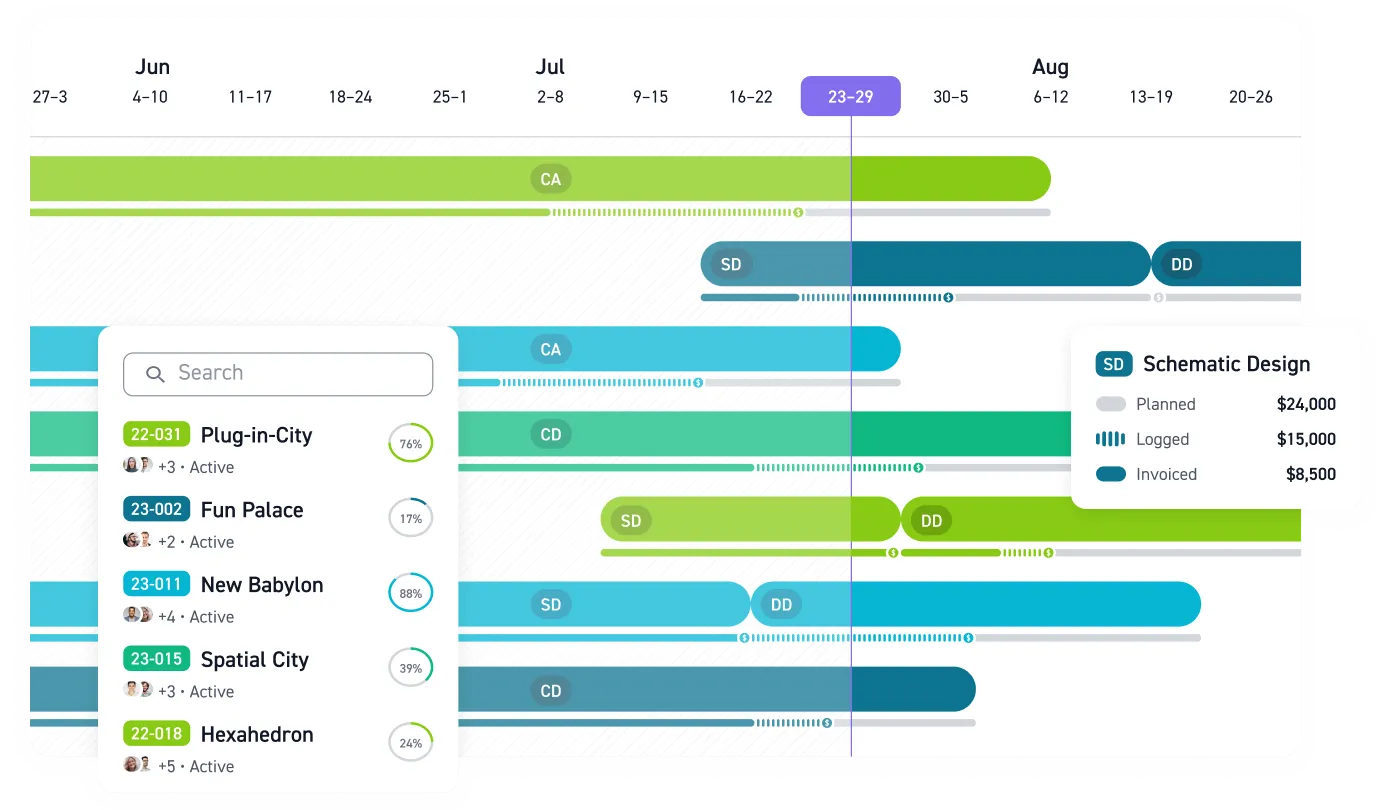
Monograph's MoneyGantt™ shows proportional fee spend relative to project timeline in real time. You can see budget-to-cash progression without building a report, which gives project managers a fast read on whether a project's financial pace matches its schedule.
Core capabilities include:
- Phase-level budgets with support for fixed-fee, hourly, and hybrid contracts, plus real-time budget vs. actual tracking
- Time-to-invoice connection: time entries feed directly into invoices, and staff assignments auto-populate timesheets
- Firm-wide dashboards surfacing utilization, realization, profit, and revenue forecasts for principals and owners
These features keep project managers and firm leaders in the same financial picture.
For project managers tracking concurrent work, Monograph provides phase-level budget vs. actual without routing a request through accounting. Plans start at $25/month per user, with unlimited projects included.
See Where Margin Is Leaking
Most engineering firm leaders already know they need better project financial visibility. The useful next step is to find where your data breaks apart: budgets in Excel, time in a separate app, accounting in QuickBooks, and approvals buried in email. That is where utilization slips, billing slows, and projects that looked healthy come back at break-even.
Monograph connects budgeting, time tracking, invoicing, and reporting in one A&E-focused platform. You can give project managers phase-level visibility, give principals a clearer view of utilization and cash flow, and keep QuickBooks Online in place for accounting. Book a demo.
Frequently Asked Questions
Do small engineering firms really need ERP software?
The better question is whether your current tools give you one connected view of budgets, time, billing, and project performance. Disconnected systems create the same operational problems in smaller firms, with less room for error.
Can we keep QuickBooks and still improve project visibility?
Yes. You can keep your accounting system in place and connect it to a project operations platform built for A&E workflows. Monograph connects with QuickBooks Online for accounting, which helps firms improve project-level visibility without rebuilding accounting from scratch.
What's the difference between generic ERP and an A&E-focused platform?
Generic ERP systems were built around manufacturing-style operations and usually need heavy customization before they fit A&E firms. Engineering firms work by project, phase, and task, with each project carrying its own billing schedule, collection cycle, and working capital profile.
How do we know when spreadsheets are no longer enough?
You know it when budget updates lag, project financials require manual reconciliation, and scope changes live in inboxes instead of a shared system. If hours are tracked in one tool, budgets in another, and billing somewhere else, spreadsheets have stopped being a tool and started becoming a risk.