


Firm management made easy

So many architecture and engineering firms face the same problem: a stack of RFPs to evaluate, respond to, and somehow win while keeping current projects on track. If you're spending more time hunting through project files and chasing down resumes than developing winning strategies, you're not alone.
The A&E industry has moved beyond ad hoc proposal management to organized pursuit workflows. More than 13,000+ architects and engineers across 1,800+ firms are adopting technology solutions to improve their proposal workflows. Advantage is built on improving key processes from proposal to payment, starting with how efficiently you can respond to qualified opportunities.
Why Generic CRM Systems Don't Work for A&E Firms
Most business development software is designed for industries relying on price-based competition and rapid transactional sales cycles. A&E firms operate in a fundamentally different procurement environment. You're navigating Qualifications-Based Selection (QBS) processes. Technical expertise, professional credentials, past project performance, and team composition matter far more than fee proposals.
Unlike typical sales processes, A&E proposals require coordinating multiple disciplines, assembling project-specific teams, and demonstrating relevant experience through detailed past performance documentation. A structural engineer responding to a hospital RFP needs different capabilities than a software salesperson tracking leads.
While other industries talk about "RFP management," successful A&E firms use "pursuit management" or "business development technology." This language reflects the relationship-driven nature of winning A&E work. Effective proposal development requires studying each RFP to determine important themes, not just assembling standard responses.
Essential Capabilities for Small-to-Mid-Size A&E Firms
When evaluating pursuit management software, focus on eight essential capabilities that directly impact your ability to respond quickly and win more work:
- QBS-specific CRM tracking: Your CRM should track opportunities through QBS-specific stages, not generic sales funnels. This means managing the qualifications phase separately from fee proposals. Requests for Qualifications (RFQs) emphasize firm and team experience with limited financial information. Full RFPs include cost and fee estimates.
- Staff qualifications management: The system should maintain current professional registrations by state, track continuing education requirements, and support quick team assembly based on project requirements. When a transportation RFP requires a PE with bridge experience and LEED AP certification, you need filtering capabilities that go beyond typical HR databases.
- SF330 form capabilities: Federal and state work requires SF330 form capabilities with automated population from your staff and project databases. The current form requires two distinct parts: Part I covers firm qualifications and Part II covers project-specific team requirements.
- Project experience libraries: You need searchable project descriptions with strong organizational capabilities, high-resolution photography with metadata tagging, and quick export capabilities for different proposal formats. Past projects should be findable and formatted for relevant RFPs in minutes, not hours.
- Collaborative workflow management: Principals approve strategy and review finals. Project managers draft technical approaches. Multiple discipline leads contribute specialized sections. Marketing coordinators handle document assembly. The system should support simultaneous contributions with clear version control and review chains appropriate for technical professionals who travel frequently.
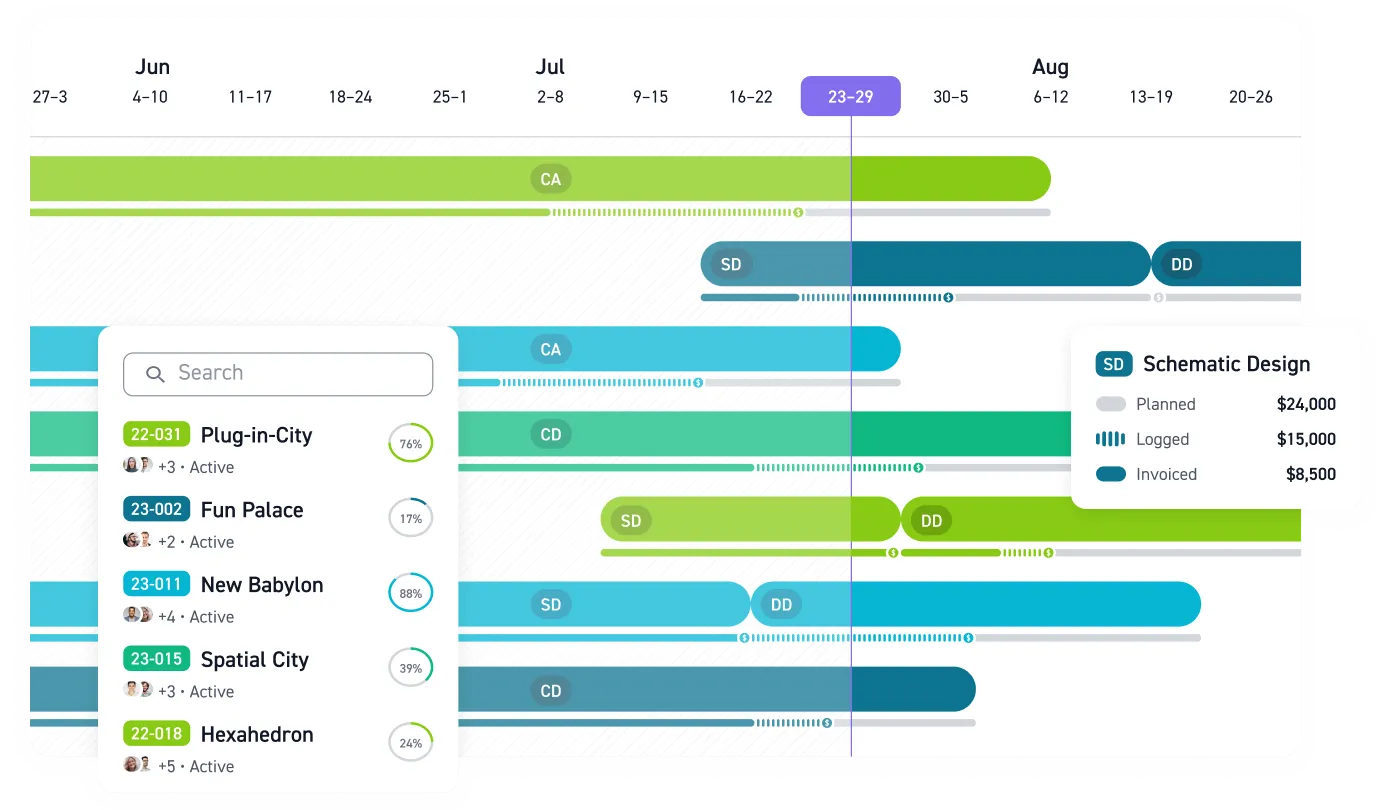
- Integration with project systems: Your pursuit management capabilities should connect seamlessly with project management systems and financial systems to provide real-time visibility across the firm. Monograph's MoneyGantt™ provides instant visual intelligence into budget-to-cash progression for ongoing projects, showing exactly which work is on track without complex spreadsheet analysis. This same clarity helps identify which team members have capacity for proposal development and which projects demonstrate relevant experience for new pursuits.
- Mobile access: Industry research shows reliable mobile access is critical for proposal approvals, quick access to project portfolios, and reviewing team availability data from phones and tablets.
- Data-driven metrics: By connecting proposal data with project management and financial systems, firms gain visibility into staff capacity planning, proposal performance metrics, and the profitability impact of pursuit investments.
Integration Requirements for Better Operations
Disconnected proposal systems prevent the real-time visibility that A&E firms need to work smarter. Real-time data around projects or firm performance isn't possible unless projects, time tracking, and invoicing are all linked together seamlessly.
Small A&E firms should prioritize tools that work with existing project management and accounting systems rather than creating isolated data silos. For firms of 5-50 employees especially, single-system connection is critical because they cannot afford disconnected systems requiring duplicate data entry or dedicated administrators.
The connection supports smarter business development decisions. Instead of making pursuit decisions based on assumptions, firms can track which team members are available for proposal development, measure historical win rates by project type and client sector, and analyze how proposal effort correlates with successful outcomes.
Implementation Strategy for A&E Firms
Getting your team to adopt new software isn't about training. It's about showing them how it makes their daily work easier.
Successful adoption requires addressing three critical dimensions: the why, the how, and the what. Frame pursuit management software as supporting creativity by reducing administrative burden and freeing professionals to focus on proposal development and client relationships.
Start with basic strategy questions before software selection. Software should support important activities, not replace them with automated document assembly. Secure principal engagement early in the evaluation process. In firms of 5-50 people, principals play a critical role in technology adoption success.
Phase implementation by starting with a single proposal type or project category before firm-wide deployment. This builds confidence, identifies workflow issues, and creates internal champions who understand the benefits.
Plan for contextual training that addresses A&E-specific requirements rather than generic software features. Your team needs to understand how the system supports Qualifications-Based Selection processes, project approach narratives, team qualifications documentation, professional licensure tracking by discipline, Federal SF330 management, and past performance references.
Making the Business Case for Investment
The financial impact of better pursuit management extends beyond proposal efficiency. Even modest improvements in win rates deliver substantial business impact for architecture and engineering practices.
Consider a 15-person firm responding to 36 qualified opportunities annually. Industry data shows A&E firms are currently winning just 50% of the bids they pursue on average. Improving that baseline 50% win rate to 54% means winning two additional projects per year. For typical project values, those two additional wins could represent $200,000 to $500,000 in additional revenue.
More efficient proposal processes directly improve how you allocate capacity. Brunton Architects & Engineers, an 18-person Minnesota firm, reduced time spent on administrative tasks by 25% and accelerated their billing process by 2x after implementing connected practice management that linked their team qualifications with project workflows.
Rather than viewing pursuit management software as an additional expense, position it as essential infrastructure for business development. The firms that thrive aren't necessarily the ones with the best design ideas. They're the ones with the best systems for winning the work that lets them implement those ideas.
Stop Losing Bids You Should Be Winning
It's Thursday at 4 PM. Your structural engineering firm just received an RFP for a hospital addition. This is exactly the project type you excel at. Deadline is Monday.
You need to pull together team qualifications, past project experience, and consultant coordination plans while your project managers are at three different job sites. You open the shared drive to find resume files scattered across folders labeled "2022," "Joe's Drafts," and "USE THIS ONE MAYBE." The bridge project that proves your capability is documented somewhere between email threads and an archived folder structure nobody's touched since 2019.
Meanwhile, the 12-person firm across town already has their response drafted. They clicked three buttons, filtered their staff database for "PE + hospital experience," exported formatted project sheets, and assembled a qualification package while you were still hunting for the right resume version.
You've lost bids like this before. Not because your technical work isn't excellent. You lose because you can't coordinate the proposal fast enough to show clients what you're capable of delivering.
Engineering firms using connected practice management cut proposal coordination time in half. When your pursuit activities connect with project delivery and team management, you see exactly who's available, which projects demonstrate relevant experience, and what qualifications you can field.
See how Monograph helps 1,800+ A&E firms coordinate proposals in half the time and win more work.
Frequently Asked Questions
Do we really need pursuit management software for a 15-person firm?
Firm size matters less than how many qualified opportunities you chase annually and how painful coordination becomes. If you're tracking 20+ proposals across email threads and shared drives, you're bleeding time that directly cuts into win rates. The question isn't whether you're big enough. It's whether you're tired of losing bids because your team can't coordinate fast enough.
How long before we start seeing results?
You'll feel the difference in your first proposal cycle, usually 2-4 weeks after setup. Most firms report faster coordination within the first month because they stop hunting through files and start pulling qualified teams together in minutes. Measurable win rate improvements typically show up within the first quarter once you've run enough proposals through the system to establish patterns. Start with one high-volume proposal type to build confidence, then expand to other pursuit categories as your team gets comfortable.
Will pursuit management software connect with our existing QuickBooks and project management tools?
Most modern platforms offer connections, but the depth varies considerably. You want information flowing automatically between systems. Won opportunities should populate project setup without re-entering data, and team utilization should inform who's available for the next proposal without opening three different dashboards. Look for platforms that handle the actual data movement rather than just claiming they "work with" your existing tools.
How do we convince our team to adopt new pursuit workflows when everyone's already stretched thin?
Show them how it cuts their admin work in half. That's what gets buy-in. When your project managers see they can assemble team qualifications in ten minutes instead of three hours, they'll use it. The trick is getting principals to visibly embrace the system alongside their teams. Firms that connect the tool to measurable outcomes like faster responses, higher win rates, and freed-up capacity see adoption rates that actually stick. Nobody wants another admin system. They want their evenings back