



Firm management made easy

If you're managing multiple design projects while juggling client reviews, consultant coordination, and team capacity, you already know the chaos. Tracking everything across disconnected spreadsheets creates that chaos. Kanban project management offers a visual alternative that helps architecture and engineering teams see their entire workload at a glance and stop starting new work before finishing what's already on their plates.
Originally developed in manufacturing, Kanban has influenced design and coordination practices in construction. The IGLC has explicitly documented the development and use of digital Kanban boards in architectural design and pre-construction processes through several prototypes and case studies. Yet widespread adoption remains limited. As one experienced architect noted in a case study, while Lean benefits during construction are well established, architects rarely apply these principles to design. That's your advantage.
How Kanban Works for Design Teams
At its core, Kanban is a visual workflow management system. The Lean Construction Institute describes kanban as "a Japanese term meaning 'a signboard' … a communication tool used in JIT production systems," noting that it increases efficiency by allowing team members to visualize the workflow on a board. For design teams, this means tracking deliverables by phase (Schematic Design, Design Development, Construction Documents), monitoring interdisciplinary review cycles, and coordinating client approvals in one place.
The system operates on foundational principles that work for A&E workflows. First, you visualize all active work so nothing hides in someone's inbox. Second, you limit work-in-progress to prevent the productivity drain of constant task-switching. Third, you manage flow by identifying and removing bottlenecks before they derail your schedule.
PMI notes that Kanban boards help teams understand what has been completed, what hasn't started, and what's currently in progress. That visibility matters when you're coordinating MEP engineers, structural consultants, and interior designers across multiple active projects.
Building Your Board: Column Structures That Work
Generic Kanban boards use columns like "To Do," "In Progress," and "Done." That's fine for simple task management, but A&E projects need structures reflecting how design work actually moves through your firm. We've seen firms succeed by adapting their boards to match their actual workflow rather than forcing generic templates.
KanbanZone's analysis recommends a five-column structure for AEC project management:
- Backlog: Projects or tasks awaiting assignment
- To Do: Work scheduled for execution
- In Progress: Active design and production work
- Ready to Review (QA/QC): Work completed and ready for quality assurance
- Done: Completed and approved work
The dedicated QA/QC column addresses interdisciplinary coordination and regulatory compliance requirements. These elements are essential for A&E work.
Alternatively, firms preferring alignment with traditional delivery frameworks can structure boards using industry-standard phases. These include Schematic Design (SD), Design Development (DD), Construction Documents (CD), Construction Administration (CA), and Complete.
Setting Work-in-Progress Limits
Here's where Kanban directly addresses one of the most common challenges in A&E firms. Starting work on every incoming project immediately leads to excessive multitasking and reduced productivity across all active work.
Architecture firms implementing Kanban have established project limits of three projects per team or individual. This WIP limitation forces teams to complete work before accepting new assignments. The Project Management Institute confirms this practice prevents overload and maintains sustainable flow.
For design work specifically, WIP limits need calibration beyond simple task counts. Consider these factors:
- Cognitive load differences between schematic design and construction documents phases
- Context-switching penalties between creative design and technical documentation
- Coordination overhead when managing interdisciplinary consultant inputs
A mechanical engineer working on HVAC system design needs different WIP limits than during equipment specification phases. Set limits per designer or discipline team based on actual mental demands, not arbitrary task counts.
The Lean Construction Institute emphasizes that managing flow means identifying handoffs that traditionally create delays. These include interdisciplinary coordination, client decision-making cycles, permit authority reviews, and external consultant deliverables. Your board should make these bottlenecks visible so you can address them proactively.
Handling Paused Projects
Any A&E firm knows the reality. Projects pause constantly. Client funding stalls. Permits get delayed. Scope changes require re-negotiation.
KanbanZone notes that the visual nature of Kanban boards makes it easy to identify bottlenecks early. This is critical when managing concurrent projects where pauses frequently occur. The key is handling paused work without cluttering your active workflow view.
Effective strategies include creating a dedicated "On Hold" column separate from active workflow, using visual indicators (color coding, labels) to distinguish pause reasons, and excluding paused projects from WIP limit calculations. This prevents artificial constraints on active work while keeping paused items visible.
Where Kanban Fits Against Traditional Methods
Kanban isn't a replacement for Critical Path Method scheduling or phase-based project delivery. ASCE guidance emphasizes that selecting the right delivery method means understanding available approaches and matching them to project requirements.
A&E firms work under contractual frameworks that reference traditional phase structures as industry best practices, but these phase structures are not generally required by regulation or professional liability rules. A 2024 literature review confirms Kanban's applicability to construction, but implementation must work within existing legal and professional structures.
The practical approach involves using both methods together. Use CPM for overall project scheduling and critical path analysis, particularly for regulatory milestones, while applying Kanban principles for day-to-day workflow management within design phases. Major firms have adopted this hybrid approach. ARUP has successfully applied Agile methodologies in building design projects, while SSOE uses Kanban to visualize workflow across teams throughout the company. Workshop/APD, a 50-person New York firm, implemented this hybrid workflow management strategy after moving from BigTime, achieving 50% profit growth and 50% efficiency gains by combining visual workflow management with their existing project delivery frameworks.
Getting Started Without Disrupting Everything
Start by mapping your current design workflow states and making all active projects visible. Establish initial WIP limits based on observed capacity, then implement pull signals for interdisciplinary handoffs. Downstream disciplines pull work when they have capacity rather than having work pushed onto overloaded teams.
The integration of visual Kanban workflow management with resource planning provides essential portfolio-level visibility. Monograph's guide on managing multiple projects notes that staffing decisions should connect directly to phase budgets, helping reduce the spreadsheet gymnastics that consume project managers' time. The firms that thrive with Kanban commit to continuous improvement and adjust based on what actually works. This means training, organizational commitment, and hands-on guidance. Don't do it alone.
Stop Starting. Start Finishing.
You've mapped the workflow. You understand WIP limits. You know Kanban complements your existing CPM schedules instead of replacing them.
But visual boards mean nothing without real-time data feeding them. You still need to know which projects are bleeding budget before they spiral. You need to see which team members are overloaded across three active phases. You need to understand when consultant deliverables will actually arrive.
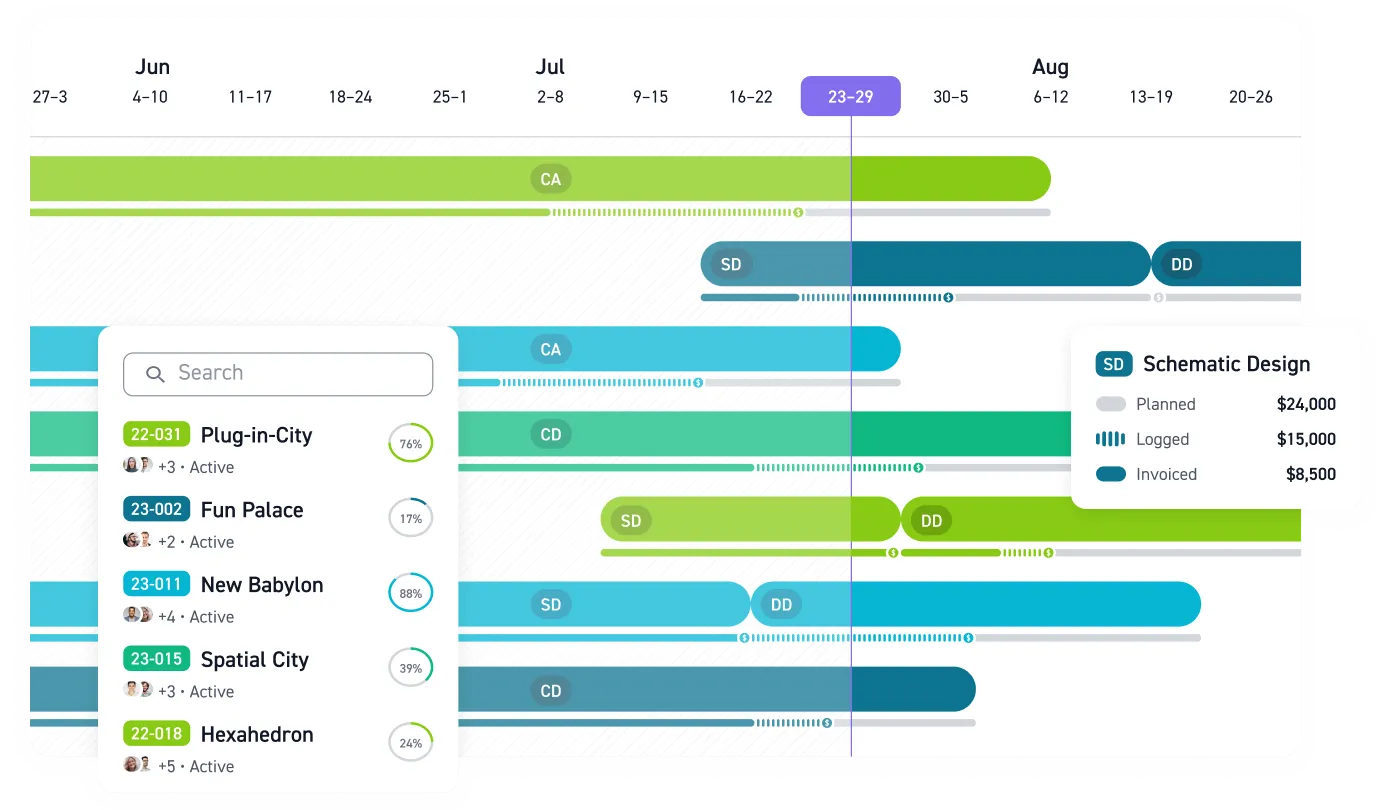
That's where Kanban principles meet practice management reality. Monograph connects visual workflow management with the budget tracking, capacity planning, and phase-based resource allocation that A&E firms actually need. Monograph's signature MoneyGantt™ makes budget-to-cash visibility easier by combining traditional timelines with budget-to-cash progression. It shows planned hours, logged hours, invoiced amounts, and paid fees in one visual timeline. This kind of integrated visibility helps firms like Workshop/APD and Workbench stop starting new work and start finishing what matters.
Integrated practice management connects visual workflow clarity with time tracking, resource planning based on actual capacity data, and project monitoring that flags potential issues early. When you combine Kanban's visual principles with comprehensive project data, you gain clarity that generic boards can't provide.
Firms that are using integrated workflow and capacity planning have faster turnarounds and higher margins. Stop starting. Start finishing. Book a demo.
Frequently Asked Questions
Will Kanban disrupt our existing CPM schedules and client deliverables?
No. Kanban complements your Critical Path Method scheduling rather than replacing it. Use CPM for overall project timelines, regulatory milestones, and client-facing schedules. Apply Kanban principles internally for day-to-day workflow management within design phases.
Major firms have successfully implemented this hybrid approach. They maintain traditional project delivery frameworks while using Kanban to manage team workflow and capacity. Your clients still receive familiar phase-based deliverables. Your team gains visual clarity into work distribution.
How long does it take to implement Kanban in an A&E firm?
Start small and build momentum. Map your current workflow and create a simple board structure in one afternoon. Pilot it with a single project type or discipline team for 2-4 weeks while maintaining your existing systems.
Gather feedback, adjust column structures and WIP limits based on actual experience, then gradually expand to additional project types. Firms typically see initial workflow improvements within the first month. Full adoption across all projects typically takes 3-6 months as teams adjust to pull-based work assignment and visual capacity management.
Do we need special software for Kanban, or can we use our existing tools?
You can start with physical boards, whiteboards, or even sticky notes to test the concept. Many firms begin with free tools like Trello or Asana to digitize their boards. However, isolated Kanban boards quickly become another disconnected system.
You'll still need to manually connect workflow visibility to budget tracking, time entry, and capacity planning. The firms seeing measurable results combine Kanban principles with integrated practice management that connects workflow visualization to actual project data, phase budgets, and team utilization.
What if our team resists changing from familiar project management methods?
Start by acknowledging that Kanban adds visibility without forcing wholesale process changes. Frame it as "making our current work visible" rather than "changing how we work." Involve team members in designing the board structure. They'll own it if they build it.
Start with volunteers who are frustrated by current tracking methods. Let early adopters demonstrate time savings and reduced chaos to skeptical colleagues. Most resistance dissolves when people realize Kanban finishes work faster rather than adding administrative burden.
How do we explain Kanban workflow changes to clients who expect traditional phase reporting?
You don't need to. Kanban is an internal workflow management tool that helps you deliver traditional phase-based work more efficiently. Clients still receive Schematic Design, Design Development, and Construction Document deliverables on familiar schedules. They still see CPM timelines and phase-based invoicing.
What changes is internal coordination. Your team stops starting everything simultaneously and focuses on completing phases before moving forward. If anything, clients benefit from more predictable delivery and fewer deadline surprises because your team has better visibility into capacity and bottlenecks.