


Firm management made easy

Most A&E firms manage projects the same way they did twenty years ago. They juggle multiple spreadsheets, chase consultants for updates, and wonder why project coordination takes longer than the actual design work. If this sounds familiar, you're not alone. A recent survey showed that half of A&E firms don't provide training to their project managers, and 76% rely on on-the-job training for project management development.
The good news? Architecture and engineering firms are discovering that agile project management methodologies like Kanban and Scrum can transform how they coordinate complex, multi-disciplinary projects.
Understanding Kanban and Scrum in A&E Context
Both Kanban and Scrum originated in software development, but they've been successfully adapted for building design and construction projects. Kanban helps maintain smooth flow by limiting work in progress (WIP), preventing overcommitment, and is adaptable for visualizing, organizing, and completing work, although these points are summarized rather than stated verbatim.
Think of Kanban as a visual workflow system that shows every project task on a board, moving from "To Do" through "In Progress" to "Complete." For A&E firms, this means tracking everything from initial client meetings through permit approvals to final construction administration, all visible at a glance. The core principle is that limiting work in progress prevents your team from being stretched across too many tasks simultaneously.
Scrum, on the other hand, breaks projects into fixed time periods called "sprints," which are typically two to four weeks. During these sprints your team commits to completing specific deliverables. Each sprint ends with a review meeting where you assess what worked, what didn't, and what to adjust for the next sprint. For architectural firms, a sprint might cover schematic design development, while engineering teams might focus on completing structural calculations for a specific building section.
The fundamental difference? Kanban emphasizes continuous flow and flexibility, while Scrum provides structured time-boxed iterations with defined roles and ceremonies. Your choice depends on how your firm actually operates.
When Kanban Works Best for A&E Firms
Kanban excels when your firm handles multiple projects simultaneously with varying timelines and unpredictable client demands. If your typical week involves juggling permit reviews, consultant coordination, and client revisions across five different projects, all with different deadlines, Kanban's flexibility makes sense.
Consider a 15-person architecture firm managing eight active projects. Some projects are in schematic design, others in construction documentation, and a few in construction administration. Client priorities shift weekly, consultants submit deliverables on their own schedules, and permitting authorities have unpredictable review times. Kanban lets you visualize all this work, identify bottlenecks when too many projects pile up in "waiting for client approval," and rebalance team assignments without disrupting ongoing work.
The visual board becomes your single source of truth. When a structural engineer asks about that hospital project's status, you see immediately that it's waiting for the MEP consultant's drawings. When a client calls about permit status, the board shows exactly where that submission stands. No more hunting through email threads or checking three different spreadsheets.
Kanban particularly suits firms with high project volume and shorter deliverables. Think engineering consultants managing 20-30 active projects where tasks move quickly through defined stages. The methodology prevents overcommitment by limiting work in progress, forcing honest conversations about capacity before accepting new work.
When Scrum Makes More Sense
Scrum works better for larger, more complex projects where your team needs focused collaboration over extended periods. If you're managing a multi-million dollar hospital project with dedicated team members working full-time for 18 months, Scrum's structured approach can help maintain momentum and accountability.
The sprint structure creates natural checkpoints. Every two weeks, your team commits to specific deliverables: completing the third-floor mechanical layouts, finishing the structural analysis for the west wing, or finalizing the rendering package for the client presentation. At sprint's end, you review progress together, identify obstacles, and plan the next two weeks.
Scrum's defined roles also help clarify responsibilities. The Product Owner, often the project architect or principal engineer, prioritizes work and makes decisions about scope. The Scrum Master, typically a project manager, removes obstacles and facilitates communication. The Development Team (your architects, engineers, and technicians) executes the work without external interruptions during the sprint.
This structure prevents the constant context-switching that kills productivity. When your structural engineer commits to two weeks of foundation design work, they're not pulled into three other projects or interrupted for "quick" client questions. The sprint boundary protects their focus.
Firms using Scrum report better collaboration between disciplines. When architects, structural engineers, and MEP consultants all work in synchronized sprints, coordination happens naturally through shared sprint reviews rather than through scattered emails and phone calls.
Hybrid Approaches for A&E Reality
Many successful A&E firms don't choose purely Kanban or purely Scrum. They adapt elements from both methodologies to match their actual workflow reality.
A common hybrid: Use Kanban for project intake and initial phases where work flows continuously, then switch to Scrum for major design phases requiring focused collaboration. Your business development and schematic design work flows through a Kanban board, but once a project enters design development, that team works in two-week Scrum sprints.
Another approach: Apply Kanban at the firm level to visualize all projects and resources, while individual project teams use Scrum internally for their work. The firm's operations manager sees every project moving through stages on the master Kanban board, but the hospital project team runs daily stand-ups and two-week sprints for their detailed work.
Some firms use Scrum's ceremonies (daily stand-ups, sprint reviews, retrospectives) without the rigid sprint commitment structure. They keep Kanban's visual workflow and flexibility while adding Scrum's communication rituals. A 10-minute daily stand-up where each team member shares what they're working on, what's blocking them, and what they need help with can dramatically improve coordination regardless of which methodology you choose.
The key is matching the methodology to your actual constraints. If your clients demand immediate revisions and your consultants submit work unpredictably, forcing everything into two-week sprint commitments creates frustration. If your team struggles with focus and accountability, Kanban's flexibility might enable too much multitasking.
Implementation Steps for A&E Firms
Start small rather than overhauling your entire practice management overnight. Pick one project or one project phase as your pilot. Choose something complex enough to reveal real coordination challenges but not so critical that experimentation creates unacceptable risk.
For Kanban implementation, begin by mapping your actual workflow stages. Most A&E firms need more columns than just "To Do, Doing, Done." Try: Backlog, Ready to Start, In Progress, Waiting for Review, Waiting for Client, Waiting for Consultants, Complete. These waiting states reveal where work actually gets stuck.
Create your board (physical or digital) and put every task on it. For the first week, just move tasks as work happens without changing anything about how you work. This baseline reveals your current state: where tasks pile up, how long each stage actually takes, and where communication breaks down.
After observing for a week, set work-in-progress limits. If you have three architects, don't allow more than six tasks in "In Progress" simultaneously. When someone finishes a task, they pull the next highest-priority item from "Ready to Start." This simple constraint forces prioritization conversations and prevents the scattered multitasking that makes everything take longer.
For Scrum implementation, start with sprint planning. Gather your team and define what "done" means for each deliverable. Not just "drawings complete" but "drawings complete, reviewed, coordinated with consultants, and ready for client review." This clarity prevents the endless "90% done" projects that never quite finish.
Commit to a realistic amount of work for your first sprint. Most teams overcommit initially. If you're uncertain, commit to less. You can always pull additional work into the sprint if you finish early, but failing to complete committed work damages team confidence.
Hold a 15-minute daily stand-up at the same time every day. Each person answers three questions: What did I complete yesterday? What will I work on today? What's blocking me? Keep it brief and focused on coordination, not detailed technical discussions.
End each sprint with a review and retrospective. Show completed work to stakeholders, then discuss what worked and what needs adjustment. These reflection moments drive continuous improvement.
Common A&E-Specific Pitfalls
The biggest mistake A&E firms make with agile methodologies is treating them as rigid rules rather than adaptable frameworks. You don't need Scrum's full ceremony structure if simplified versions work better for your team. You don't need Kanban's specific work-in-progress calculations if simpler limits achieve the same focus.
Another pitfall: Implementing the methodology only for internal work while leaving client communication and consultant coordination unchanged. If your team works in focused two-week sprints but clients still expect immediate responses to random questions, the sprint structure provides no actual focus. Set boundaries: "We review all client questions during our Tuesday sprint planning and respond by Wednesday."
A&E firms also struggle with the visual transparency these methodologies require. If your board shows that three projects are stuck waiting for principal review, that visibility can feel uncomfortable. But that discomfort is the point. It forces addressing bottlenecks rather than letting them remain invisible.
Many firms try implementing agile methodologies while keeping all their existing meetings, reporting requirements, and approval processes. The result: all the overhead of the new system plus all the overhead of the old system. Be willing to eliminate redundant status meetings if the daily stand-up covers the same ground. Stop creating weekly project reports if your Kanban board shows real-time status.
Finally, don't confuse the methodology with the tools. You don't need expensive project management software to implement Kanban or Scrum. A physical board with sticky notes works fine for small teams. Digital tools like Monograph help when you need to coordinate remote team members or integrate workflow visibility with budget tracking and billing, but the methodology matters more than the tools.
Measuring Success in A&E Context
Track metrics that matter for architectural and engineering work, not generic agile metrics borrowed from software development. Velocity and story points mean nothing for design projects.
Instead, measure cycle time: how long tasks actually take from start to completion. If permit review consistently takes 23 days instead of your planned 10 days, you can plan more realistic project schedules. If schematic design revisions average 5 days but you're telling clients 2 days, you're creating unnecessary stress.
Track work-in-progress per person. If your senior project architect has 12 active tasks across 6 different projects, that explains why nothing completes quickly. Reducing that to 4-5 active tasks might feel uncomfortable initially but will increase actual throughput.
Measure blocked work: how many tasks sit waiting for someone else? If 30% of your work is perpetually waiting for client approvals or consultant deliverables, you need better strategies for managing dependencies or setting expectations.
For Scrum teams, track sprint completion rates. If you consistently complete only 60% of committed work, either you're overcommitting or your estimates are unrealistic. Adjust sprint planning accordingly rather than just accepting partial completion as normal.
Most importantly, measure outcomes that matter for A&E firms: project profitability, on-time delivery rates, client satisfaction, and team utilization. If your new methodology improves coordination but projects still lose money or miss deadlines, something's not working.
Make Project Coordination Effortless
Whether you choose Kanban, Scrum, or a hybrid approach, the methodology only works if your team can actually see project status, track time accurately, and coordinate work without constant status meetings.
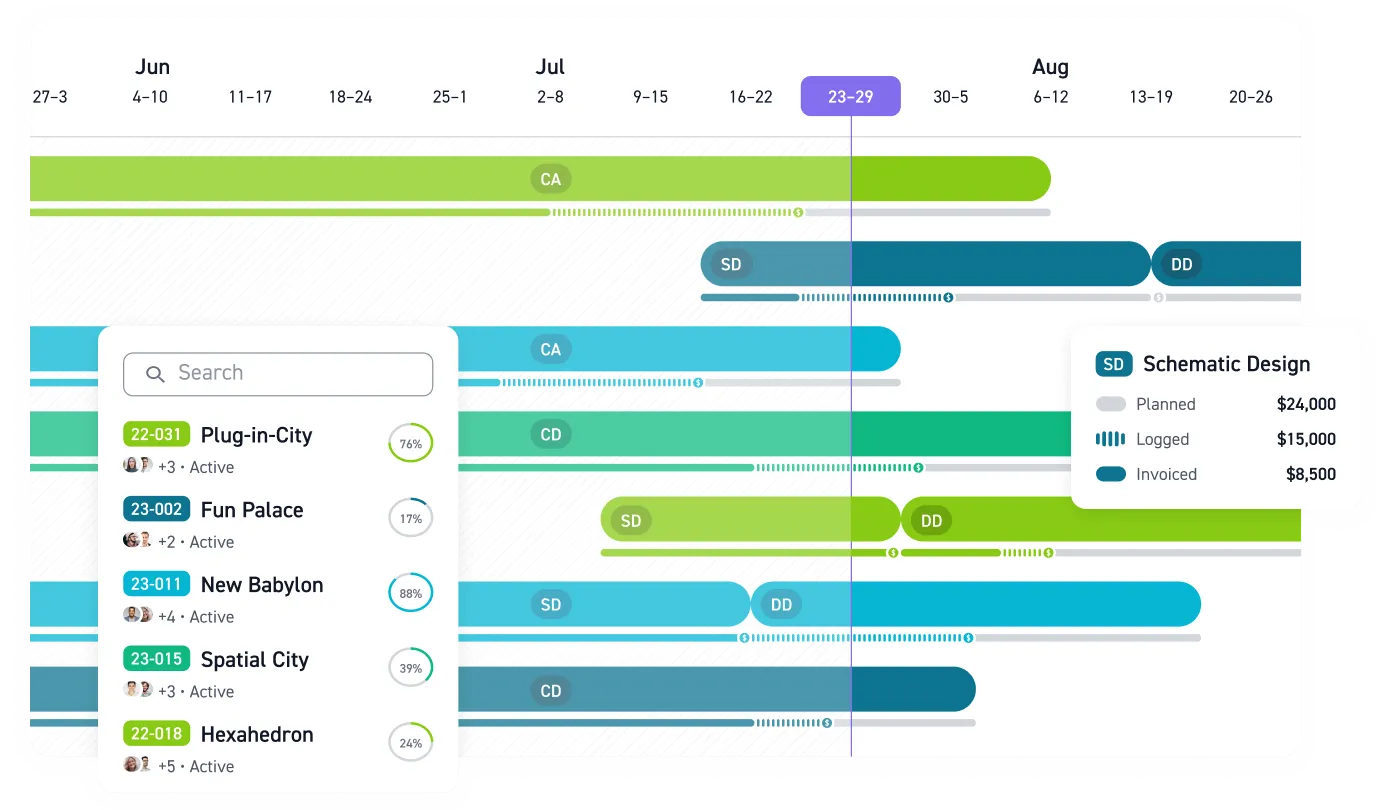
Monograph gives A&E firms the clarity they need to make agile methodologies work. Monograph's signature MoneyGantt™ feature provides instant visual intelligence into budget-to-cash progression, combining traditional timeline tracking with financial performance in one view. See real-time project status across all your work without hunting through spreadsheets. Track time seamlessly with automated staffing plans that flow into timesheets. Coordinate consultants through integrated workflows that eliminate email chaos.
Over 13,000 architects and engineers across 1,800+ firms use Monograph to work smarter and faster. Woodhull, a firm using Monograph, saved 66% of time on administrative tasks and reduced billing cycles by 50%. This is the kind of efficiency that lets agile methodologies deliver their full potential.
Stop managing projects through scattered systems. Book a demo.
Frequently Asked Questions
Can agile methodologies really work for long-duration A&E projects that take 12-18 months?
Yes, but you need to adapt the approach. Break long projects into meaningful phases that align with actual design stages: schematic design, design development, construction documentation. Treat each phase as a separate sprint cycle or Kanban workflow segment. The key is maintaining visibility and coordination across the full project timeline while staying focused on current deliverables. Many A&E firms successfully use two-week sprints within each major phase, reviewing progress regularly while keeping the overall project timeline visible.
How do we handle client-driven changes and scope creep with structured methodologies?
Build a clear change request process into your methodology from the start. In Scrum, changes go into the backlog for the next sprint rather than interrupting current work. In Kanban, create a separate "Change Requests" column where proposed changes wait for review before entering the main workflow. The visual board makes scope changes visible to everyone, supporting conversations about timeline and budget impacts before committing to additional work.
What if consultants and contractors won't participate in our agile processes?
You don't need external partners to adopt your full methodology, just establish clear communication touchpoints. Schedule consultant coordination meetings that align with your sprint reviews or weekly planning sessions. Share relevant portions of your Kanban board showing work that depends on consultant deliverables. Most consultants appreciate clearer visibility into when you need their work and how delays impact your timeline, even if they don't adopt Kanban or Scrum internally.
Should we implement the same methodology across all projects or customize by project type?
Start with one methodology for your pilot project, then expand thoughtfully. Many successful A&E firms use different approaches for different project types: Kanban for high-volume, shorter-duration projects, and Scrum for complex, long-duration work with dedicated teams. The overhead of switching methodologies decreases as your team gains experience with both approaches. Focus on consistent communication practices (like daily stand-ups and visual workflow boards) that work across all projects regardless of methodology.