
You already know Excel. You've built project budgets in it, tracked hours against fee phases in it, and assembled billing reports from it at the end of every month. Excel works for simple tracking, but growing firms hit a point where it no longer works well enough. For most project managers, that point arrives before anyone wants to admit it.
Where Excel Breaks Down in A&E Workflows
Excel captures a snapshot. Dedicated project management software captures a live state. That difference matters when you're reconciling hours logged by a Project Architect against a Schematic Design phase budget, and the spreadsheet reflects last Tuesday's data instead of this morning's reality.
In growing firms, proposals, contracts, projects, and invoices end up living in one person's memory or a single shared drive. Research on A&E growth breakpoints confirms the pattern: as headcount increases, informal systems produce errors, delays, wasted time, and missed opportunities. Complexity does not scale cleanly. It compounds.
The A&E workflows that fracture under spreadsheet management usually follow a familiar pattern:
- Multi-phase budget tracking: Schematic Design, Design Development, Construction Documents, and Construction Administration each require separate tracking. Adding rows, renaming phases, or working from different file versions breaks formula structures with no warning.
- Cross-project resource allocation: Each project lives in its own file. A PM managing multiple projects has no single view showing which team members are over-allocated across all projects at the same time.
- Time-to-invoice lag: Staff timesheet submissions arrive as separate files, must be manually reconciled against phase budgets, then combined with consultant invoices and retainer balances before an invoice can be built.
- Consultant cost tracking: Consultant invoices arrive as PDFs or emails, get manually entered into the budget tracker, and are manually reconciled against contracted fees with no automated threshold alerts.
If subconsultant tracking is not built into your project management system, your team tracks it manually in disconnected spreadsheets. Consultant fees can represent 40% or more of total fees in A&E financial statements. That is a material share of project economics living outside any connected system.
The version control problem is easy to miss: out-of-date versions cannot be identified by auditing the data and formulas in the spreadsheet itself. A PM reviewing a budget file for accuracy has no reliable way to detect they're working from last month's version.
The Performance Gap Is Measurable
The gap between high-performing and average A&E firms is large enough to deserve serious attention. The 2024 Deltek Clarity A&E Industry Study documents meaningful performance gaps between stronger firms and their peers across profitability, budget performance, revenue per employee, and labor efficiency.
That kind of gap does not come from one magic variable. Across the sources cited here, the pattern is consistent: better visibility and more structured tracking support better decisions. Firms implementing proper tracking systems can improve performance within the first year.
Industry benchmarks reinforce the direction. Median EBITDA margin on net service revenue reached 19.2% in 2025, according to the latest data. Firms pushing those numbers are not relying on spreadsheets to piece together project health.
The Costs You Can't See in a Cell
Spreadsheet-based project management distorts decisions because hidden errors shape budgets, staffing, and billing before anyone catches them. Field audits consistently find that 94% of spreadsheets in operational use contain errors, with an average cell error rate of 5.2%. Any spreadsheet tracking multi-phase project labor, subconsultant costs, and billing milestones can end up in the near-certain error zone. The most basic spreadsheet flaws do not just affect analysis quality. They affect the quality of every decision built on that analysis.
There is also a compounding effect in A&E firms: software subscriptions, consultant fees, travel expenses, and equipment rentals get allocated imprecisely or not at all. Small inaccuracies spread across multiple projects, making it hard to understand true project economics. You cannot price future projects accurately, evaluate which service types are actually profitable, or make confident business development decisions from that kind of fog.
What Dedicated Project Management Software Changes
Dedicated project management software gives you current project data without the weekly rebuild. Instead of spending Monday morning compiling a project health report from disconnected files, you open a dashboard that already reflects every hour logged, every consultant invoice received, and every phase budget consumed.
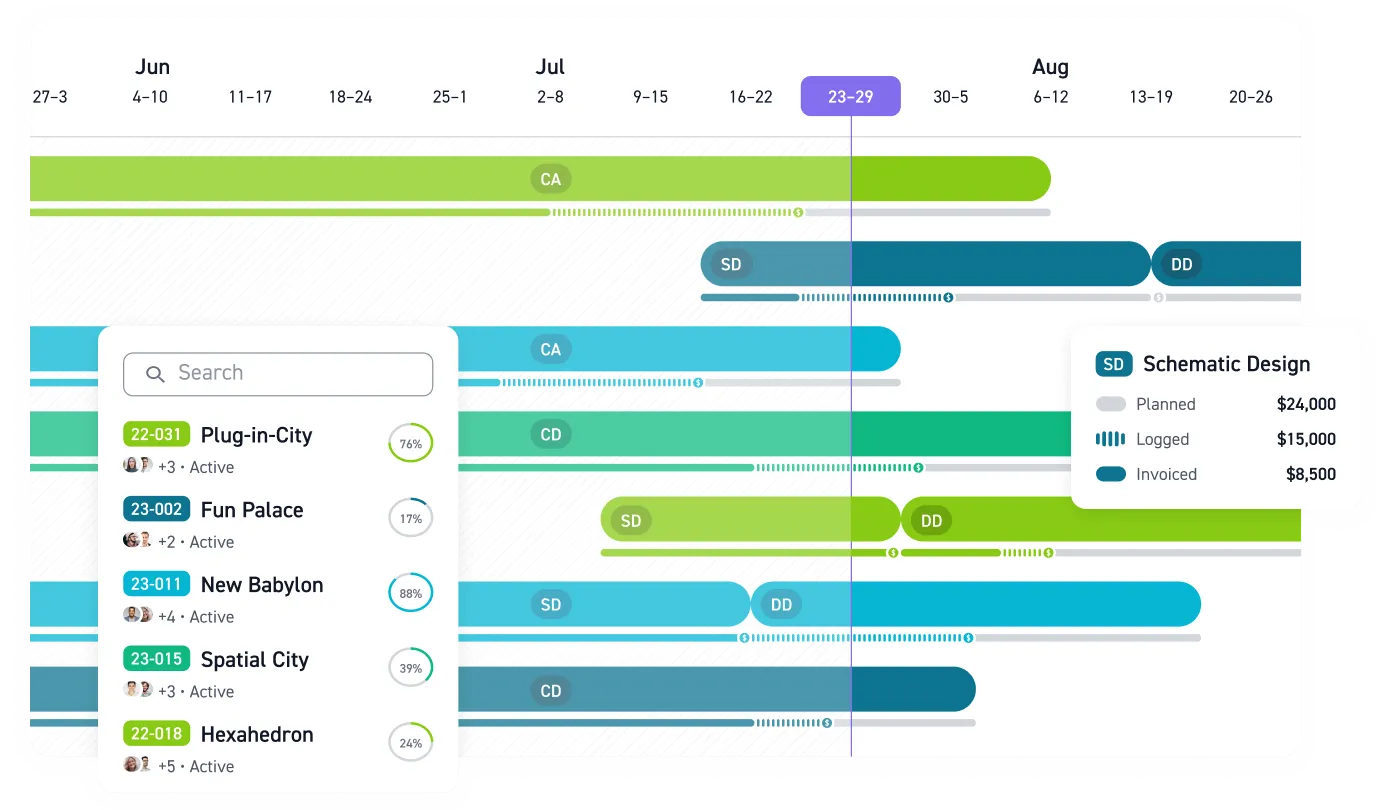
Monograph supports this shift in A&E firms. The platform consolidates budget tools, time tracking, staffing, invoice workflows, and reporting into a single system designed around A&E phase structures and fee types. Monograph's MoneyGantt™ combines project timeline and fee burn into one view, showing how much time and money has been tracked against a project in real time. Spreadsheets, with separate schedules, budgets, and tasks, cannot provide that same connected view.
The workflow improvements map directly to the breakdowns above:
- Phase-level budgets update automatically as hours are logged, with alerts when projects trend over budget.
- Team capacity shows allocation and upcoming capacity forecasting.
- Time tracking connects directly to invoicing, eliminating the manual assembly process that delays billing cycles.
- Consultant billing includes bill submission and automated billing reminders for consultants.
Those changes replace manual reconciliation with current project data. Teams spend less time rebuilding the story of a project's finances and more time acting on what the project needs.
Firms using Monograph report measurable results. Dynamic Engineering saw 25% profit growth and a 2x efficiency gain after switching from Excel. Garrison Architects cut admin costs 50%, accelerated billing 1.5x, and reached 2.5x faster time-to-payment.
The Competitive Pressure Is Already Here
A&E firms are increasing technology investment, with recent industry reports pointing to growing interest in AI-driven efficiency tools across the sector. The investment is a response to tighter margins and growing project complexity. Firms that have already made the switch are operating with better visibility into profitability, staffing, and project health.
The AIA's 2024 Strategic Council Year in Review identifies a widening knowledge gap between practices that adopt emerging technologies and those that do not as an immediate threat. This is an active market shift that affects which firms move faster and which firms get squeezed on fees.
Meanwhile, 27% of AECO professionals still rank emails, spreadsheets, and PDFs as their team's most relied-upon tools. Every month spent assembling reports from disconnected spreadsheets is a month your competitors spend working from current project data.
Stop Running A&E Projects Through Spreadsheets
Spreadsheet project tracking creates more problems than it solves once your firm is juggling multi-phase budgets, consultant invoices, staffing decisions, and billing cycles at the same time. When budgets, time, invoicing, and consultant coordination live in different files, you lose the ability to see what a project is actually doing financially until the damage is already done.
Monograph gives A&E firms one place to track budgets, time, staffing, invoicing, and consultant collaboration. That means fewer manual reconciliations, faster billing, and a clearer view of project profitability while there is still time to act. Monograph's MoneyGantt™ makes that visibility visual, so you can see fee burn and project timing together instead of rebuilding the story in Excel every week.
The spreadsheet ceiling is real. Stop managing around it. See the platform.
Frequently Asked Questions
Is Excel still good enough for a small A&E firm?
It can work for a while, especially when the number of active projects is low and one person still holds most of the operating context in their head. The problem starts when that same firm is tracking multiple phases, coordinating consultants, and trying to understand profitability across several projects at once. In that environment, spreadsheets become a source of delays, version confusion, and missed financial signals.
What's the first sign we've outgrown spreadsheet-based project tracking?
Usually it is not one dramatic failure. It is the accumulation of small breakdowns. Budget files fall out of date, timesheet data has to be manually reconciled before invoicing, consultant costs live outside the main budget tracker, and no one can answer a basic profitability question without rebuilding a report first.
Will project management software actually help us invoice faster?
Yes, when time tracking connects directly to invoicing. That connection removes the manual assembly process that slows billing cycles in spreadsheet-based workflows. The customer examples in this article point to the same pattern: firms using Monograph reported faster invoicing, faster payments, and lower unbilled fees after moving away from Excel.
What should we track first if we want better project profitability?
Start with the areas that most directly affect project economics: phase-level labor, consultant costs, and invoicing status. Those are the workflows most likely to break in spreadsheets and the ones that most directly affect whether a project is actually making money.
Why does real-time visibility matter so much in A&E firms?
Because A&E projects unfold across phases, fee structures, and consultant relationships that change over time. A snapshot from last week does not help much if the budget shifted this morning or consultant costs came in yesterday. Real-time visibility helps project managers and principals act on current conditions instead of making decisions from outdated files and partial data.