
Timing creates the risk when budget data gets trapped in a spreadsheet or utilization numbers get compiled after payroll already went out. Late billing triggers add the same problem. Small and mid-size architecture and engineering firms need a project management workflow that connects phase structure, budget tracking, and the operating rhythm that keeps fixed-fee projects on track.
Phase Structure: The Backbone of Every A&E Project
Basic services are organized into sequential design phases, with owner approvals required at each transition point. For architects, these phases are defined by basic service phase definitions: Schematic Design, Design Development, Construction Documents, Bidding/Negotiation, and Construction Administration. Engineering firms use parallel but differently named stages, with ACEC framing a Study and Report Phase and a Preliminary Design Phase, while architects often separate Programming/Pre-design from later phases such as Schematic Design and Design Development.
The naming differs. The PM responsibilities don't. Every gate you skip becomes a scope argument later. Projects may include gate reviews or other phase-end decision points before moving into the next stage. Missing or informal gate reviews are one of the fastest paths to scope disputes.
Key transitions demand specific PM attention throughout a project:
- SD to DD: Written owner approval of schematic design documents before design development begins. Multiple stakeholders, including zoning boards, lenders, and owners, may each require independent review timelines that the PM must build into the schedule.
- DD to CD: Owner approval plus PM authorization to proceed. A key DD challenge is that clients and architects often lack a sufficiently clear idea of what DD deliverables will include until they're delivered. Defining deliverables explicitly at the start of DD is a named PM responsibility.
- Late CD milestone: A written cost estimate submitted for owner approval. If the estimate exceeds the owner's budget, the architect may be required to redesign at no additional charge.
- CD to Bidding: Owner approval of final construction documents before procurement begins.
Engineering firms commonly add internal sub-gates within phases as stage-gate checkpoints for multi-discipline coordination. Building these into the phase-based PM workflow from day one prevents the "we thought we were further along" conversation at formal reviews.
Budget Tracking: The Percent Complete vs. Percent Spent Gap
A&E teams catch budget trouble by comparing how much of the budget they've consumed with how much of the work they've finished. Think of construction documents billed well ahead of drawing progress: the fee is disappearing, but the sheets aren't keeping up.
Percent spent and percent complete are separate metrics. One tracks dollars, the other tracks deliverables. On fixed-fee contracts, that gap comes straight out of your firm's margin, because the firm continues working without additional compensation once the fee is consumed.
Earned value management gives a framework for catching these problems early. Multiply total contract fee by percent complete to get earned revenue, then compare it against actual costs. If the project is spending faster than it's earning value, the budget problem is already forming.
A strong budget review includes current margin, percent complete, work-in-progress balance, burn rate, and AR aging. By the time a budget problem appears in a spreadsheet, the labor cost has already been spent.
Utilization: Setting the Right Targets by Role
Firm-wide utilization averages are misleading as individual performance targets. Role-level targets vary widely, according to role-level benchmarks, and firm-wide averages are often discussed alongside published KPI data.
Very high utilization is a warning sign because it often leaves too little time for business development or mentorship. Training gets squeezed too. Monograph's 2026 Architecture & Engineering Business Benchmarks Report adds context on how these metrics play out in day-to-day operations.
Individual utilization goals can create perverse incentives. Employees who see their work queue shrinking tend to stretch remaining tasks. Reported utilization rises, and projects move over budget. Set utilization targets at the firm or studio level instead.
Managing Paused Projects and Capacity
Managing project holds is a structural part of the workflow. Every firm deals with it.
Review paused projects with a regular cadence and make the next step clear:
- Reallocate idle hours to active work and update the resource plan so staff are not waiting on client decisions.
- Before a hold occurs, flag tasks as quick-resume or full re-mobilization.
- Review capacity on a rolling horizon so overload is visible well before a deadline hits.
- Cross-train staff on low-risk tasks to widen the talent pool available when projects pause or shift.
That structure reduces the friction that turns a short pause into a long productivity loss.
From Manual Tracking to Operational Rhythm
Many A&E firms have adopted digital and cloud-based tools, yet still struggle to resolve workflow challenges in practice. Cloud and SaaS adoption continues to grow across firms, even as many organizations still rely on spreadsheets for parts of their workflows. Disconnected SaaS tools are the core problem 53% of firms are trying to solve when they name business process improvement as their top priority.
That shift can produce measurable operational gains. One California firm reported 8x faster staffing, 4x faster billing process, and 75% less unbilled fees after replacing disconnected workflows.
The connected workflow replaces the manual data pull with a repeatable operating cadence:
- Regularly: Scan utilization across the team so bench time and billable time are visible before they become a margin problem.
- During the month: Check work-in-progress balances to catch fee burn before it becomes a write-off.
- At firm planning checkpoints: Stack actual profit against the annual plan and decide whether to recalibrate rates, staffing, or both.
This cadence gives PMs and firm leaders a clearer basis for action.
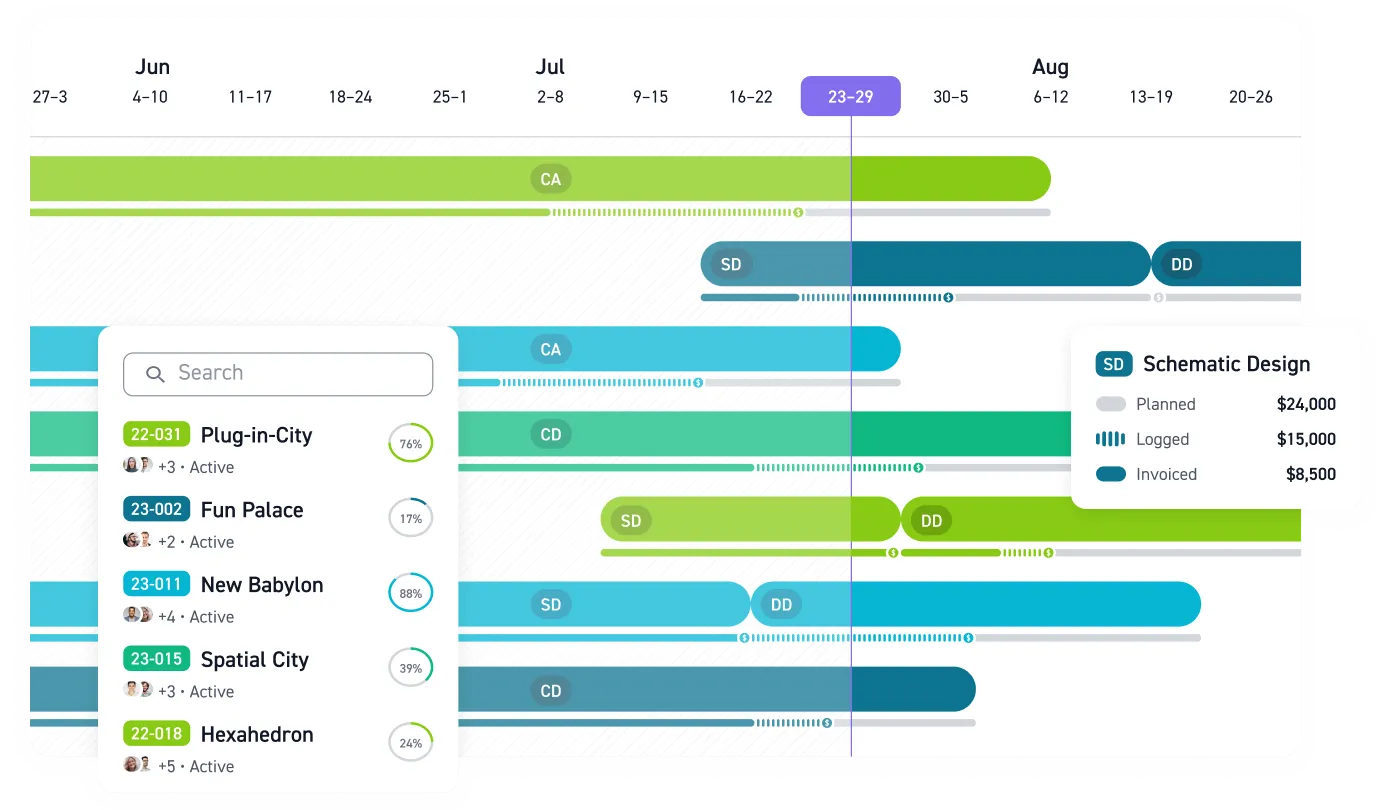
Monograph's MoneyGantt™ helps teams Compare planned, logged, and budget progress in an at-a-glance view of project health. It replaces the spreadsheet someone updates once a month.
Every PM knows the components of A&E project management. Firms protect margins when data is available at the moment decisions need to be made.
See Project Health Before the Budget Slips
Workflow problems start when phase gates are informal, budget checks happen too late, utilization targets push the wrong behavior, and paused projects quietly distort capacity.
Monograph gives A&E teams a clearer operating rhythm. With project health in one place, PMs, operations leaders, principals, and owners can compare planned hours, logged hours, and budget progress before a write-off shows up in the spreadsheet.
The lag between decision and data is where margins disappear. Close it. Book a demo.
Frequently Asked Questions
Do small A&E firms really need formal project stage gates?
Yes. Even in a small firm, skipped approvals between SD, DD, CDs, and bidding create scope arguments later, especially when owner approvals and stakeholder review timelines are involved.
How often should project budgets be reviewed?
Use a regular review rhythm for active budget management. By the time a problem shows up in a spreadsheet, the labor cost has already been spent. A practical review includes current margin, percent complete, work-in-progress balance, burn rate, and AR aging.
What's the difference between percent complete and percent spent?
Percent spent tracks budget consumption. Percent complete tracks deliverables. When those numbers drift apart on a fixed-fee project, margin disappears because the firm keeps working after the fee has effectively been consumed.
How should firms manage paused projects without hurting utilization and staffing?
Review paused projects regularly, reallocate idle hours to active work, and update the resource plan so people are not left waiting on client decisions. It also helps to flag work as quick-resume or full re-mobilization before a pause happens, then manage capacity on a rolling horizon reviewed consistently.