

A milestone on the schedule means nothing if you can't connect it to money in the bank. Yet many architecture and engineering (A&E) project managers treat milestones as abstract checkpoints, disconnected from the fee structures and billing triggers that keep firms solvent. Recent industry data shows 40% of engineering and construction firms experienced schedule delays or cost impacts of more than 20% in 2023, with causes spanning planning, coordination, staffing, supply chain, and design changes.
The fix starts with knowing which milestones matter in each phase, and how each one connects to a deliverable, an owner approval, and an invoice.
Architecture Milestones: The AIA Phase Structure
Standard phase contract terms from the American Institute of Architects (AIA) organize an architect's basic services into sequential phases, with owner approvals required at key transition points. In some cases, those approvals also line up with payment milestones. AIA's phase sequence guide lists the core phases as Schematic Design, Design Development, Construction Documents, Bid or Negotiation, and Construction Contract Administration.
These milestones usually gate progress and support billing across a typical architecture project:
- Owner SD Approval: The client signs off on the schematic package, including site plan, floor plans, sections, elevations, and an SD scope summary. This is often the first major billing event after pre-design.
- Owner DD Approval: Under AIA practice standards, the Owner's written approval of the Design Development Documents is required before the next phase proceeds. That approval establishes the design character, structural system, MEP (mechanical, electrical, and plumbing) coordination, and draft Project Manual for further development in Construction Documents.
- Permit Submission and Final CD Bid Set: The construction documents package produces the complete drawing set and specifications. Internal checkpoints help teams stay ahead, but permit submission and the final bid set carry stronger contractual weight.
- Substantial Completion: Defined in AIA A201 as the point when work is sufficiently complete for the owner to occupy or use the project for its intended purpose. This starts the punch list process and marks the move toward final completion.
Each milestone is where scope, schedule, and fee meet. Miss one, and the project slows down along with the next invoice.
Engineering Milestones: The Design Review Framework
Engineering projects follow a parallel but distinct structure. Civil infrastructure work typically references standard engineering agreements that establish a two-phase design structure, while many building projects track against a staged Construction Document review framework used across civil, structural, and MEP disciplines.
USACE's design review checklist outlines progressive design reviews and gives teams a shared reference point for where the design stands, especially when a project pauses and later resumes.
Beyond design package milestones, engineering delivery carries its own regulatory and construction checkpoints:
- Investigations complete: Geotechnical and specialty investigations are prerequisite milestones before preliminary design can advance.
- Special inspections statement submitted: Required under inspection code guidance where special inspections apply.
- Foundation and framing inspections: Concealed work must be approved before enclosure proceeds.
- MEP rough-in inspections complete.
These checkpoints tie engineering scope to approvals and field conditions that control real project progress.
Linking Milestones to Billing and Budget
A milestone that lives only on a Gantt chart is a missed financial opportunity. Published milestone billing guidance makes the standard clear: milestones should be objectively verifiable events such as document submittals and owner approvals, not subjective guesses about percent complete. That makes billing easier to defend and easier to process.
The most important financial distinction for any project manager comes from financial management guidance: percent spent and percent complete are separate metrics. When percent spent runs ahead of percent complete, the project has consumed more budget than the work delivered supports. That gap needs action right away.
Standard contract payment terms raise the stakes. Once a progress payment is made at a milestone, it cannot be adjusted based on later budget changes. The contract also describes situations where redesign or related work may become an Additional Service. For that reason, milestone payment amounts need to be defined clearly at contract execution.
A practical earned value check is simple. Compare direct labor charged against your billing multiplier, then compare that result to the total fee and the work delivered. Run that check at every milestone so invoiced fee stays proportionate to progress.
Tracking Milestones Across Multiple Projects
Managing milestones on one project is manageable. Managing them across a full workload is where spreadsheet systems start to fail. Teams lose sight of who owns the next approval, which paused projects are still sitting in the forecast, and whether fee burn still matches progress.
Industry schedule modeling guide standards treat milestones as part of the schedule model and distinguish major milestones from internal checkpoints. Those smaller checkpoints help teams catch drift before it turns into a missed contractual date.
A few practices make the difference:
- Plan resources using realistic availability. Milestone dates built on full availability are usually already slipping.
- Assign clear ownership. Each discipline milestone needs clear lead ownership accountable for progress and weekly communication.
- Formally freeze paused projects. Published change control guidance addresses approved changes through formal control and supports schedule or budget updates when warranted. Informal pauses create compounding financial and schedule risk.
Those disciplines turn milestones into reliable anchors rather than moving targets.
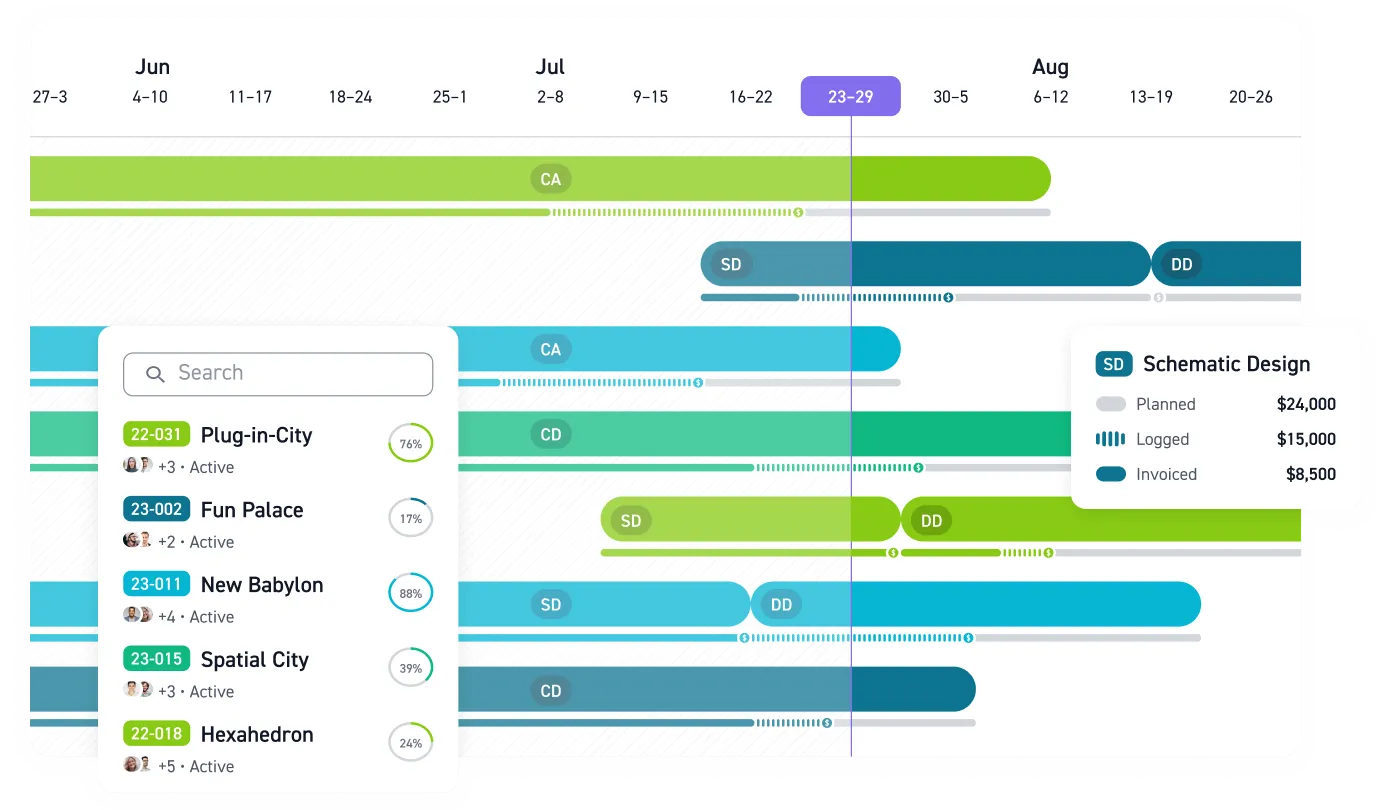
Purpose-built practice management tools give A&E firms this visibility directly. Monograph's MoneyGantt™ combines project timelines with budget-to-cash progression, tracking phases from planned through logged, invoiced, and paid. In one customer example, Workbench reported 8x faster staffing, 4x faster billing, and 75% less unbilled fees after moving off BQE Core. That kind of visibility helps project managers see when a project is burning budget faster than milestone completion justifies. It also gives teams project tracking that spreadsheets struggle to maintain.
Firms that hit milestones consistently define them before work starts, tie each billing trigger to a clear event, and track budget burn against progress at every checkpoint.
Stop Letting Milestones Drift Away From Revenue
When milestone tracking lives in a spreadsheet and billing lives somewhere else, delays stay hidden until cash flow slips. Owner approvals, internal checkpoints, staffing assumptions, and invoice timing drift apart, and project managers end up managing the gap by hand.
Monograph brings project phases, budgets, staffing, and invoicing into one platform built for architects and engineers. Monograph's MoneyGantt™ shows how work moves from planned to logged to invoiced to paid, so teams can see whether milestone progress and fee burn still match before a schedule issue becomes a margin problem.
See how milestones connect to real financial visibility. Book a demo.
Frequently Asked Questions
What milestone should trigger an invoice on a fixed-fee A&E project?
The strongest billing milestones are the ones already defined in the contract and easy to verify, such as owner approvals, document submittals, permit submission, or issuance of a final bid set. Use objective events, not vague percent-complete judgments.
Are design review milestones enough for engineering projects?
They are a useful shared reference point across civil, structural, and MEP work, but they are not the whole milestone plan. Engineering projects also carry prerequisite, regulatory, and inspection checkpoints that need to be tracked alongside design reviews.
How should we handle milestones when a project is paused?
Formally freeze the project instead of letting it sit in limbo. Paused projects should go through change control or re-baselining when warranted so schedule dates, budget expectations, and resource plans stay credible.
What's the difference between internal checkpoints and contractual milestones?
Internal checkpoints help teams catch drift early. Contractual milestones formally gate progress, secure approvals, and often support billing. A CD review can help internally, but permit submission, owner approval, or final design issuance usually carry more financial weight.
How do milestones help protect project margin?
They create clear moments to compare progress, approvals, and fee earned. When teams review budget burn and invoicing at each milestone, they can catch misalignment before it turns into write-offs or delayed billing.