

On a fixed-fee project, every hour your team spends beyond the budget comes directly out of your margin. There's no mechanism to recover those costs unless a formal change order gets executed and accepted by the client. That reality makes project scheduling a financial discipline first and a delivery discipline second.
Fixed-fee contracts are common in architecture and engineering (A&E) work, especially among smaller firms. If you're a project manager at a small or mid-size firm, your schedule is one of the primary tools protecting profitability.
Scheduling Methodologies Worth Your Time
A&E firms layer several scheduling frameworks depending on project delivery method and complexity. The most useful approaches for project managers at smaller firms include:
- Phase-based scheduling. Most A&E project managers already work within the design phases: Schematic Design, Design Development, Construction Documents, Bid/Negotiation, and Construction Administration. Each phase carries defined deliverables, review gates, and payment triggers. AIA best practices also call for a project milestone chart that maps sequence, meeting dates, and key events from project inception.
- Milestone planning. This adds the contractual and financial layer. On lump-sum work, milestones are payment triggers tied to contract deliverables like submittal of preliminary plans or final plans. Research on design-build projects found that meeting key milestones supports owner satisfaction even when the overall schedule extends.
- Critical Path Method. The approach is described as a fundamental planning skill for engineers and project managers. It identifies which tasks drive the finish date and where you have float.
- Rolling wave planning. This fits projects where full scope isn't known at kickoff. The approach maintains milestone-level planning for the full project while building detailed activity schedules only for the immediate phase.
Used together, these approaches give project managers a practical way to connect deliverables, staffing, and fee protection.
Why A&E Schedules Break Down
Project schedules can be affected by a range of factors, including workload from other projects. Schedules built in isolation from a team's other active commitments rarely hold.
A few patterns show up repeatedly:
- Scope creep drives rework. Survey data shows 56% of AEC leaders identified client changes and scope creep as the primary causes of costly project rework.
- Staffing gaps emerge after award. Firms may plan scope carefully, but recruiting the talent to deliver the work often starts too late.
- Mid-career professionals absorb the impact. More than two-thirds of A&E professionals report long work hours as an expected part of the profession, and mid-career staff carry the highest rates of burnout. Those same capacity constraints affect schedule adherence.
These problems compound quickly once a project starts slipping.
Schedule Slip Is Financial Loss
The connection between schedule and profit is direct. Industry benchmarks put the achieved direct labor multiplier for A&E firms around 3.0. Any shortfall from that target shows up as schedule and budget slippage eroding fee realization.
The early warning system requires tracking two metrics in parallel:
- Percent complete: a physical progress estimate of what has actually been produced, independent of billing or invoicing
- Percent spent: costs incurred to date divided by the total project budget
Together, they show whether production and fee consumption are still aligned.
When those two numbers diverge, the project is in trouble. Percent spent can substantially exceed percent complete without triggering alarm if project managers track only one metric. If the fee is being consumed faster than the work is being produced, the project is already moving toward a loss.
Practices That Protect Your Schedule and Your Fee
These practices are intended for firms without dedicated schedulers.
Build a phase-based work breakdown at kickoff with short task ceilings. Set up columns for phase name, task, duration, dependency, required role, and budget. Break each phase into tasks short enough to expose risk without creating unnecessary management overhead.
Secure team commitments at the proposal stage. Obtain tentative commitments from key personnel during proposal preparation, before the workload arrives.
Use phase-gate checklists at every transition. The design development checklist includes schedule, manpower, program, area, and budget review as part of the transition. Treat that review as a gate condition before moving forward.
Run weekly short-interval scheduling. The master schedule establishes what can be done. The weekly schedule determines which tasks with float can be deliberately deferred to free capacity for higher-priority work.
Track flow efficiency alongside utilization. Flow efficiency measures time spent on a task divided by total time to complete it. A team member can look fully utilized and still produce rework. Add a standing weekly question: What was completed this week?
Run a near-term resource forecast. Hold a short weekly or bi-weekly meeting covering all active projects' staffing visibility against firm-wide availability. Firms that centralize staffing visibility usually spot conflicts earlier. One Monograph customer reported 8x faster staffing, 4x faster billing, and 75% less unbilled fees. The output can be a simple matrix:
- Team member names across the top
- Weeks down the left side
- Percentage allocation per project in each cell
This makes staffing conflicts visible before they become schedule problems.
Flag conflicts before they become crises. Regular re-sequencing conversations with clients are becoming standard practice across the AEC industry as firms manage heavier concurrent workloads.
Moving Beyond Spreadsheets
Spreadsheets cannot natively align time tracking with project phase activities or show non-billable time's impact on profitability. Every connection between scheduling and financial tracking requires manual workaround, and those workarounds break down as projects multiply.
A&E-specific platforms differ from generic tools by organizing scheduling and budget tracking around project phases rather than generic task lists. For a project manager handling fixed-fee work, the critical view shows what the phase schedule says, how much budget has been consumed, and whether the spending rate is sustainable through phase completion.
Protect Your Fee Before the Schedule Slips
When your schedule, budget, and staffing live in different places, overruns stay hidden until the phase is nearly over. That's when fixed-fee work turns into write-offs, burned-out teams, and difficult client conversations.
Bring schedule, staffing, and fee tracking into the same weekly review so you can compare phase progress, team capacity, and budget consumption before a phase goes off track.
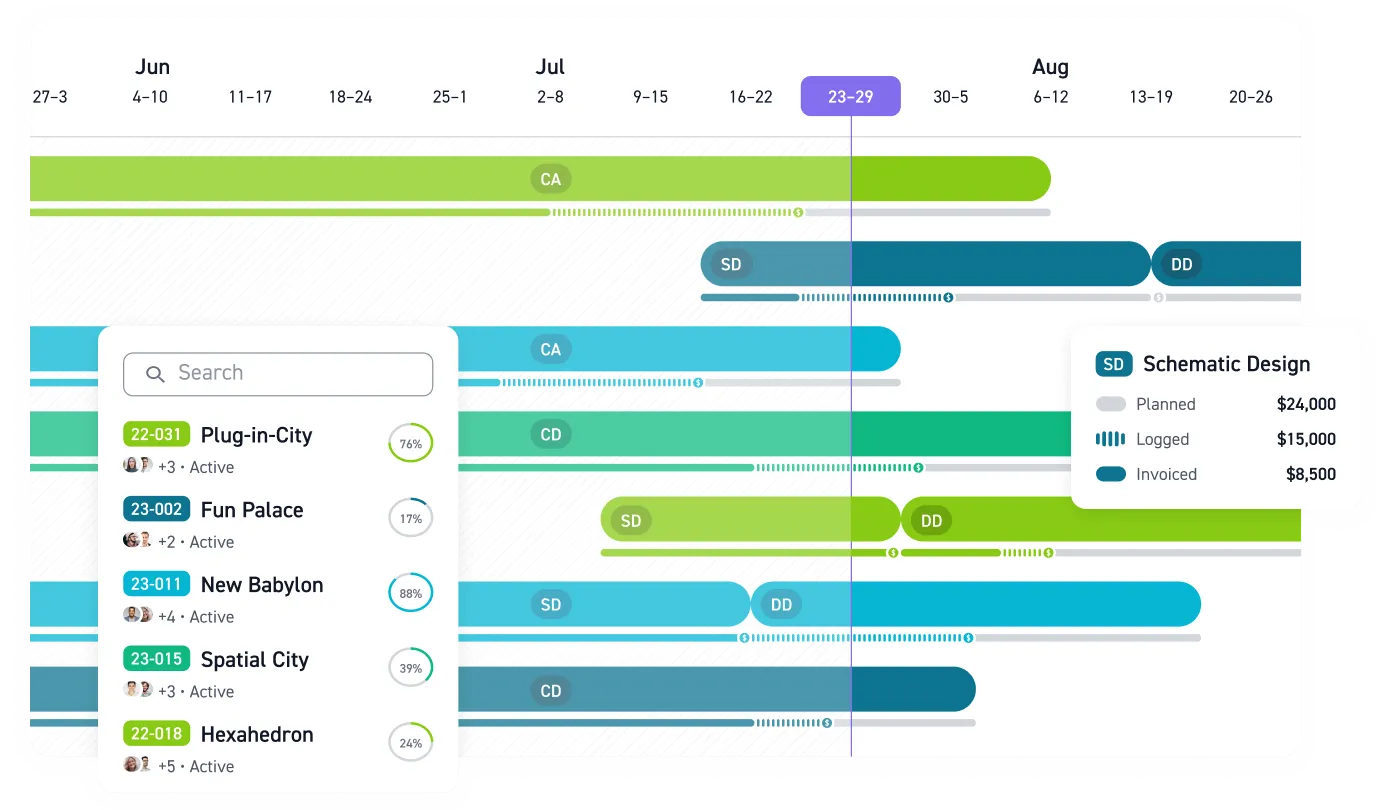
Monograph is built around this problem. The project planner lets you plan and organize your project's schedule, budget, and resources in one place. Monograph's MoneyGantt™ displays budget alongside timeline, showing where money flows throughout the project so you can identify budget risks before they become overruns. Staff allocation, consultant management, time tracking, and invoicing all connect at the phase level.
Fee erosion starts early. Catch it before a phase goes off track. Book a demo.
Frequently Asked Questions
How detailed should an A&E project schedule be on a fixed-fee job?
Detailed enough to expose risk without turning into micromanagement. A phase-based work breakdown with short task durations is a practical standard for small and mid-size firms. Tasks that run too long mask risk; tasks chunked too small generate management overhead without much benefit.
What's the first warning sign that a schedule problem is becoming a fee problem?
A gap between percent complete and percent spent. If the fee is being consumed faster than the work is being produced, the project is already moving toward a loss. Catching that gap during weekly review keeps it from compounding into a write-off at phase close.
Do small firms really need CPM or formal scheduling methods?
They need the discipline behind those methods, even if they don't need specialized software. A well-structured phase-based schedule with task dependencies identified is already a functional Critical Path Method application for many small A&E firms. The investment pays off when staffing conflicts and milestone risks become visible before they affect fee.
How often should project managers review staffing against the schedule?
Weekly. Short-interval scheduling and a near-term resource forecast give project managers enough frequency to catch conflicts before they become missed milestones or overtime. If staffing review happens only when a deadline is already slipping, the schedule is no longer doing its job.