

Most A&E firms know their backlog well. But few can answer a harder question: how much of that backlog converts to cash in the near term? Generic forecasting models usually break down in A&E because project timing shifts, direct costs move, and signed work does not always turn into near-term revenue when you expect it to.
Why Revenue Forecasting Breaks in A&E Firms
A&E revenue is hard to forecast because many projects are contracted on fixed-fee or unit-price terms. The fee may be known, but the cost to deliver it is not. A forecast can look stable while net revenue erodes through scope creep or underestimated complexity. Net revenue is the amount your firm retains after direct project costs, and it deserves more attention than most firms give it.
The AIA makes the distinction clear in its income statement guide: net service revenue, not gross revenue, is the right forecasting unit for A&E firms. If gross contracted revenue includes subconsultant pass-throughs, net service revenue is the amount against which to forecast staffing costs, overhead, and profit. Backlog, pipeline, and capacity planning all become more useful when they are measured in NSR.
Project timing adds another layer of difficulty. A&E firms do not experience revenue as a smooth monthly stream. Projects start, pause, restart, and cancel. Firms at certain growth breakpoints can become unstable when one expected project is carrying too much of the hiring plan. A forecast built on backlog alone overstates near-term revenue when project status is stale.
The Metrics That Actually Drive Your Forecast
You probably already track utilization and backlog. For forecasting, a smaller set of metrics matters more:
- Net revenue per employee: This shows whether the firm is producing enough revenue per person to support overhead and profit targets.
- Backlog-to-NSR ratio: A backlog benchmark relative to net service revenue can signal whether the pipeline is keeping pace with current operations.
- Overhead rate: Your forecast has to reflect the real cost structure of the firm, not just top-line billings.
- Architecture Billings Index: The ABI is a useful leading indicator for changes in future demand. When the index stays below 50 for consecutive months, it signals contracting conditions ahead.
Profitability benchmarks matter here too. Any forecast that ignores the difference between gross billings and what actually reaches the bottom line is built on the wrong base.
Five Forecasting Methods That Work Together
No single method is reliable on its own. These methods work best as a system:
- Backlog analysis starts the process. Remaining backlog is contract value minus billed and unbilled revenue. The step many firms miss is spreading that backlog by month based on actual phase schedules. Backlog without timing is weak for financial planning. A&E firms track backlog rigorously, but timing is what turns it into a forecast.
- Weighted pipeline forecasting extends visibility beyond signed work. Apply probability assumptions to active proposals using your own history by project type, client, and repeat relationship. Segmenting those assumptions produces a more credible forecast than treating every proposal the same.
- Staffing capacity modeling builds the forecast from capacity: available billable hours multiplied by billing rates across the team. A&E firms still rely heavily on spreadsheets for labor forecasting, a gap highlighted in recent workforce planning research. Firms with stronger resource allocation processes can forecast more accurately because their capacity data stays closer to real-time project activity.
- Phase-level budget tracking improves timing. AIA project phases create a practical structure for estimating when contracted revenue becomes earned revenue. This also helps surface scope creep early enough to pursue a change order or recognize a write-down.
- Driver-based scenario forecasting tests the forecast under different conditions. Build base, upside, and downside cases around win rate, backlog burn rate, and utilization. Different markets move at different speeds, so a single-scenario forecast rarely holds up for long.
These methods reinforce each other. Pipeline updates change backlog expectations. Backlog changes resource demand. Resource demand then feeds scenario planning.
From Spreadsheets to Real-Time Forecasting
If your firm fits the common A&E profile, the workflow probably feels familiar: budgets in Excel, timesheets somewhere else, invoices in another tool, and QuickBooks Online holding the general ledger. That setup makes forecasting brittle because project data goes stale fast.
The bigger issue for most firms is the handoff between systems. When time, phase budgets, proposals, and costs live in different places, revenue forecasting turns into a spreadsheet cleanup exercise instead of a management tool.
An A&E-specific platform helps in three practical ways:
- Time tracking connects to phase budgets, so earned revenue stays closer to current project activity.
- Pipeline tracking with probability weighting becomes an active forecast input instead of a static spreadsheet.
- QuickBooks Online sync ties project profitability to real costs instead of rough assumptions.
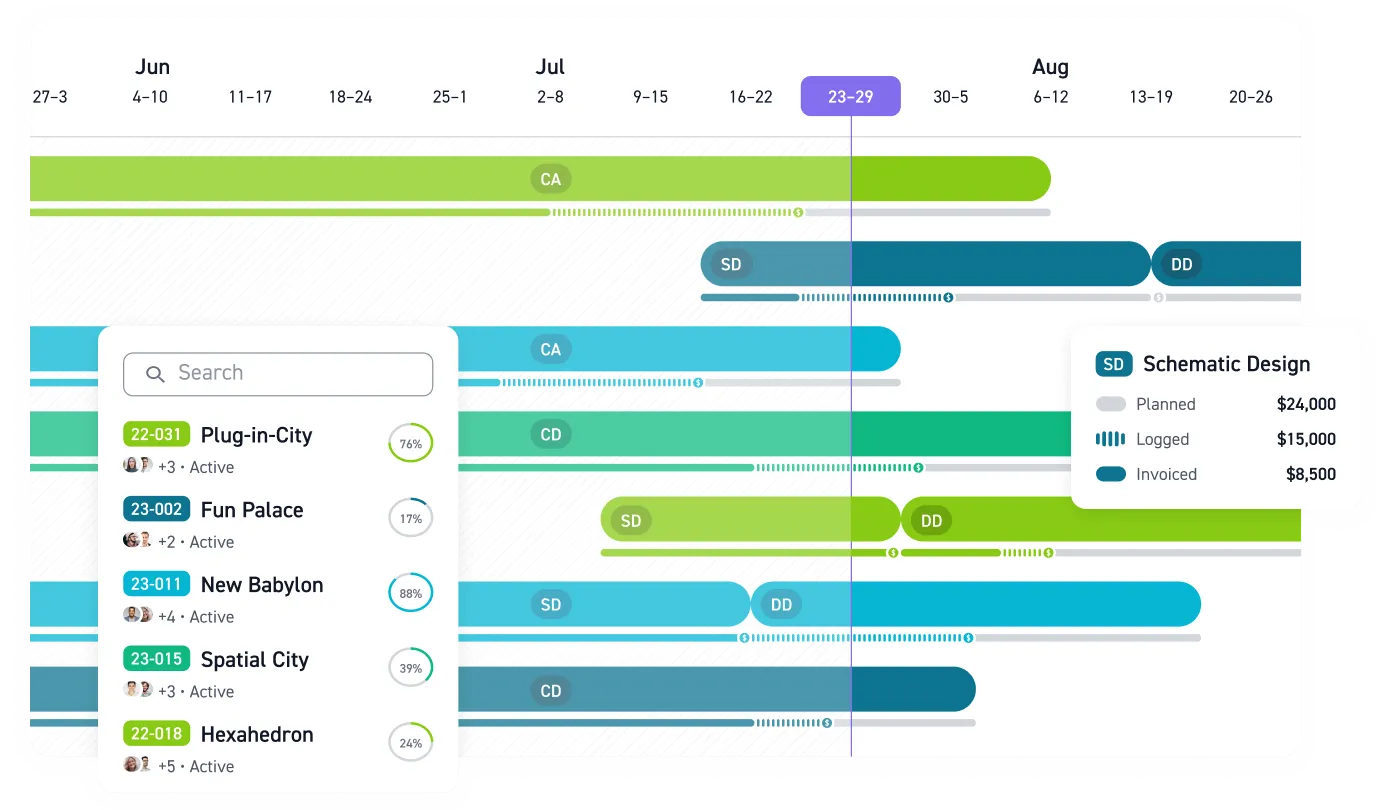
Monograph's MoneyGantt™ gives principals and project managers a visual view of planned, logged, invoiced, and paid revenue at the project level. Instead of digging through separate reports, they can see budget health on one timeline. Monograph's pipeline forecast is built to make leads and proposals visible in revenue projections so pipeline activity connects more directly to projected revenue.
That shift shows up in daily work. Woodhull, a 25-person firm in Maine, cut admin time by 66% and reduced budget overage by 66% after consolidating project data into one platform. Dozens of firms across the country report similar improvements in billing speed and budget accuracy.
What Happens When You Get This Wrong
Multiple AEC sectors entered 2025 with strong demand signals, but proposal activity affects cash flow over a long planning window. Firms that look only at current billings and existing backlog are forecasting with a major blind spot.
- Reactive hiring and layoffs. Without a model for future utilization demand, hiring decisions follow short-term urgency instead of pipeline quality. Monograph's staffing tools help firms plan capacity against projected revenue so they can avoid rushed hiring during peaks and painful cuts during troughs.
- Suppressed firm valuation. Revenue growth and valuation benchmarks are linked. A less predictable revenue stream makes the firm harder to value, whether for internal ownership transition or external acquisition.
- No early warning in a downturn. When billings softened in late 2025, firms with forward-looking models had more time to adjust staffing, pricing, and business development.
The pattern is consistent: once lagging indicators confirm the problem, most of the room to correct it is already gone. Each of these problems starts as a forecasting issue and becomes an operational problem when the numbers are stale.
Stop Forecasting Revenue in Spreadsheets
When backlog, phase budgets, pipeline, time tracking, and invoicing live in different places, the forecast breaks as soon as a project pauses or a proposal slips. That is how firms make staffing and cash decisions with stale numbers.
Monograph connects those moving parts in one A&E-specific system. Monograph's MoneyGantt™ gives principals and project managers a real-time view of planned, logged, invoiced, and paid revenue, while pipeline tracking and QuickBooks Online sync keep project-level profitability tied to current activity instead of spreadsheet assumptions.
Stale forecasts get expensive fast. Schedule a demo.
Frequently Asked Questions
Is backlog enough to forecast revenue accurately?
No. Backlog is the starting point, but backlog without timing is weak for cash flow planning. You need to break backlog down by month based on actual phase schedules and account for paused projects, pipeline probability, and resource capacity.
Why does net service revenue matter more than gross revenue in an A&E forecast?
Because net revenue is what your firm retains after direct project costs. Gross contracted revenue can include subconsultant pass-throughs, which should not be treated as revenue available to cover staffing costs, overhead, and profit.
How should paused projects affect a revenue forecast?
They should reduce your confidence in near-term revenue if you are relying on backlog alone. Paused work can cause a backlog-based forecast to overstate monthly revenue unless timing and project status are updated regularly.
What should a small A&E firm track first to improve forecasting?
Start with NSR, backlog timing by phase, pipeline probability, utilization, and project-level costs. If those numbers are split across spreadsheets, timesheets, invoicing tools, and QuickBooks Online, the first practical step is connecting them so the forecast reflects current project activity.