


Firm management made easy

The best project management software for engineers helps firms plan projects, manage resources, track budgets, and deliver work profitably. But the right tool depends on whether your team needs better task management, project scheduling, time tracking, or financial visibility.
For architecture and engineering (A&E) consulting firms, project management involves more than meeting deadlines. Teams need to manage fixed fees, coordinate employees across multiple projects, track billable hours, and understand how project work affects profitability.
That's where the difference between general project management tools and A&E-specific software becomes important.
In this guide, we compare nine software options, including Monograph, BQE Core, BigTime, Deltek, and general-purpose platforms. We'll look at their key features, strengths, limitations, and ideal use cases so you can find the right fit for your firm.
What Is the Best Project Management Software for Engineers?
Monograph is a strong choice for engineering consulting firms that want to connect project budgets, staffing, time tracking, and invoicing. BQE Core is worth considering for firms with complex billing requirements, while Deltek Vantagepoint and Unanet AE offer broader enterprise resource planning capabilities.
For teams primarily focused on task management, project scheduling, and collaboration, general-purpose tools like Asana may be sufficient.
Here's how the nine options compare.
The biggest consideration isn't which platform offers the most features. It's which one helps your firm manage its most important workflows without creating unnecessary administrative work.
How We Evaluated Engineering Project Management Software
Engineering firms need project management tools that support both project delivery and business operations. For this editorial comparison, we focused on six areas:
- Project budgeting: Can firms track fees, planned hours, and actual costs against project phases?
- Time tracking and billing: Can employees record billable hours and connect that information to invoices?
- Resource management: Can managers understand staff availability, allocate resources, and plan future workloads?
- Project planning: Does the software support project schedules, milestones, and deadlines?
- Task management and collaboration: Can teams assign responsibilities, coordinate work, and monitor progress?
- Reporting and integrations: Can firms access useful project information and connect existing accounting or business systems?
We also considered the intended audience for each platform, including smaller engineering practices, multidisciplinary consulting firms, and organizations with more complex accounting requirements.
Editorial disclosure: This article is published by Monograph, which develops project management software for architecture and engineering firms. We include competing products because different platforms serve different needs. The comparison is qualitative, not an independently tested ranking or weighted benchmark.
What Makes Project Management Software for Engineering Firms Different?
Engineering consulting firms manage more than tasks and deadlines. Every project has a scope, contracted fee, staffing requirements, planned hours, expenses, and client billing obligations.
General project management software might show that a deliverable is 50% complete. But can it also show that the team has already used 80% of its planned hours?
For fixed-fee engineering projects, that distinction matters.
Imagine a structural engineering firm working on a $100,000 project. The team has completed approximately half the work but has already used $75,000 of its planned labor budget.
A task management platform might show that project milestones are progressing. A platform connecting project budgets with timesheets can help the project manager identify financial pressure and investigate whether staffing, scope, or remaining effort needs to change.
This is one reason engineering firms often need software that connects project planning, resource allocation, time tracking, and financial management.
What Research Says About Project Management Software
Research supports the importance of reliable project information. Raymond and Bergeron's research in the International Journal of Project Management examined how project management information systems contribute to project outcomes through the quality and use of project information. The findings should not be interpreted as proof that software alone causes project success.
Read the research on project management information systems.
Research on construction project management information systems also highlights the importance of system quality, user satisfaction, and the practical value users receive from technology.
Read the study on project management system quality and adoption.
These studies don't establish that any particular software platform is superior. They reinforce an important consideration: project management software is only valuable when it provides useful information and people can use it effectively.
For engineering firms, that means choosing tools that fit existing workflows and give project managers information they can act on.
What Features Should Engineering Firms Look for in Project Management Software?
The right project management software should help firms plan work, coordinate teams, manage budgets, and understand project performance. Here are six features to prioritize.
1. Project Planning and Scheduling
Project planning tools help engineering teams organize project phases, deliverables, milestones, and deadlines.
Gantt charts are particularly useful for visualizing project timelines and task dependencies. They help managers understand which activities need to happen first and how scheduling changes could affect later work.
Some project management tools also offer Kanban boards, calendar views, and project templates.
When comparing software, consider whether your firm needs detailed task dependencies, high-level phase schedules, or both.
For a more detailed approach, see our engineering planning guide for budgets, resources, and schedules.
2. Resource Management and Allocation
Resource management helps firms understand who's available, who's overbooked, and how upcoming projects will affect staffing.
Resource allocation tools should make it easier to assign employees based on project requirements, capacity, and deadlines.
For example, an MEP firm managing 30 active projects needs to know whether the same electrical engineer is scheduled for several major deadlines in one week. Capacity planning can help managers identify those conflicts before they affect delivery.
Look for software that helps answer:
- Who has capacity for additional work?
- Which projects need more staff?
- How will upcoming projects affect utilization?
- Are we assigning more hours than employees have available?
Learn more in our engineering resource planning guide.
3. Task Management and Collaboration
Task management software helps teams organize responsibilities, track progress, and coordinate deliverables.
General project management tools often include task lists, Kanban boards, notifications, file sharing, and workflow automation. These collaboration tools can be useful for managing design reviews, project milestones, and internal communication.
However, task management alone may not provide the financial oversight engineering firms need. A firm may still require separate tools forproject accounting, time tracking, resource planning, or invoicing.
4. Time Tracking and Timesheets
Accurate time tracking helps engineering firms understand how much effort goes into each project. Look for software that allows employees to record billable and nonbillable hours against specific projects or phases.
When timesheets connect to project budgets, managers cancompare planned and actual effort without manually reconciling multiplesystems.
Some platforms also offer automated time tracking, reminders, and AI-powered time entry suggestions.
For example, Monograph's Smart Time Tracking can suggest time entries using calendar activity and other workday signals. Employees review and approve suggestions before they're recorded.
For engineering firms, accurate time tracking isn't just about billing clients. It's also essential for understanding project costs and profitability.
5. Project Budgeting and Financial Management
Engineering firms need to understand whether projects are staying within their contracted fees. Project budgeting tools should help managers track planned hours, actual hours, expenses, and remaining budgets.
For fixed-fee projects, phase-level financial tracking is particularly useful. If a project phase is approaching its budget before the work is complete, managers can investigate the cause and consider whether scope, staffing, or remaining effort needs to change.
6. Reporting and Forecasting
Reporting tools help firm leaders understand project performance, utilization, staffing capacity, and financial health. Look for dashboards that connect project budgets, timesheets, resource allocation, and invoicing.
The goal is to identify issues while there's still time toact, rather than discovering them after a project closes.
The 9 Best Project Management Software Options for Engineers

1. Monograph
Best for engineering and consulting firms that want to connect projects, people, and finances.
Monograph is project management software built specifically for architecture and engineering firms. It connects project planning, budgets, staffing, time tracking, invoicing, and financial reporting in one platform. This makes it particularly useful for engineering consulting firms managing fixed-fee and phase-based projects.
Key features
- Project planning and phase-based budgets
- Resource management and staffing
- Time tracking and timesheets
- AI-powered Smart Time Tracking
- Project financial tracking
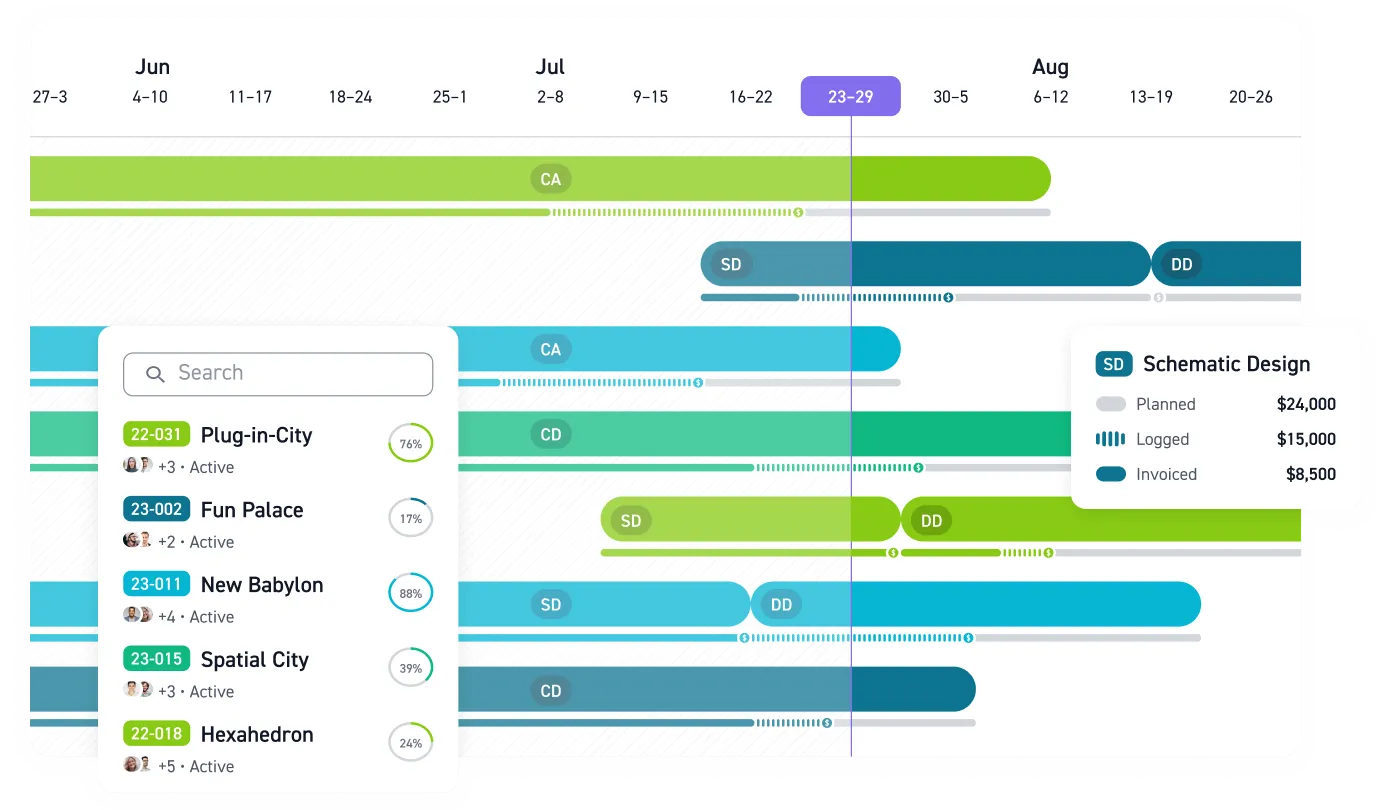
- MoneyGantt™ for understanding project financial progress alongside schedules
- Invoicing and financial reporting
- QuickBooks Online integration
Where Monograph stands out
Monograph connects the work happening on a project with its financial impact. Project managers can compare planned and actual effort against project budgets, helping them identify potential overruns before work is complete.
Its resource management capabilities also help firms plan staffing across multiple active and upcoming projects. For example, if an engineering firm wins three new projects in the same month, managers can review planned workloads and available capacity before assigning employees.
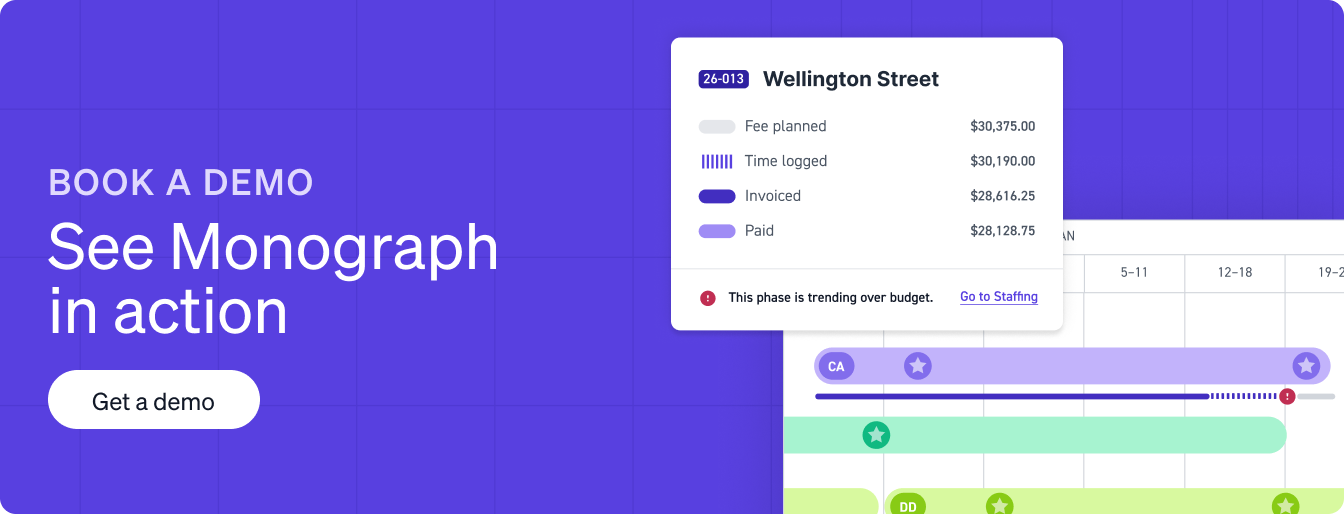
Monograph's MoneyGantt™ also helps teams understand how planned, logged, invoiced, and paid amounts relate to the project plan.
Potential limitations
Monograph is designed for A&E firm operations rather than detailed engineering design or construction document management. Firms needing advanced task dependencies, BIM coordination, drawing revision control, or specialized engineering calculations may need additional software.
Pricing: See Monograph's current pricing.
Best fit: A&E consulting firms that need connected project budgeting, staffing, time tracking, and invoicing.
2. BQE Core
Best for firms with detailed billing and accounting requirements.
BQE Core is professional services software that supports project management, time tracking, expenses, billing, and financial reporting. It serves architecture and engineering firms alongside other professional services businesses.
Key features
- Time and expense tracking
- Project budgeting
- Client billing and invoicing
- Resource management capabilities
- Financial reporting
- Optional accounting functionality
Where BQE Core stands out
BQE Core offers extensive time and billing capabilities. It may appeal to engineering firms managing high volumes of billable work or requiring more detailed billing workflows.
Potential limitations
Its range of features and modules may require more setup andtraining than a simpler project management platform. Firms should confirm which capabilities are included in their subscription.
Pricing: Quote-based, depending on selected functionality.
Best fit: Engineering firms prioritizing time, billing, and accounting workflows.
3. BigTime
Best for professional services firms focused on time and billing.
BigTime combines time tracking, project management, billing, and financial reporting. It is designed for professional services organizations managing billable projects.
Key features
- Time and expense tracking
- Project budgeting
- Billing and invoicing
- Resource management options
- Financial reporting
- Accounting integrations
Where BigTime stands out
BigTime helps connect recorded project hours with client billing and financial reporting. For engineering firms that need better visibility into billable work, it may offer a useful combination of time and project financial management.
Potential limitations
Project budgeting and advanced resource management capabilities depend on the subscription tier or additional modules. Firms should confirm which features are included before purchasing.
Pricing: Varies by plan and selected features.
Best fit: Professional services firms needing connected time tracking and billing.
4. Deltek Ajera
Best for A&E firms looking for integrated project accounting.
Deltek Ajera is project management and accounting software designed for architecture and engineering firms. It combines project financial management, accounting, time tracking, and reporting.
Key features
- Project accounting
- Project budgeting
- Time and expense tracking
- Invoicing
- Financial reporting
- Project management capabilities
Where Deltek Ajera stands out
Ajera supports A&E-specific accounting workflows, making it worth considering for firms looking to manage project finances and general accounting together.
Potential limitations
Firms seeking lightweight project scheduling or simple task management may find its accounting-oriented functionality more extensive than necessary.
Pricing: Quote-based.
Best fit: A&E firms that want integrated accounting and project financial management.
5. Deltek Vantagepoint
Best for larger A&E firms with complex operations.
Deltek Vantagepoint is an enterprise resource planning platform for professional services firms. It supports project management, resource planning, financial management, and business development.
Key features
- Project planning
- Resource management
- Project accounting
- Time and expense tracking
- Financial reporting
- Business development and pipeline management
Where Deltek Vantagepoint stands out
Vantagepoint provides broad operational and financial functionality. It may be a good fit for engineering firms with multiple offices, complex reporting requirements, or more extensive ERP needs.
Potential limitations
Implementation requirements and administrative complexity may be greater than those of a lightweight project management tool.
Pricing: Quote-based.
Best fit: Larger or operationally complex A&E organizations.
6. Unanet AE
Best for A&E firms with advanced financial management needs.
Unanet AE is an ERP and project management platform developed for architecture and engineering firms. It combines project accounting, financial management, resource planning, and reporting.
Key features
- Project accounting
- Financial management
- Time and expense tracking
- Resource planning
- Project reporting
- Billing and invoicing
Where Unanet AE stands out
Unanet AE supports firms that need extensive financial and project accounting functionality. It may appeal to organizations managing complex billing, reporting, or operational requirements.
Potential limitations
Firms should carefully evaluate implementation needs and confirm which accounting, reporting, and compliance capabilities are available. Software alone does not establish compliance with government contracting requirements.
Pricing: Quote-based.
Best fit: A&E firms seeking comprehensive project accounting and ERP functionality.
7. Harvest
Best for small teams needing straightforward time tracking.
Harvest is a time tracking and invoicing platform. It helps teams record hours, monitor time budgets, track expenses, and bill clients.
Key features
- Time tracking
- Timesheets
- Project time budgets
- Expense tracking
- Invoicing
- Reporting
Where Harvest stands out
Harvest focuses on making time tracking and billing straightforward. For small engineering teams with simple project structures, it may provide enough functionality without requiring a larger project management system.
Potential limitations
Harvest isn't a complete A&E project accounting or resource management platform. Firms needing detailed phase budgets, staffing forecasts, or integrated project financial management may need additional software.
Pricing: Free and paid options, depending on current plans.
Best fit: Small engineering teams primarily focused on time tracking and invoicing.
8. Toggl Track
Best for teams prioritizing simple time tracking.
Toggl Track helps individuals and teams record time, understand how hours are spent, and generate reports.
Key features
- Time tracking
- Timesheets
- Billable time reporting
- Project estimates and time budgets on supported plans
- Team reporting
- Integrations
Where Toggl Track stands out
Toggl Track is focused on making it easy to capture and review time. It may be useful for teams that want better timesheet accuracy without adopting a comprehensive project management platform.
Potential limitations
Toggl Track is primarily a time tracking solution. Engineering firms may still need separate project management tools for resource allocation, project accounting, detailed budgeting, and invoicing.
Pricing: Free and paid plans.
Best fit: Teams that primarily need time tracking and reporting.
9. Asana
Best for engineering teams focused on task management and collaboration.
Asana is a general project management platform that helps teams organize tasks, coordinate deadlines, and track progress.
Key features
- Task management
- Project timelines
- Gantt-style views
- Kanban boards
- Workflow automation
- Team collaboration
- Project reporting
Where Asana stands out
Asana can help engineering teams coordinate deliverables, assign responsibilities, and manage project schedules. Its task management and collaboration tools are particularly useful when multiple employees need visibility into upcoming work.
Potential limitations
Asana offers task management, scheduling, and collaboration tools, with advanced features such as Gantt charts available on paid plans. It also offers budgeting functionality through an add-on, but firms needing A&E-specific project accounting and invoicing should evaluate whether additional software is required.
Pricing: Free and paid plans, with features varying by tier.
Best fit: Engineering teams prioritizing task management, project scheduling, and collaboration.
General Project Management Software vs. Engineering-Specific Software
Not every engineering team needs industry-specific project management software. The right choice depends on whether your primary challenge is coordinating tasks or managing the operational and financial performance of projects.
The takeaway: General project management tools can be excellent for organizing work. A&E-specific software is worth considering when project budgets, staffing, time tracking, and billing need to work together.
How Can Engineering Firms Manage Multiple Projects More Effectively?
Managing one engineering project is challenging enough. Managing dozens at once requires visibility into schedules, staffing, budgets, and competing priorities. That's where portfolio management, resource scheduling, and risk management become important.
Project Portfolio Management
Project portfolio management helps firms understand how individual projects affect overall workload, capacity, and financial performance. Rather than evaluating each project separately, managers can review active and upcoming work to identify competing deadlines, staffing constraints, and financial risks.
For engineering firms, effective portfolio management should help answer questions like:
- Which projects are approaching their budgets?
- Where are upcoming staffing shortages?
- Do we have capacity to take on new work?
- Which projects need management attention?
Resource Scheduling and Capacity Forecasting
Resource scheduling helps managers assign employees to projects based on availability and upcoming commitments. Capacity forecasting takes this further by helping firms anticipate future workload requirements.
For example, if an engineering firm expects several projects to enter construction documentation in the same month, capacity forecasting can help identify whether enough staff will be available. Connecting resource planning with project schedules can help firms avoid overcommitting employees.
Project Risk Management
Risk management involves identifying potential problems before they affect project outcomes. For engineering consulting firms, common risks include scope changes, staffing shortages, missed deadlines, and budget overruns.
Project management software can support risk management by making project schedules, budgets, and resource commitments easier to review. However, software should support a firm's risk management process rather than replace professional judgment.
Keeping Project Information Connected
Engineering firms often use multiple systems to manage projects. A CRM such as HubSpot may support business development and client relationships. Microsoft Teams can help employees communicate, while project documentation may live in shared folders, Google Docs, or Notion.
Some firms also use a client portal to share project information or documents with clients. Accounting platforms such as QuickBooks Online or Xero may manage financial records, while dedicated project management software handles budgets, staffing, and project delivery.
The important consideration is how information moves between these systems. For example, when a project moves from the CRM into active delivery, managers need accurate information about its scope, budget, and staffing requirements.
Not every platform integrates directly with every application. Firms should verify supported integrations and data flows before choosing a system. Connecting the right workflows can reduce duplicate data entry and give project managers a clearer picture of project performance.
How Much Does Engineering Project Management Software Cost?
Engineering project management software costs vary depending on the platform, number of users, subscription tier, and features required. Basic task management and time tracking tools may offer free or lower-costplans. A&E-specific platforms and enterprise resource planning systems often have broader financial management capabilities and may use custom pricing.
When comparing software costs, consider:
- Subscription fees and user minimums
- Implementation and onboarding
- Training requirements
- Accounting integrations
- Additional modules
- Data migration
- Ongoing administration and support
For example, a low-cost task management tool may seem attractive initially. But if your firm also needs separate software for resource management, time tracking, project accounting, and invoicing, the combined cost and administrative effort may be higher than expected.
The right comparison is the total cost of managing your projects, not simply the monthly subscription price. Always confirm current pricing and plan-specific features with the vendor before making a purchasing decision.
Why Connected Project Management Matters for Engineering Firms
A project can be on schedule and still be losing money.
That's why engineering firms need to understand more than whether tasks are complete.
When project planning, staffing, time tracking, and invoicing live in separate systems, managers may struggle to understand how daily decisions affect financial performance.
Connecting this information can help firms:
- Compare planned and actual project hours
- Identify staffing constraints earlier
- Monitor budgets throughout project delivery
- Reduce manual reporting
- Understand project profitability
- Make more informed resource allocation decisions
- Connect completed work with invoicing
Research on project management information systems also highlights the importance of system quality, usability, and useful project information.
For engineering firms, the practical lesson is to evaluate how well a system supports the decisions project managers need to make.
The most useful software provides timely, understandable information about projects, people, and finances.
Find the Right Project Management Software for Your Engineering Firm
The best project management software for engineers is the one that fits how your firm works.
General project management tools like Asana, ClickUp, and Wrike can help teams organize tasks, manage deadlines, and collaborate.
Time tracking platforms like Harvest and Toggl Track may work well for smaller teams with straightforward requirements.
For engineering consulting firms that need deeper financial management, A&E-specific platforms like Monograph, BQE Core, Deltek, and Unanet AE are worth evaluating.
Monograph brings project budgets, staffing, time tracking, invoicing, and financial reporting together, helping engineering firms connect the work they deliver with the financial performance of their business.
See how Monograph works for engineering firms or request a demo.
Other Project Management Tools Engineers May Consider
Not every engineering team needs a platform built specifically for A&E firms. General project management tools can be useful for managing tasks, coordinating teams, and organizing project schedules. However, these platforms vary considerably in their financial management capabilities.
ClickUp
ClickUp is a flexible project management platform with task management, Gantt charts, Kanban boards, dashboards, and workflow automation. Teams can organize projects into tasks and subtasks, assign responsibilities, and track progress across different project views.
ClickUp may be useful for engineering teams that need customizable project workflows and collaboration tools. However, firms should evaluate how its budgeting, time tracking, and integrations fit their financial management requirements.
Wrike
Wrike offers project planning, task management, resource management, and collaboration tools. Engineering teams can use Wrike to coordinate deliverables, manage project schedules, and monitor workloads. Wrike also offers Gantt charts, dashboards, and resource planning capabilities.
For firms comparing Wrike with A&E-specific platforms, the key consideration is whether Wrike's project management features can support the firm's financial workflows. Wrike may be a good fit for teams prioritizing task coordination and project scheduling, while firms needing integrated phase-based budgets and project accounting should evaluate additional tools.
Trello
Trello is a visual task management platform built around boards, lists, and cards. Its Kanban boards make it easy to organize tasks, assign responsibilities, and track progress.
Trello can work well for smaller engineering teams managing straightforward workflows. However, firms needing detailed resource scheduling, financial tracking, or project accounting will generally require additional software.
Smartsheet
Smartsheet combines spreadsheet-style project management with scheduling, reporting, and workflow automation. It supports Gantt charts, task dependencies, and project tracking. Additional capabilities are available through its broader product offerings.
Smartsheet may appeal to engineering firms transitioning from spreadsheets to more structured project management tools. However, firms should evaluate whether Smartsheet can support their project budgeting and invoicing requirements without extensive configuration or integrations.
Notion
Notion is a flexible workspace for organizing project information, documentation, and tasks. Engineering teams can use Notion to maintain project notes, create internal knowledge bases, organize project documentation, and manage simple task workflows. Notion also supports databases and customizable project views.
While Notion can be useful for collaboration and documentation, it isn't a dedicated A&E project accounting platform. Firms using Notion for project coordination may still need separate software for resource allocation, timesheets, and financial reporting.
Zoho Projects
Zoho Projects is a general project management platform offering task management, project scheduling, Gantt charts, and time tracking. Teams can organize tasks and subtasks, track project milestones, and coordinate work across projects.
Zoho Projects may appeal to firms already using other Zoho applications. Engineering firms evaluating Zoho Projects should confirm how its financial capabilities, invoicing integrations, and resource management tools support their requirements.
Microsoft Project
Microsoft Project is a project scheduling and planning solution within Microsoft's broader project management offerings. It is associated with detailed project schedules, Gantt charts, task dependencies, and resource planning.
Microsoft's project management products and licensing have evolved, so firms should confirm which scheduling and resource management capabilities are available in the specific Microsoft plan they are considering. Microsoft Project may be appropriate for teams needing detailed schedule management, but engineering firms may still need separate systems for project accounting and client billing.
Airtable
Airtable combines database functionality with customizable workflows and project tracking. Teams can use Airtable to organize project information, manage tasks, and create custom views of their work.
Airtable may be useful for firms that want flexible internal workflows, but building comprehensive engineering project management processes may require additional configuration and integrations.
Jira, GitHub, and GitLab
Jira, GitHub, and GitLab are primarily associated with software engineering and development workflows. Jira supports issue tracking, agile project management, Scrum boards, Kanban boards, and sprint planning. GitHub and GitLab provide tools for managing code, coordinating development work, and tracking software issues.
These platforms can be useful for engineering teams developing software, embedded systems, or internal applications. However, agile workflows and bug tracking serve different needs than the project budgeting, staffing, and invoicing requirements of most engineering consulting firms.
Frequently Asked Questions
What project management software do engineering firms use?
Engineering firms use a range of project management tools depending on their size and requirements. Industry-specific options include Monograph, BQE Core, Deltek Ajera, Deltek Vantagepoint, and Unanet AE. Teams with simpler requirements may use general project management or time tracking tools alongside accounting software.
What is the best project management software for a small engineering firm?
Small engineering firms should prioritize software that fits their project volume, billing structure, and administrative capacity. Monograph is worth considering for firms needing connected budgets, staffing, time tracking, and invoicing. Harvest or Toggl Track may be sufficient for teams primarily focused on recording hours.
What features are most important in engineering project management software?
Important features include project planning, resource management, time tracking, budget tracking, invoicing, and reporting. Gantt charts and task management tools help teams coordinate deadlines, while resource allocation and capacity planning help firms manage staffing across multiple projects.
Can engineering firms use Asana, ClickUp, or Wrike?
Yes. General project management tools can help engineering teams organize tasks, manage project schedules, and collaborate. However, firms needing phase-based budgets, project accounting, or connected invoicing may require additional software or an A&E-specific platform.
What is the difference between project management software and ERP software?
Project management software focuses on planning, organizing, and tracking project work. ERP software generally includes broader business functions such as accounting, financial management, and operational reporting. Some A&E platforms combine project management with financial and resource management capabilities.
Do engineering firms need Gantt charts?
Not every engineering firm needs Gantt charts, but they can be useful for managing complex project timelines, milestones, and dependencies. Firms with simpler workflows may prefer phase-based schedules or task lists.
How does project management software help engineering firms improve profitability?
Project management software can help firms improve profitability by connecting planned budgets with actual project effort. Tracking hours, expenses, staffing, and billing helps managers identify overruns, manage resources, and make adjustments before project costs exceed expectations.
How much does engineering project management software cost?
Costs vary by vendor, number of users, subscription plan, and functionality. Basic task management and time tracking platforms may offer free or lower-cost subscriptions, while A&E-specific project management and ERP systems may require higher-tier or custom pricing.
What's the difference between engineering project management software and construction management software?
Engineering project management software for consulting firms focuses on project fees, staffing, time tracking, budgets, and invoicing. Construction management software often emphasizes field operations, contractor coordination, RFIs, submittals, and construction documentation. Some firms need both types of tools.
Is project management software worth it for a small engineering firm?
It depends on project volume and complexity. If a firm can reliably manage budgets, staffing, and billing using existing systems, it may not need a larger platform. But when manual reporting, disconnected timesheets, or limited project visibility begin creating problems, dedicated project management software may help reduce administrative work and improve decision-making.