

Firm management made easy

If your team is copying data between spreadsheets, QuickBooks, and email threads to piece together what a project actually cost, your tools were not built for how A&E firms work.
Time tracking in architecture and engineering is not just about logging hours. It is the foundation for phase budgets, billing, utilization analysis, staffing forecasts, and whether you catch a scope problem before or after the phase closes. The software you choose determines how well all of those things connect.
There are three types of tools in this space. Some are built specifically for architecture and engineering workflows. Others are professional services platforms that cover accounting and project tracking across multiple industries. A third group handles general-purpose time logging well but lacks the phase-based structure A&E firms need for billing. This list covers all three, so you can evaluate what fits your firm.
WHAT IS TIME EXPENSE TRACKING SOFTWARE FOR ARCHITECTS?
Not every time tracking tool is built for the way architecture and engineering firms operate. Three criteria separate the right fit from a workaround.
The software should treat time as a financial unit, not just a log. When hours hit a timesheet, they need to flow into phase budget burn, billing, and project profitability without manual translation. It also needs to be straightforward to run without a dedicated IT administrator, because most A&E firms do not have one. Third, A&E firms operate differently from law firms, consultants, and agencies. Software built for those markets will always require workarounds for phase-based contracts, consultant pass-throughs, and AIA billing formats.
The Top 10 Time Tracking Software Options for Architects
1. MONOGRAPH

Monograph is built exclusively for architecture and engineering firms. It covers project management by phase, budget tracking, time tracking, and invoicing in a single workspace. When staff log time, it flows directly into phase budget burn, draft invoices, and profitability reports without re-entry.
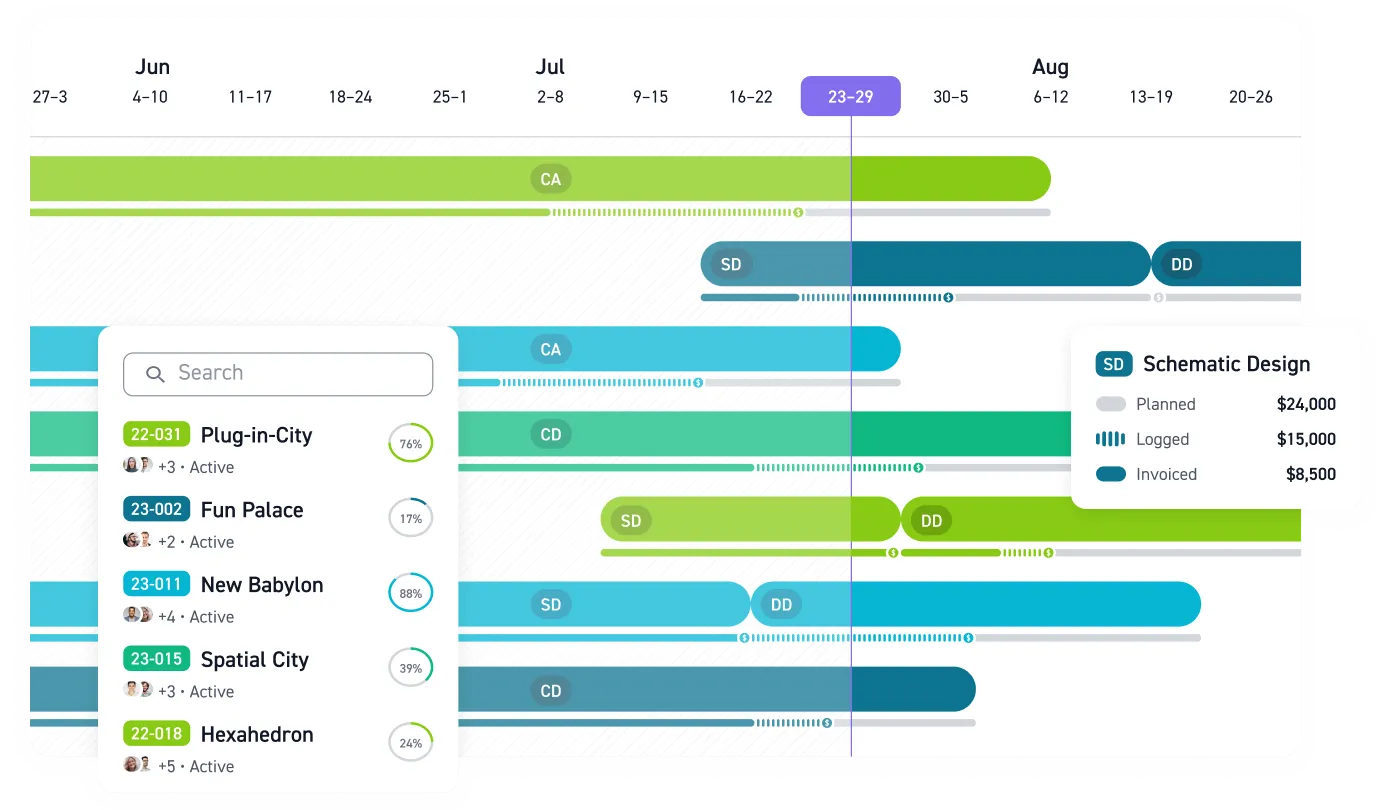
Monograph's MoneyGantt™ shows scope, schedule, and fee status in a single view so principals can see whether a phase is drifting before it closes.
“Every week, the team also uses the MoneyGantt to look at how much is owed to them, and how much time they have billed per project per phase to make sure they’re not going over budget.”
—Brad Mallette, Founder at AMBL Studios
Approved time flows into draft invoices that sync to QuickBooks Online. For staffing, the resource planning view replaces the manual process of sifting through emails and spreadsheets to schedule the team. Jessica Hester, CEO and Principal Architect at Verdant Studio, found that task went from four to five hours per week to under an hour after switching to Monograph.
Workbench, a 30-person California firm that previously ran on BQE Core, Excel, and Smartsheets, reported 75% fewer unbilled fees after moving to Monograph.
"I have downloaded every major software and tried at least 30-40 different platforms. None of them compare to the ease of use, simplicity, graphic style, and overall effectiveness of Monograph."
—Swatchroom | WASHINGTON D.C.
Key features:
- Phase-based budget tracking and burn visibility
- Multi-rate billing across roles and project phases
- Resource planning tied to phase schedules and fee budgets
- Monograph's MoneyGantt™ for real-time scope, schedule, and cash visibility
- Time tracking that flows directly into draft invoices
- QuickBooks Online sync
Pricing: Monograph offers two plans. Contact Monograph directly or visit the pricing page for current rates.
Reviews: 4.5 ⭐ (224 Reviews on Capterra)
Check out how Monograph customers build, manage, and grow high-performing A&E firms.
- How AMBL Studios Manage Budget and Time with Monograph
- How Woodhull streamlines collaboration after switching from BQE Core to Monograph
2. Deltek Ajera

Deltek Ajera is project management and accounting software developed specifically for architecture and engineering firms. It includes built-in accounting, so firms that want to replace QuickBooks rather than integrate with it will find it relevant. Some users note that the interface reflects its age, so it is worth requesting a demo to evaluate usability directly.
Key features:
- Real-time dashboards
- Built-in accounting tools
- Billing and invoicing
- Payroll services
- Mobile app
- Time and expense tracking by project
- Staff utilization and workload forecasting
Pricing: Deltek Ajera does not publish pricing publicly. Contact their sales team for a quote.
Related Read: Deltek Ajera Alternatives for Architecture Firms
3. BQE Core

BQE CORE is presented as an all-in-one firm management platform created by architects and engineers. It is feature-rich, with several capabilities carried over from its predecessor ArchiOffice. Product reviews indicate it can require meaningful effort to implement and administer. INC Architecture & Design reported saving dozens of hours each month after implementing the platform.
Key features:
- Phase-based budgeting and invoicing
- Direct AIA G702/G703 billing support, including Schedule of Values for G703 continuation sheets
- Time tracking and expense management
- Project management and document management
- CRM and HR modules
- Comprehensive reporting
- Mobile app for iOS and Android
Pricing: Public benchmarks suggest starting costs around $29/user/month, with add-ons for different features and usage levels. Contact BQE directly for a current quote.

4. Harvest

Harvest is time tracking software for small businesses with invoicing and basic project management capabilities. It integrates with tools like Asana and Trello and is easy to get running quickly. Because it was not designed for A&E workflows, it does not track time against project phases or contracts, which means A&E firms typically maintain separate budget spreadsheets alongside it. Dorman Associates, an 18-person California firm, moved to Monograph after using Harvest and reported 2x faster billing and 25% fewer budget overages.
Key features:
- Time tracking and timesheets
- Project budgeting at the project level
- Invoicing and basic billing
- Reporting and integrations
- Mobile app for iOS and Android
Pricing: Starts at $12/user/month.
5. Toggl

Toggl Track helps teams track time, manage projects, and generate reports. It is widely used by freelancers and small teams who need simple, accurate time logs. It does not handle phase-based contract structures, which are central to how architects invoice. A free plan supports up to five users; paid plans give access to billable rates, team reporting, and project forecasting.
Key features:
- Easy-to-use time tracking
- Visual reports
- Billable rates and revenue tracking (paid plans)
- Team overview and activity monitoring
- Mobile app for iOS and Android
- Integrations with Asana, Trello, and other project tools
Pricing: Free for up to 5 users. Starter plan starts at $10/user/month ($9 billed annually). Premium plan starts at $20/user/month ($18 billed annually).
6. TimeCamp

TimeCamp is a web-based time tracking tool suited for freelancers through larger teams. It offers income calculation, invoicing, attendance tracking, and a broad set of integrations. It does not include A&E-specific billing or phase-level budget logic. Teams that need to track time against project phases will find it requires manual budget reconciliation outside the tool.
Key features:
- Automatic time tracking
- Income and expense calculation
- Invoicing module
- Attendance and time-off tracking
- Integrations with Slack, Salesforce, Toggl, Harvest, Zapier, and others
Pricing: Free plan available. Paid plans start around $3.99/user/month billed annually.
7. RescueTime

RescueTime approaches time tracking differently from the rest of this list. Rather than tracking time against projects and clients, it tracks how time is spent across apps and websites, scores productivity, and helps individuals and teams improve focus habits. It is best suited for firms focused on reducing distraction and improving personal productivity, not for project billing or financial management.
Key features:
- Automatic app and website tracking
- Productivity scoring and daily highlights
- Focus session tools and distraction blocking
- Goal setting and detailed reports
- Team-level visibility
Pricing: Plans start at $7/month.
8. Timely

Timely automates timesheets using an AI-powered memory tracker that logs activity across apps without requiring manual entry. It helps teams struggling with timesheet compliance by reducing the burden of logging after the fact. It does not include phase-based structure for A&E billing. For firms where incomplete time logs are the primary problem, it is worth evaluating.
Key features:
- Automatic timesheets via AI memory tracker
- Copy-and-paste time entries across multiple days
- Scheduler to compare planned vs. actual work
- Team dashboard for tracking submission status
- Automatic reminders for missing entries
Pricing: Starter plan starts at $11/user/month. Premium plan starts at $20/user/month.
9. TrackingTime

TrackingTime is a cloud-based tool for tracking progress and measuring productivity across teams of any size. It covers the basics of time logging, scheduling, and calendar syncing. Like other general tools in this category, it is not structured for A&E contract workflows. A free plan is available for small teams.
Key features:
- Time tracking and repeating event scheduling
- Calendar sync and due date management
- Team activity overview
- Import of time entries
- Reporting and productivity analysis
Pricing: Free plan available for small teams. Paid tiers start at $3.75/user/month.
10. Everhour

Everhour integrates time tracking directly inside task management tools, including Asana, Trello, and Basecamp. It offers billing, budgeting, visual planning, and invoicing features. It is not structured for phase-based A&E contracts, but for teams already running their work inside a task manager, the embedded approach reduces friction for time logging.
Key features:
- Time tracking inside popular task management apps
- Billing, budgeting, and expense tracking
- Invoicing
- Visual planning and task management
- Reporting
Pricing: Free plan available for individuals. Team plans start at $8.50/user/month.
4 Reasons Architects Should Use Time Tracking Software
1. It Saves Time on Administration
A good time tracking system should save time in the way it is designed, not just in the data it produces. Sifting through emails and staffing spreadsheets to plan the week for a team of ten can take four to five hours. With resource planning that pulls directly from project data, that same task takes closer to an hour. The hours recovered go back to design work and business development, not administration.
2. It Keeps Projects on Time and on Budget
Scope creep goes unbilled when firms have no way to see a phase is over budget until after the work is delivered. Whether you bill hourly or on a fixed fee, project-based time tracking is how you see where the budget stands relative to the timeline. Monograph's MoneyGantt™ puts a fee indicator directly on the project schedule so principals can course-correct before a phase closes, not after.
3. It Gives You Real-Time Visibility Into Costs
The firms that manage profitability well are not running reports at the end of the month and hoping for the best. They have live insight into planned fees versus consumed fees, billable hours versus logged hours, and which projects are tracking to margin. Monograph's Projects Report surfaces that data in a single view across every active project, without pulling numbers from multiple spreadsheets.
4. It Lets You Forecast Your Pipeline
Understanding what work is coming, and when it will generate revenue, is what separates reactive scheduling from deliberate growth. Dawn Zuber, FAIA, Principal at Studio Z Architecture, uses Monograph's Planned Profit Report for exactly this:
“Planned Profit Report is so useful for us in our monthly meeting to look forward for the next 3 months. Being able to look at what’s coming down the pipeline and to see what we think we’re going to be making is extremely helpful."
—Dawn Zuber, FAIA, Principal at Studio Z Architecture
Why the Tool Choice Has Real Financial Stakes
The gap between target and actual staff chargeability widened to 4.0%, up from 2.9% the prior year. Firms often collect payment roughly two months after invoicing, and only 23% of project fee arrives by the end of schematic design. When time entries do not connect to phase budgets and billing, those problems stay invisible until after a phase closes.
Industry data shows that two out of three technology-forward firms projected a profit rate of at least 20% over the following 12 months, compared to half of firms that had not prioritized technology investment.
The right project billing software gives you visibility into where fees are going, which phases are profitable, and where money is slipping away before it is gone. Clear visibility into fee burn supports better project accounting decisions at every level of the firm.
Stop Managing Time Across Spreadsheets and Guesswork
If your team pieces together budgets, billing, and staffing across spreadsheets, QuickBooks, and email, you are making project decisions with delayed information. The longer that continues, the harder it gets to catch phase overruns before they turn into lost profit.
When phase budgets, billing, and staffing are visible in one place, overruns become visible before they close out. Book a demo to see what that looks like in practice.
Frequently Asked Questions
Do small A&E firms really need A&E-specific time tracking software?
Often, yes. Smaller firms can skip a full ERP and still need phase-based budgeting, multi-rate billing, consultant cost tracking, and real-time budget burn visibility. General time trackers handle hour logging but leave the financial layer to spreadsheets, which means the same manual work every billing cycle.
Should we replace QuickBooks or keep it?
That depends on how you run accounting today. ERPs like BQE CORE and Deltek Ajera include built-in accounting, while platforms like Monograph layer A&E-specific capabilities on top of QuickBooks Online.
What should we verify first if we bill by project phase?
Start with phase-level budgeting and invoicing. If the system cannot budget and invoice at the phase level, your team will rely on manual workarounds every billing cycle. From there, confirm multi-rate billing across roles and verify that you can see whether a phase is burning through its fee before it closes.
What matters most if we also manage consultants and construction administration?
You need consultant cost tracking by phase, pass-through billing support, and clear visibility into consultant obligations. If you handle construction administration, verify G702/G703 support directly with any platform you are evaluating. BQE CORE explicitly documents this capability in its public materials.
What is the difference between a full ERP and an A&E-specific PM and billing platform?
A full ERP replaces your accounting software and consolidates more of the business in one system. An A&E-specific PM and billing platform is often a better fit for firms that want phase-based budgeting, invoicing, and staffing visibility while keeping QuickBooks Online in place.
Are general time trackers like Toggl or Harvest worth using for architecture firms?
They work well for basic hour logging and are a reasonable starting point for solo practitioners and very small teams. The limitation shows up at billing time. Without phase-level budget tracking, multi-rate billing, and consultant pass-throughs, most firms end up maintaining separate spreadsheets alongside the tool to manage their actual project accounting.