
It's fee proposal season, and your principal just handed down a profitability target that looks great on paper. Meanwhile, your project managers are building task-level estimates that tell a completely different story. The gap between those two numbers? That's the tension between top-down and bottom-up budgeting. How you resolve it shapes whether your firm makes money or just stays busy.
For A&E firm leaders and finance managers, choosing a budgeting approach has real consequences. It determines whether you know your projects are profitable or whether you're just hoping they are.
What Each Approach Looks Like in Practice
Top-down budgeting starts at the leadership level. Principals and CFOs set firm-wide revenue targets, overhead recovery requirements, and profit margins. Those numbers then cascade down to individual projects, dictating how they're priced and staffed. Think of it as the structural grid for your firm's finances. Everything else has to fit within it.
Bottom-up budgeting works in reverse. Project managers build detailed task-level estimates by phase, discipline, and staff role. Those project budgets aggregate into the firm-wide financial picture. It's granular, collaborative, and grounded in the realities of actual project delivery.
Both approaches sound reasonable in isolation. The problem is that A&E firms don't operate in isolation. They operate in a world of fixed-fee contracts, paused projects, and clients who want more scope for less money. According to the AIA/Deltek Architecture Billings Index, billings have declined for 28 of the last 31 months since they first dipped into negative territory following the post-pandemic boom, while 90% of firm leaders report projects that have been significantly delayed over the past six months. In that kind of environment, fee conversations get harder, not easier. If your budgets aren't sharp, you feel it immediately at the proposal stage.
Where Top-Down Budgeting Works, and Where It Doesn't
Top-down budgeting gives your firm strategic clarity. Leadership sets the financial guardrails, and every project operates within them. For firms running repetitive project types with reliable historical data, this approach works well because past performance creates a dependable planning baseline.
The strategic advantages are real. The AIA's Work-on-the-Boards survey data shows that stipulated sum (fixed fee) is considered the most profitable fee method by 30% of firm leaders, with professional fee plus reimbursable expenses (25%) and hourly rate (24%) close behind. That kind of fee structure decision happens at the leadership level. It's a top-down call that individual project managers wouldn't necessarily make on their own.
Top-down budgeting also keeps billing rates consistent. Industry compensation benchmarks found that architect compensation grew at less than 3% annually between 2023 and 2025, a notable slowdown from the 5% annual growth seen during the post-pandemic boom. Without leadership-level rate strategy, project managers may underprice work or miss opportunities to adjust fees.
But here's the catch. Pure top-down budgeting removes project managers from the budget creation process. A/E management guidance from The Well-Designed Firm reinforces that firms where PMs lack full financial responsibility over their projects will struggle to reach optimal efficiency and profitability. When PMs don't own their budgets, accountability drops. So do margins.
The Case for Bottom-Up Budgeting (And Its Blind Spots)
Bottom-up budgeting shines where top-down falls short: in the messy, phase-by-phase reality of project delivery. When your PM builds a budget from task-level estimates, they're accounting for the actual work, including coordination meetings, consultant reviews, and design iterations that generic top-down targets miss entirely.
This level of detail matters most for firms handling complex, multi-phase projects. Bottom-up budgets give you visibility: Catching budget overruns before they become unrecoverable
That granularity is especially valuable when you consider that payroll and related costs represent up to 75% of a firm's total operating costs. Every staffing decision ripples through your entire financial picture.
But bottom-up budgeting has a well-documented blind spot. Task-level estimates consistently miss indirect costs: the principal's client calls, the PM's weekly coordination meetings, the admin time processing consultant invoices. Firms learn this lesson the hard way. That "profitable" project built from detailed task estimates still loses money because nobody budgeted for the work that doesn't fit neatly into a phase. A practical way to address this is to apply a consistent contingency (based on your firm's historical performance) to cover indirect time that rarely shows up cleanly in a task list.
Bottom-up budgeting also takes longer. A comprehensive, firm-wide budgeting process can take significantly more time and coordination than setting top-down targets.
Why Most Successful Firms Use Both
The data consistently shows that the top-down vs bottom-up budgeting debate is a false choice. Successful small to mid-size A&E firms use hybrid approaches that combine strategic direction from leadership with detailed estimates from project teams.
Strategic planning guidance for A&E firms reinforces this. Firms that fail to gather input broadly across their own organizations end up with plans that look good on paper but fall apart in execution. A good plan creates clarity. A great plan creates alignment. You need both.
The Direct Labor Multiplier (DLM) is a financial ratio (often called the net multiplier) that relates direct labor costs to billable rates or net revenue. It can be used as one tool when comparing top-down revenue targets to bottom-up labor estimates, but it is not uniquely or commonly defined as the mechanism that forces alignment between them. Here's how it works:
- Leadership sets the target DLM based on firm-wide overhead recovery and profit goals. Industry overhead rates typically run between 150-175% of direct labor.
- PMs build project budgets from task-level hour estimates multiplied by labor rates
- The project DLM gets compared against the firm-wide target to check viability
- Misalignment triggers adjustments to scope, fee structure, staffing, or all three
When a project's bottom-up estimate can't achieve the firm's top-down DLM target, you have a clear decision point: renegotiate the fee, reduce scope, or pass on the project.
Making the Hybrid Work at Your Firm
Implementation doesn't need to be complicated. The key is establishing clear responsibilities so that strategic decisions stay with leadership while execution-level budgeting lives with project teams.
Start with these practical steps:
- Set firm-wide financial targets first. Revenue goals, profit margins by service line, and billing rate strategies are leadership decisions that create the top-down framework.
- Let PMs build project budgets within those constraints. Task-level estimates by phase, role, and consultant give you the accuracy that fixed-fee contracts demand.
- Add an indirect-cost contingency to every project. Calibrate it to your firm's historical data so you're not guessing, and so PM budgets account for the non-phase work that always happens.
- Reconcile monthly, not annually. Track actuals against estimates and adjust before small variances become big problems.
The reconciliation step is where most firms fall short. A/E financial management experts warn consistently that too many firms track KPIs that don't actually drive decisions or behavior. Budgeting only creates value when you have the systems and cadence to act on what the numbers tell you.
For example, after adopting a more integrated approach to practice management, Maine-based architecture firm Woodhull was able to reduce budget overages by 66%, demonstrating the direct impact of connecting project planning to financial outcomes.
This is where your financial infrastructure matters. Firms still running budgets through disconnected spreadsheets struggle to reconcile top-down targets with bottom-up actuals in real time. Tools like Monograph give project managers visual budget health and real-time phase burn rates while giving finance leaders firm-wide profitability analysis.
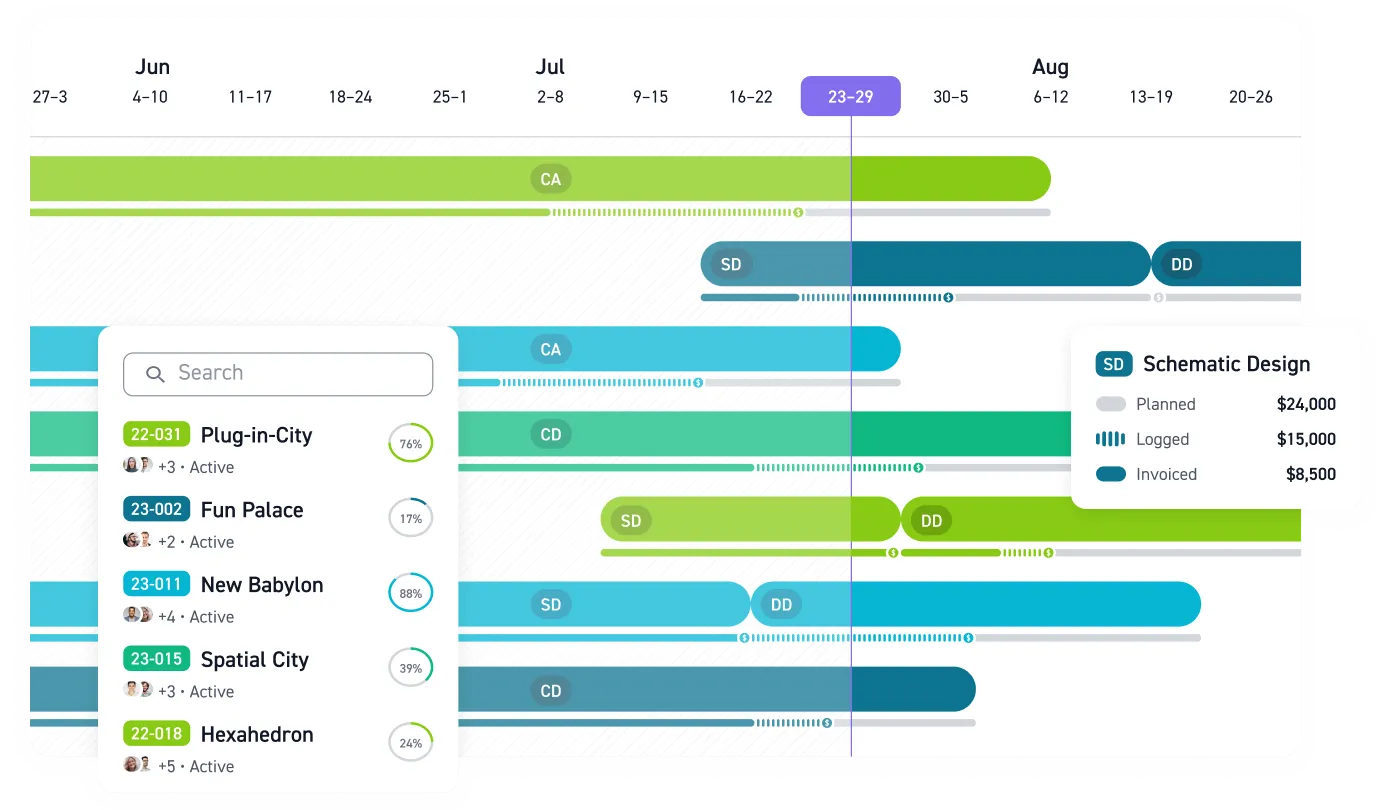
Monograph's signature MoneyGantt™ feature is built for this exact hybrid reality. It turns complex project finance into instant visual intelligence by showing budget-to-cash progression (planned to logged to invoiced to paid) alongside your project timeline. That makes it easier to see, at a glance, whether the bottom-up plan your PM built is actually tracking toward the top-down targets leadership needs.
The firms that thrive aren't choosing between top-down and bottom-up. They're building systems where both work together, where strategic clarity meets project-level precision, and where every team member can see exactly how their work connects to the firm's financial goals.
Stop Choosing. Start Aligning.
You can't run a profitable firm when your leadership's financial targets and your project managers' real-world estimates live in separate, conflicting spreadsheets. The constant battle between top-down goals and bottom-up realities burns out your team and erodes your margins. Reconciling them once a quarter is too late. The damage is already done.
Monograph gives you the hybrid visibility to bridge the gap, connecting leadership's targets with the project-level precision of your teams. See in real time how bottom-up project plans stack up against firm-wide profitability goals, and make adjustments before it's too late.
Build a system where strategy and reality work together. Book a Monograph demo.
Frequently Asked Questions
Our firm is small. Isn't a hybrid budgeting approach overkill?
It's actually more critical for small firms. With tighter margins, you can't afford a single unprofitable project. A hybrid approach doesn't add bureaucracy. It makes sure your fee proposals are grounded in the reality of the work required, and it connects financial goals directly to project-level decisions.
How do we start implementing a hybrid model without disrupting current projects?
Start small. Pick one new project and have the PM build a detailed bottom-up budget. Then compare that to your typical top-down fee target for that project type. The gap between those two numbers is your first, most valuable conversation about scope, staffing, and fee strategy.
My project managers aren't trained in finance. How can they create accurate bottom-up budgets?
They don't need to be accountants. They need to be experts in the work, which they already are. A solid bottom-up budget is a task list with hours by role. The key is giving PMs a simple way to translate phases and tasks into hours and rates so they can own the plan and spot scope creep early.
What's the most common failure point when firms try to reconcile top-down and bottom-up budgets?
They treat it as a one-time, annual exercise. A budget is a living document. The value comes from reconciling actuals against the plan during the project, not just comparing two estimates at kickoff. If you can't see budget health in real time, you're forced to react when the money is already gone.