
You know the drill. Project budgets live in one spreadsheet. Time tracking happens in another app. Invoicing runs through QuickBooks. Client communication sits in your inbox. And when someone asks whether a project is profitable, you spend the next three hours piecing together an answer from four different sources.
Most mid-sized A&E firms operate across 6-12 platforms spanning delivery, finance, and client management. That's not a technology stack. That's a patchwork quilt held together by manual data entry and good intentions.
The Hidden Weight of Fragmented Systems
Industry analysis of A/E software needs confirms what most firms already suspect: when critical project management features aren't baked into a firm's primary system, teams end up tracking data manually in spreadsheets or disconnected tools. That disconnect creates administrative overhead, data inconsistencies, and decisions made on stale numbers.
Think about what happens when a principal asks for a project status update. In a fragmented setup, someone has to pull time data from one system, compare it against a budget spreadsheet, cross-reference billing in the accounting software, and compile it all into something presentable. That's not project management. That's data archaeology.
It also creates a quieter kind of risk: the firm starts accepting "close enough" as normal. When numbers come from four sources and none match exactly, teams stop trusting the data. Then the loudest opinion wins, not the best information.
Firm management technology in this space has remained largely static for years. But firms can move performance more rapidly through better management systems than through many other operational changes. The gap between what firms need and what their cobbled-together systems deliver represents real money left on the table.
Where 17.6% of Your Team's Time Disappears
Data from 337 architecture firms shows the median utilization rate sits at 82.4%. That means 17.6% of your team's time (roughly 7 hours per week per person) goes to non-billable activities. Internal meetings, administrative tasks, business development, chasing down timesheets, reconciling data between systems.
Here's where it gets interesting. Top-performing firms reduce non-billable time to just 4.8%. That's a 72% reduction in administrative overhead compared to the median. The difference isn't that top performers skip internal meetings or ignore business development. They've built systems that eliminate the manual work eating into everyone's week.
The administrative burden hits leadership hardest. Compensation survey data found that senior managers dedicate up to 25% of time specifically to marketing and business development. And that figure is likely understated because many firms don't record senior managers' time for these activities separately from other overhead. If you're a principal who feels like you spend more time on operations than design leadership, the data confirms you're not imagining it.
There's an even more frustrating truth: a lot of that "overhead" time isn't actually improving the work. It's time spent reconciling contradictions between systems. The work is administrative, but it's also mental. You're carrying context in your head because your software can't carry it for you.
The 8 Pain Points That Keep Compounding
Research from multiple industry groups, including professional services management consultancies, AEC advisory firms, and AIA validates eight critical pain points that architecture firms experience with disconnected tools. They cluster into three categories.
Visibility and financial control gaps:
- No real-time financial visibility, leading to budget overruns discovered too late to correct
- Cash flow management complexity in project-based work, where firms need connected billing, time tracking, and tracking to ensure stability
- Disconnected time tracking that prevents profitability analysis by project phase
Operational friction:
- Manual data re-entry across systems, creating error risk and wasted hours
- Complex connection challenges that force some firms to build custom data warehouses just to connect tools
- Stagnant legacy systems lacking modern capabilities
Strategic barriers:
- Technology adoption challenges, particularly for smaller firms. AIA research found that the smallest firms struggle the most with modern technology adoption
- Software selection paralysis, where firms stay stuck in inefficient tool stacks because evaluating alternatives feels overwhelming
Those labels are accurate, but they can still sound abstract. Here's how the pain shows up in real life.
1) No real-time financial visibility
When budgets live in a spreadsheet, they only update when someone has time to update them. That's usually after a deadline, after a billing cycle, or after a meeting where leadership asks for "an updated view."
In practice, this means you find overruns when they're already sunk costs. A PM might realize in week 10 that schematic design burned through 70% of fee, but by then the team already staffed the next two weeks. The easiest "fix" becomes unpaid overtime or quietly eating scope.
2) Cash flow management complexity
Project cash flow is a weird animal. You can be busy and still be broke. With disconnected systems, billing tends to happen in batches: once a month, after timesheets are in, after a PM approves, after someone exports, after someone cleans the invoice, after accounting posts it.
Each "after" is a delay. And delay turns into real money when invoices go out late, then get paid later. A connected workflow helps firms bill closer to when the work happens, which is one of the simplest ways to keep cash predictable.
3) Time tracking that can't answer phase questions
Most firms don't just want to know if Project X is profitable. They want to know where it's leaking.
If time lives in a separate tool without consistent phase structure, you can't answer basic questions:
- Did we overspend in DD, or did CA eat the margin?
- Are we under-fee because we under-scoped, or because we staffed too senior?
- Are consultant coordination hours exploding, or are we just not capturing them cleanly?
Without phase-level clarity, every post-mortem ends the same way: "We'll be more careful next time."
4) Manual data re-entry
Manual re-entry isn't just slow. It's error-prone.
The most common failure mode looks small: a project name doesn't match between your budget sheet and your accounting system. Or a phase code is typed differently. Or a PM changes the fee and forgets to tell the person who builds invoices. Multiply that across 30 active projects and you get a consistent haze of mismatched numbers.
And because the fixes are "small," they rarely get prioritized. The firm just absorbs the drag.
5) Connection challenges that trigger DIY workarounds
Once firms feel the pain, they try to connect the tools. That's when the hidden cost appears: you're now managing integrations.
If you've ever built a Zapier flow, a custom spreadsheet import, or a shared folder full of "finalFINALv3.xlsx," you've experienced this. The firm becomes a mini software company. Someone internal turns into the de facto systems admin, and the moment they go on vacation, reporting stops.
6) Stagnant legacy systems
Legacy tools are often good at one thing: accounting, timesheets, or invoicing. The issue is they were not designed around how modern A&E firms operate today:
- more concurrent projects
- more consultant coordination
- more fixed-fee pressure
- higher expectations for real-time reporting
Even if the tool "works," it may require so much process discipline and manual patching that your team starts resenting it. Adoption drops, and the data gets worse.
7) Technology adoption challenges
AIA research points out that the smallest firms struggle the most with adoption. That makes sense. Smaller firms don't have an operations manager to run implementation, build training docs, and police compliance.
So adoption becomes personal. The principal either champions the tool and uses it daily, or it dies quietly. That's why "simple and unified" matters. When one system replaces three, you reduce training, logins, and the daily friction that makes people revert to old habits.
8) Software selection paralysis
If you've ever thought, "We should fix our stack, but I can't take on another evaluation process right now," you're not alone.
The hard part isn't recognizing the problem. It's the feeling that you need to solve everything at once: time tracking, budgets, invoices, reporting, and QuickBooks. A unified platform reduces that fear because you're not stitching together five vendors and hoping they cooperate. You're choosing one source of truth and building around it.
Each pain point feeds the others. Poor visibility leads to reactive management. Manual processes consume time that should go toward design work. And the complexity of fixing everything at once keeps firms locked into the status quo.
What a Unified Platform Actually Delivers
A unified platform isn't "software consolidation" for its own sake. It changes how decisions get made day to day.
Instead of asking, "Can someone pull a report?" you get to ask, "What should we do about what the report is telling us?" That's the difference between managing data and managing a practice.
Firms like Smith Vigeant Architecte saw what happens when you replace Excel-based project tracking with a single system: they reported 50% less time spent on admin and a 2x faster billing process, while also reducing budget overages.
You see similar patterns across other firms that moved off patchwork operations. For example, Woodhull reported 66% time saved on admin and a 50% faster billing process.
Those numbers make sense when you map them back to the pain points. A unified platform eliminates the manual compilation work, provides real-time budget visibility, and connects time tracking directly to project financials.
It also makes weekly management routines more realistic. In a disconnected stack, PMs often avoid financial check-ins because pulling the numbers is painful. In a unified system, you can build a rhythm:
- log time daily (because it's easy)
- review budgets weekly (because it's visible)
- invoice consistently (because it's connected)
Instead of discovering a project went over budget last month, you see the trend developing this week.
For project managers, the shift is even more tangible. When time entries, budgets, phases, and invoicing live in one place, the Monday morning scramble to compile status reports disappears. You stop being a data aggregator and start being an actual project leader.
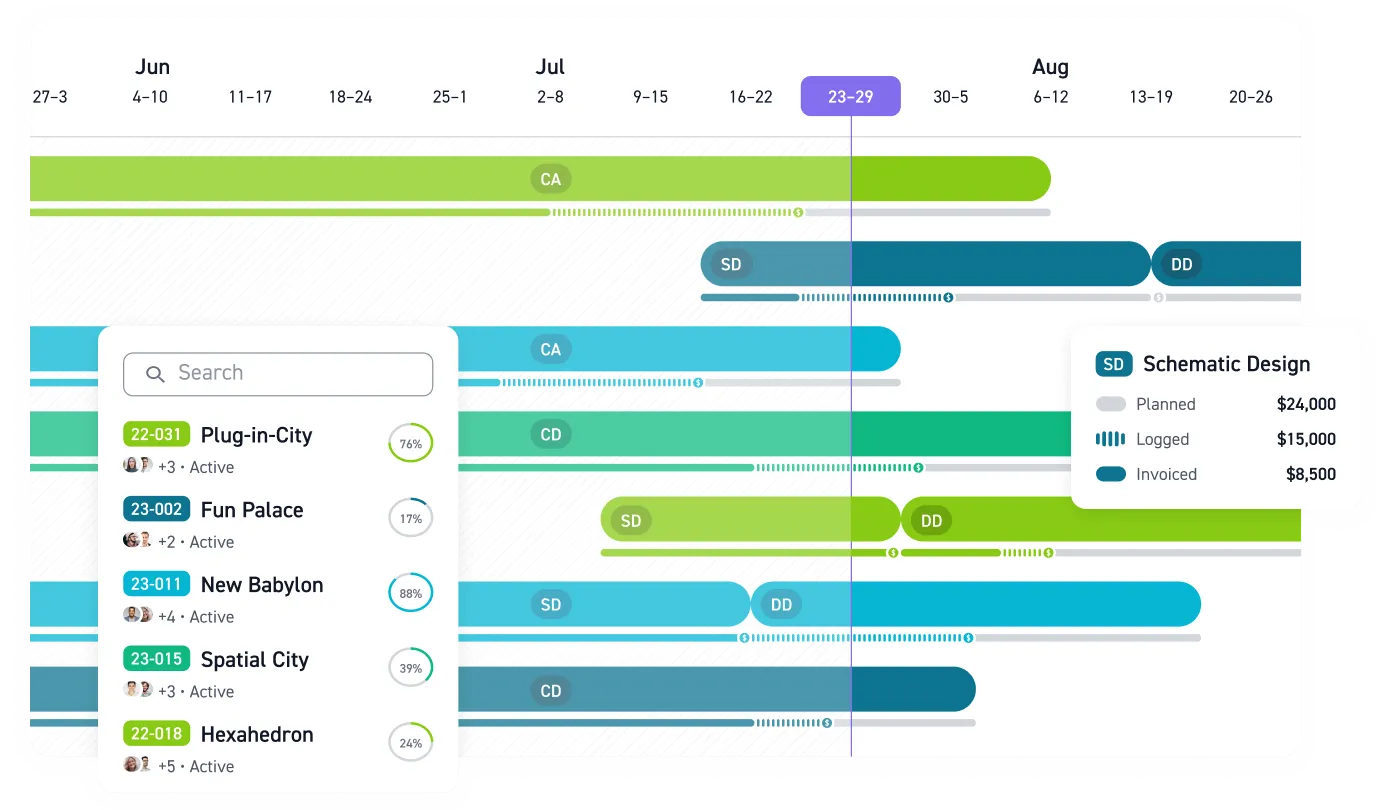
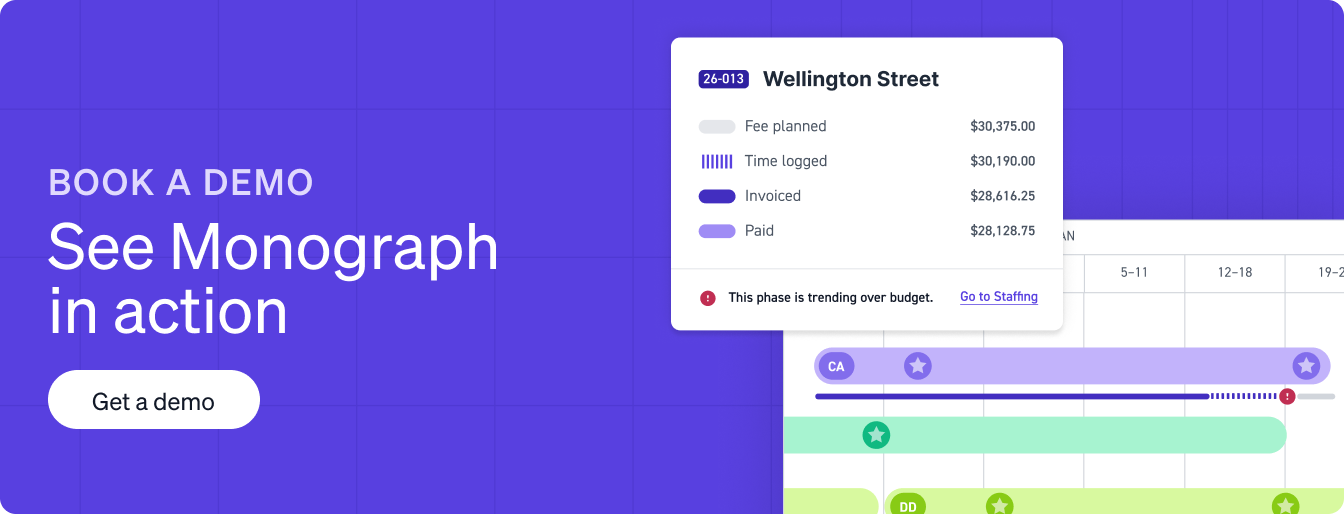
And when the financial picture is visual, it's faster to act. Monograph's signature MoneyGantt™ view turns planned fees, logged time, invoiced amounts, and payments into a single visual track, so you can see what's drifting before it becomes a write-off. That's the kind of clarity spreadsheets promise but rarely deliver.
Why Market Conditions Make This Urgent
Market cycles always hit A&E firms, even the well-run ones. When new work slows or projects pause, fragmentation gets expensive fast because you lose two things you can't afford to lose: cash predictability and staffing confidence.
AIA's Architecture Billings Index (ABI) is the profession's most-watched indicator for near-term demand. You can track the latest ABI releases and regional breakdowns in AIA's ABI resource center: ABI updates.
When billings soften, every percentage point of profitability matters more. Firms running disconnected systems burn overhead on manual coordination while losing visibility into which projects are still generating revenue.
This gets especially ugly with paused work, which is more common than most firms like to admit. Managing paused projects across fragmented platforms means reconstructing context from scattered sources every time something restarts, or worse, losing that context entirely. You end up restaffing from memory, rescoping from old emails, and explaining budget drift with incomplete data.
Industry benchmarking data shows indirect labor represents 35% of total payroll in A&E firms. Since payroll is by far the single largest cost to operate a firm, that's also where administrative inefficiency from tool fragmentation hits hardest. As AIA's own accounting guidance puts it, indirect labor is the largest single component of overhead and the most controllable day-to-day.
In a declining market, trimming that overhead isn't a nice-to-have. It's survival.
Building the Practice You Actually Want
AIA's technology adoption research makes the case that finding a path to adopt technologies serving all aspects of a firm's business is something every architect should be actively pursuing. That path doesn't mean adding another tool to the pile. It means replacing the pile with something built for how architecture firms actually work.
A unified system also changes the culture inside the firm.
In fragmented stacks, financial information becomes "special." Only a few people can access it, interpret it, or trust it. That creates a predictable dynamic:
- PMs feel judged by numbers they didn't create
- principals feel like they're always the last to know
- operations staff become the bottleneck for every question
In unified systems, transparency can become normal. Not because everyone becomes a finance expert, but because the basics are visible and consistent. The team can have healthier conversations earlier, when changes are still easy:
- "We're burning too fast in SD. Can we adjust staffing?"
- "CA is growing. Do we need a fee amendment?"
- "This project is billing late. What's blocking invoicing?"
Good work doesn't suffer when the business is clear. Good work suffers when the business is chaotic.
One Platform, Built for A&E Reality
Monograph was built by architects who lived every one of these pain points: the spreadsheet archaeology, the billing delays, the Monday morning guessing games.
It brings project management, time tracking, budgets, and billing into one platform designed specifically for 5-50 person A&E firms, with a QuickBooks Online connection that ties practice management to your accounting without custom workarounds.
Over 13,000+ architects and engineers across 1,800+ firms use Monograph to work smarter, faster. Firms using Monograph add 21% more revenue on average in their first year by combining clearer insights with more efficient workflows.
The firms that thrive through market uncertainty aren't the ones with the best design ideas alone. They're the ones with the systems to know exactly where they stand, financially, operationally, and strategically, without spending half their week figuring it out.
Stop Juggling Tools. Start Managing Your Practice.
You can't run a profitable architecture practice when your team spends more time hunting for data than designing. Every hour wasted reconciling spreadsheets, chasing timesheets, and manually compiling project reports is an hour your competitors are using to win the next project.
A unified platform isn't just another tool. It's the operational foundation that gives you real-time visibility into budgets, profitability, and team capacity. It replaces administrative chaos with clarity, allowing you to make decisions based on live data, not last month's numbers.
The firms that thrive in any market are the ones that have their systems in order. See Monograph in action.
Frequently Asked Questions
We're a small firm. Is a unified platform overkill for us?
Not at all. In fact, small firms benefit the most. Without a dedicated admin team, principals and project managers end up doing the manual data entry themselves. A unified platform cuts the administrative work that disproportionately lands on small teams, freeing up your most valuable people to focus on design and client work.
Won't migrating to a new system disrupt our active projects?
It's a common fear. A practical approach is to start by unifying the workflows that create the most weekly pain, typically time tracking, budgets, and billing. The goal isn't to flip a switch overnight. It's to stop adding complexity, and start retiring it.
If accounting is your biggest concern, platforms like Monograph connect with tools you already use, like QuickBooks Online, so you can change how you manage projects without creating chaos in your accounting.
Our current mix of tools seems to work. Why go through the trouble of changing?
The patchwork system feels like it's working until it isn't. The real cost is hidden in the 7+ hours per week each team member loses to non-billable admin, the budget overruns you only discover after the fact, and the decisions you can't make because your numbers are stale.
A unified platform isn't about fixing what's broken. It's about getting back the time and visibility you're already paying for, every week.