


Firm management made easy

Every A&E firm hits a growth stage where the systems that got them here start holding them back. Proposals live in a principal's head. Budgets sit in spreadsheets that have not been updated since last month. Nobody knows which projects are actually making money.
As firms grow, they often need to change operating models. Invoicing complexity, project status tracking, and budget visibility all break down at the same time. If you are still piecing together project health from separate spreadsheets, inboxes, and accounting tools, growth gets expensive fast.
The firms that scale successfully are usually doing the same few things well. They build specific, repeatable systems around seven operational levers.
Track Utilization Rate Like Your Business Depends on It
Because it does. Utilization rate is one of the core financial KPIs, alongside net multiplier, payroll multiplier, and overhead rate, in A&E benchmarks. The median architecture firm utilization rate sits at 61% based on industry benchmark data covering nearly 700 firms across the U.S. and Canada.
That gap is one of the clearest efficiency opportunities for most firms. Firms that use consistent tracking systems, including simple ones, often see utilization gains within the first year. Measuring consistently matters more than the tool you use.
Utilization tracking also connects directly to staff well-being. Rebalancing workloads across team members means catching burnout before it becomes turnover, and making sure the right people are matched to the right tasks at the right time. In A&E practice, that matters when one PM is overloaded in CA, another team is light in DD, and nobody sees the imbalance until deadlines start slipping.
Build Your Measurement Systems Before Growth Demands Them
When a firm is small, the founding principal often knows which projects are profitable and which clients pay on time. That knowledge lives in one person's head, and it works. As the firm grows, that same approach creates visibility gaps and bad decisions.
What works is building measurement systems before the lack of visibility becomes a crisis. The key areas to track include:
- Utilization trends as a leading indicator of capacity and staffing needs
- Project burn to catch overruns before they become unrecoverable
- Aging receivables to identify cash flow risks weeks earlier
- Overhead allocation to understand true project profitability
These numbers give project managers and department heads the financial context they need to make better decisions about resource planning, client relationships, and scope management every day. Track net revenue, not gross billings. Firms that do not net out subconsultant pass-throughs and reimbursables will misread their own performance.
Know the True Cost of Every Hire
Most principals underestimate what their people actually cost. Salary is only part of the picture. Once you account for the full cost stack, the real number is much higher:
- Benefits and insurance: health, retirement, PTO, payroll taxes
- Software licenses: design tools, collaboration platforms, project management
- Office space and equipment: rent, furniture, hardware allocation per seat
- Administrative support and overhead: HR, accounting, IT, and firm management time
That gap compounds across every hire as a firm scales. Your payroll multiplier and overhead rate tell you whether your billing structure supports your staffing model. Industry data shows the typical overhead benchmark across A&E firms runs between 150% and 175% of direct labor. If your billing rates are not built around that reality, every new hire can decrease profitability instead of increasing capacity.
Standardize Workflows to Make Delegation Possible
You cannot delegate what you have not defined. A&E firms have adopted Lean principles that standardize the design process so it does not require a principal's involvement at every step, without stripping out design judgment.
The firms that scale successfully build systems alongside project capacity. Turner Fleischer is one example: the firm created operational departments rather than only adding project staff. Growth stage research confirms that each threshold requires a different operating model. Standardization is not a one-time investment. It is a capability you rebuild at each growth stage.
Close the Gap Between Design Tools and Business Tools
A&E firms have made significant investments in BIM, Revit, and design software. Many of those same firms use spreadsheets to run the business. That disconnect is where the efficiency gap lives.
Across adopting firms, an AIA study found that time and cost savings were among the most commonly cited motivations for AI adoption, alongside improved output quality. Practitioners also see strong potential returns in using AI to automate admin tasks. The specification process remains one of the areas where firms report the most workflow friction.
A critical caveat: simple, consistently used tracking systems beat sophisticated systems that nobody maintains. The right adoption sequence matters:
- First, identify what the firm needs to measure
- Second, build the discipline to measure it consistently
- Third, select or upgrade tools that support those measurements
That sequence keeps firms from buying software before they know what they need it to support.
Monograph follows this principle. Built for A&E practices, it connects time tracking, phase-based budgeting, and invoicing in one place so firms get real-time project visibility without stitching together disconnected systems. More than 13,000 architects and engineers across 1,800+ firms use Monograph. Dynamic Engineering reported 25% profit growth after switching from Excel, and Cascadia Architects cut admin time by 50% while growing from 11 to 19 staff in twelve months.
Fix Your Invoicing and Collection Process
A&E firms take an average of 81 days to collect payment, according to the Deltek Clarity A&E Study. Delays in that cycle usually come from invoice generation and client payment, and each needs a different fix:
- Speed up invoice generation by linking projects, time tracking, and invoicing in a single workflow. Billing delays happen when firms struggle to pull data from multiple systems.
- Speed up client payment by sending electronic invoices with electronic payment capability for clients.
- Eliminate the assembly problem by ensuring real-time project data feeds directly into billing when projects, time tracking, and invoicing are linked together.
Firms that map the full proposal-to-paid process as a unified workflow see the biggest improvements. This is the part operations teams feel most acutely at month end, when time entries are late, consultant bills are still arriving, and someone is still rebuilding the invoice from three different systems.
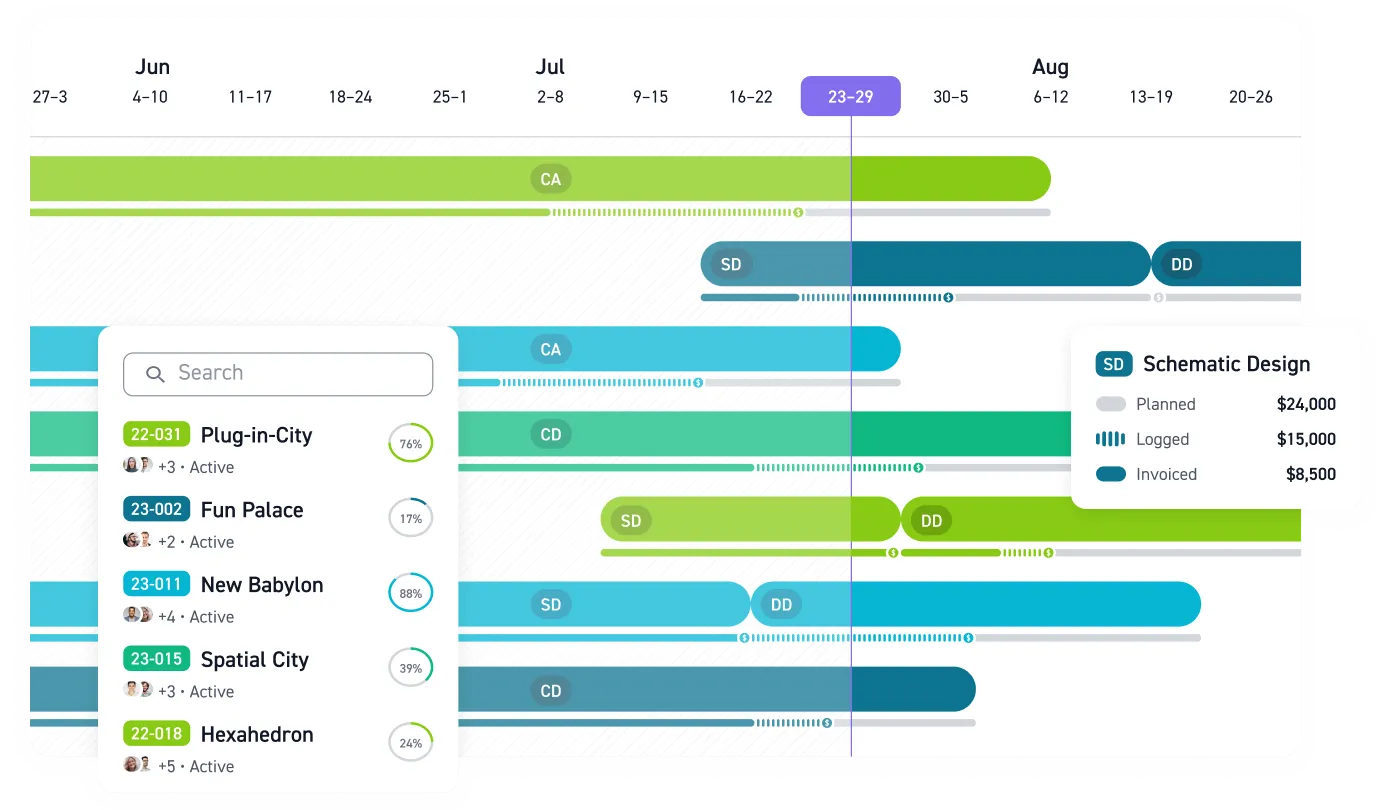
Monograph's MoneyGantt™ feature addresses this directly, transforming complex financial data into visual insights that show budget-to-cash progression across every project phase. When billing data is easier to assemble, invoices go out faster and cash comes in sooner.
Formalize Business Development as a Firm Function
Business development stays important for A&E firms. Architecture and engineering firms have continued to adjust staffing and business development strategies in response to market conditions. Both seller-doer and dedicated BD roles are growing.
SMPS Foundation research has examined how firms allocate marketing resources. Outside consultants make sense for PR, market research, and website design. But proposal work should stay in-house, where the team understands the work and can respond quickly.
The operational prerequisite here is the same as everywhere else: you need visibility into which project types and client relationships are actually profitable before you can make smart BD decisions. Envisage Architecture used Monograph to gain clearer profit visibility and become more selective about which projects they pursue.
The median pre-tax profit benchmark for A&E firms has climbed from 11.8% to 19.2% over the past decade. That spread reflects the difference between firms that invested in business systems with the same rigor they bring to design and firms that did not.
Build the Systems Your Growth Demands
Growth exposes every weak handoff in your firm. If utilization lives in one spreadsheet, budgets in another, and invoicing in someone's inbox, scale gets expensive fast.
Monograph helps A&E firms connect time tracking, phase-based budgeting, invoicing, and project visibility in one workflow. That gives principals, project managers, and operations leaders a clearer view of capacity, burn, and cash flow before small issues turn into margin problems.
If you are spending more time hunting through spreadsheets than reviewing project performance, something is broken. Book a demo to see how Monograph can help your firm scale with more clarity.
Frequently Asked Questions
What's the First Operational System an A&E Firm Should Formalize as It Grows?
Start with measurement. The article points to utilization trends, project burn rates, aging receivables, and overhead allocation as the core visibility systems that help firms make better staffing, scope, and cash flow decisions. If you cannot see those clearly, growth will expose the gap.
How Do We Improve Utilization Without Burning Out the Team?
Track workloads consistently and use that visibility to rebalance work early. Better utilization is not about squeezing more hours out of people. It is about matching the right people to the right tasks, catching uneven workloads sooner, and reducing the hidden inefficiencies that create burnout.
When Should a Firm Move Beyond Spreadsheets?
Usually before growth makes the decision for you. Spreadsheets can work when a founding principal still holds most of the firm's financial and project knowledge, but that breaks down as headcount grows and information asymmetry sets in. If project status, budget visibility, and invoicing are already hard to assemble, you have likely waited long enough.
Do We Need New Software Before Fixing Our Workflows?
No. The article is clear that discipline comes first. Identify what you need to measure, build the habit of tracking it consistently, and then choose tools that support that process. Simple systems that people actually maintain beat sophisticated systems nobody uses.
Which Metric Matters Most When Scaling Operations?
Utilization rate is one of the clearest starting points because it connects staffing, profitability, and workload balance. But it works best alongside burn rates, receivables, overhead, and net revenue. Scaling firms need a measurement system, not a single magic number.