


Firm management made easy

A standard proposal costs an A&E firm between $12,000 and $15,000 to produce. The average win rate across the industry sits between 37% and 44%, depending on discipline. Run those numbers on ten pursuits and you could be looking at a six-figure investment with nothing to show for it.
For principals and senior leaders at small-to-mid-size firms, every lost proposal stings twice. You don't have a dedicated marketing department absorbing the hit. You wrote those proposals yourself, late at night, after managing projects and clients all day. The right proposal software helps you protect your time and reuse what you've already built. It also keeps you from burning hours on pursuits you should have passed on and scrambling to assemble content you've already created three times before.
Why Generic Proposal Tools Miss the Mark
A&E procurement follows a different logic than a typical sales cycle. Qualifications come before price. Federal work is shaped by federal selection rules. Client relationships span decades, not quarters. Teams get assembled per project from multiple disciplines and subconsultants. And if you're pursuing government contracts, the SF330 form is non-negotiable for procurements over $25,000.
When you're assembling a team of subconsultants at 10 PM for a Thursday deadline, you need software that already understands how A&E teams get built. A blank document editor designed for SaaS sales proposals won't cut it.
General-purpose platforms like Proposify, Qwilr, and PandaDoc handle basic document creation and e-signatures. They don't support SF330 compliance, credential management, or AEC-specific integrations. For straightforward private-sector proposals they can work. For anything more complex, they create gaps that cost you time and accuracy.
Features That Actually Matter for A&E Firms
Just as you wouldn't design a building without understanding the site conditions, you shouldn't evaluate proposal tools without understanding your firm's specific procurement landscape:
- Structured Go/No-Go frameworks: Only 40% of A&E firms use a formal process for deciding which opportunities to pursue. At $12,000+ per proposal, disciplined pursuit selection is the single highest-impact improvement most firms can make.
- Searchable project experience databases: When every proposal starts from scratch because no one can find last year's winning content, institutional knowledge walks out the door with every departing employee.
- Capacity-aware pipeline forecasting: Unlike generic sales tools, A&E firms need to evaluate new opportunities against current project workload so they don't pursue work they can't staff.
- SF330 automation: For firms pursuing federal contracts, this single capability narrows the field dramatically. Manual SF330 preparation is a well-documented time sink that professional development programs address regularly across the industry.
These tools vary widely in depth. For seller-doer firms, the priority order is clear: go/no-go discipline first, then reusable content and pipeline visibility, then SF330 automation if federal work is part of your strategy.
The Best Proposal Software Tools by Firm Profile
The A&E proposal software landscape breaks into distinct tiers based on firm size, procurement type, and whether you have dedicated marketing staff.
Deltek Vantagepoint remains the enterprise standard for mid-to-large A&E firms. Its SF330 automation pulls data directly from the platform's database, and it connects opportunity data with resource planning and financials for more accurate forecasting. The trade-off is custom enterprise pricing and a significant implementation investment. Best for firms with 20+ staff, dedicated IT support, and heavy federal work.
Unanet CRM by Cosential occupies the mid-market with purpose-built AEC proposal capabilities. It automatically compiles data from project, financial, and HR systems into a centralized proposal asset library. Strong integration with OpenAsset makes it particularly effective for firms managing large project photo libraries. Pricing starts around $50/user/month. Best for mid-size firms with a dedicated marketing coordinator.
OpenAsset positions itself as the AEC Marketing Platform, combining digital asset management with proposal production capabilities. A survey of 535 AEC marketers found that 63% struggle to manage the digital assets needed for proposals. OpenAsset addresses this through centralized photo and project storage, its Proposal Studio for AI-assisted writing, and a standalone RFP analysis tool called Shred.ai. The platform is used by over 1,000 AEC firms. Best for firms with significant visual portfolios or multiple concurrent pursuits managed by marketing staff.
Flowcase specializes in personnel qualifications and credential management, with template automation for SF330, FIDIC, and Europass forms. If your firm's bottleneck is assembling team resumes and credentials for federal submissions, Flowcase targets that problem directly.
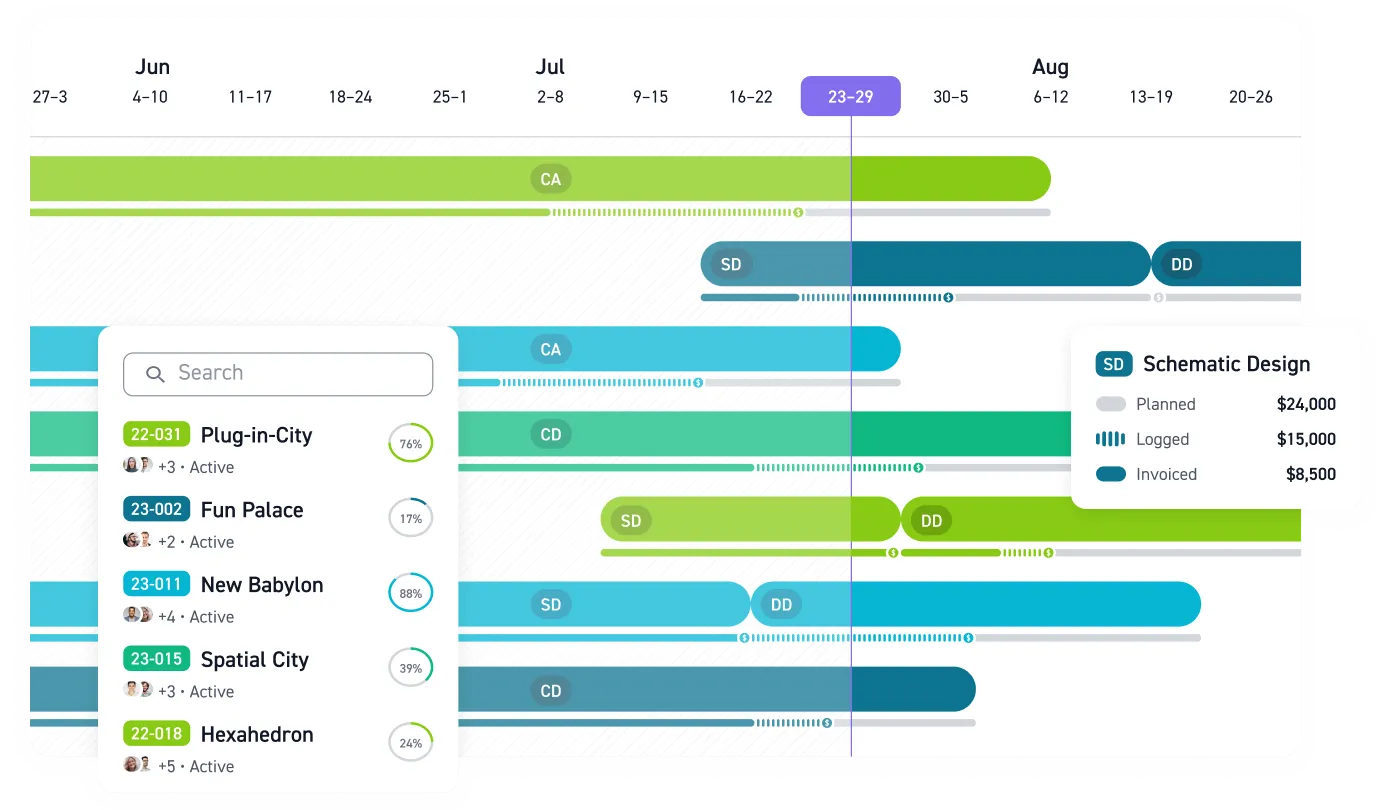
Monograph connects pipeline data directly to project execution, closing the gap between winning work and starting it. Its Pipeline feature links leads, proposals, and forecasts in one view, while contract extraction automatically pulls phases, budgets, and staffing requirements from uploaded contracts so your project structure is ready the moment you win. Monograph's MoneyGantt™ provides a distinctive capacity view, letting you assess new proposals against live project data, current team workload, and budget-to-cash progression. The platform serves 13,000+ architects and engineers across 1,800+ firms at roughly $25/user/month. Best for firms under 50 people where the people winning work are the same people doing it. Brunton Architects & Engineers, an 18-person firm, switched from Deltek Ajera and reported 25% less administrative time along with a 2x faster billing process. That directly increased the time available for proposal development and winning new work.
Proposify ($19–$65/user/month) and Qwilr ($35–$59/user/month) handle basic proposal creation with templates and e-signatures but lack SF330 support or practice management integration.
AI Is Already Reshaping How Firms Win Work
Broad AI adoption across A&E firms has reached 53%, up from 38% the prior year. Within proposal teams specifically, adoption runs even higher, with one AEC marketing survey reporting that 57% of firms already use AI for proposal writing. Firms also point to measurable gains in win rates and turnaround times alongside these AI-enabled workflows.
The practical applications are specific and measurable. Firms report that AI takes on the administrative weight of proposals so humans can stay focused on strategy:
- Compliance matrices and outline automation that speed up first drafts
- Library-wide past-content search across existing proposals
- Automated RFP requirement checks that flag scope risks and evaluation criteria
One mid-size architecture firm connected their existing DAM and CRM systems with targeted automation and cut duplicated effort across their proposal workflow. The lesson for small firms is straightforward: you can modernize by connecting the tools you already use, then filling the gaps with the right platform.
Picking the Right Tool for Your Firm
Before committing to any platform, pressure-test your choice against these realities:
- Federal contract volume: If SF330s are a regular part of your pursuits, you need dedicated SF330 automation, not a workaround.
- Marketing staff capacity: Firms with a dedicated marketing coordinator can handle platforms with steeper learning curves. Seller-doer firms need tools that work without a dedicated operator.
- Tech stack integration: The best proposal tool connects to what you already use for project management and financials. It shouldn't create another data silo.
If you're already using Deltek for financials, Vantagepoint's proposal module is a natural extension. If you're running a leaner stack and juggling active projects while chasing new ones, a platform that connects pipeline to project execution without enterprise overhead makes more sense.
Take Control of Your Pipeline
You can't afford to spend over $100,000 on lost proposals. Generic tools and disconnected spreadsheets don't give you the visibility to know which pursuits to chase and which to pass on. They also can't tell you if you have the capacity to staff the work if you win it.
Monograph connects your proposal pipeline directly to project management and resource planning. See your team's real-time capacity, make data-driven Go/No-Go decisions, and stop wasting late nights rebuilding content you already paid for. Firms like HDG Architecture have seen measurable improvements in project visibility and financial oversight after making the switch. The right proposal is the one you can win and staff profitably. Book a demo.
Frequently Asked Questions
We're a small firm. Isn't dedicated proposal software overkill?
It's usually more critical for small firms. At $12,000+ per proposal, every loss hits harder when you don't have a marketing department to absorb the cost. The right tool adds discipline: it helps you qualify pursuits, reuse the best parts of past proposals, and avoid starting from a blank page every time.
Our biggest problem is just finding the right project sheets and resumes. How does software fix that?
That problem usually comes from disorganized data and inconsistent file storage. Good A&E proposal software is built around a central, searchable library of projects, people, and approved boilerplate. Instead of hunting through folders, you search by client, market sector, size, or role and pull consistent information into your proposal package.
How does proposal software help with Go/No-Go decisions?
It connects the pursuit conversation to reality. When your pipeline lives next to actual workload and staffing, you can see whether you're chasing work you can't deliver without burning out the team. That turns Go/No-Go from a gut call into a clearer decision based on capacity, timing, and fit.
We do some federal work. Do we need SF330 automation?
If SF330s are a regular part of your business, yes. Manual SF330 assembly is slow, error-prone, and hard to standardize across subconsultants and disciplines. If you only touch federal work occasionally, you may be able to get by with strong resume and project data management first, then add SF330 automation when federal pursuits become a consistent strategy.