

New design contracts at architecture firms declined sharply through August 2025, the longest contraction since the AIA began collecting that data. Engineering revenue growth moderated to 2.3% in 2025, down from the prior year. In this environment, WIP management, scope creep detection, and cash flow from existing projects are the load-bearing financial functions of A&E firms. The right financial tools give finance managers and CFOs the visibility into project performance to catch problems before they erode margins.
The Decision That Shapes Everything Else
Before comparing platforms, answer one structural question: do you keep QuickBooks Online and add an A&E-specific layer, or replace QBO with a full ERP?
- QBO-overlay tools like Monograph and Factor AE work alongside QBO. They add phase-based budgeting, project profitability tracking, and consultant cost coordination while your bookkeeper keeps working in the system they already know.
- Full ERP tools like Deltek Vantagepoint, Deltek Ajera, and Unanet AE replace QBO entirely. They absorb the general ledger, AP/AR, and project accounting into one system, with longer rollout demands.
For firms with an established QBO workflow, this distinction matters more than any feature chart. A firm that moves to a full ERP when a QBO overlay would suffice burns time on rollout while the margin problems it needed to solve keep compounding.
The Tools Worth Evaluating
The A&E financial software market in 2026 is shaped by two forces: Deltek Vision is being phased out, and AI capabilities are shipping across major platforms.
QBO-overlay tools:
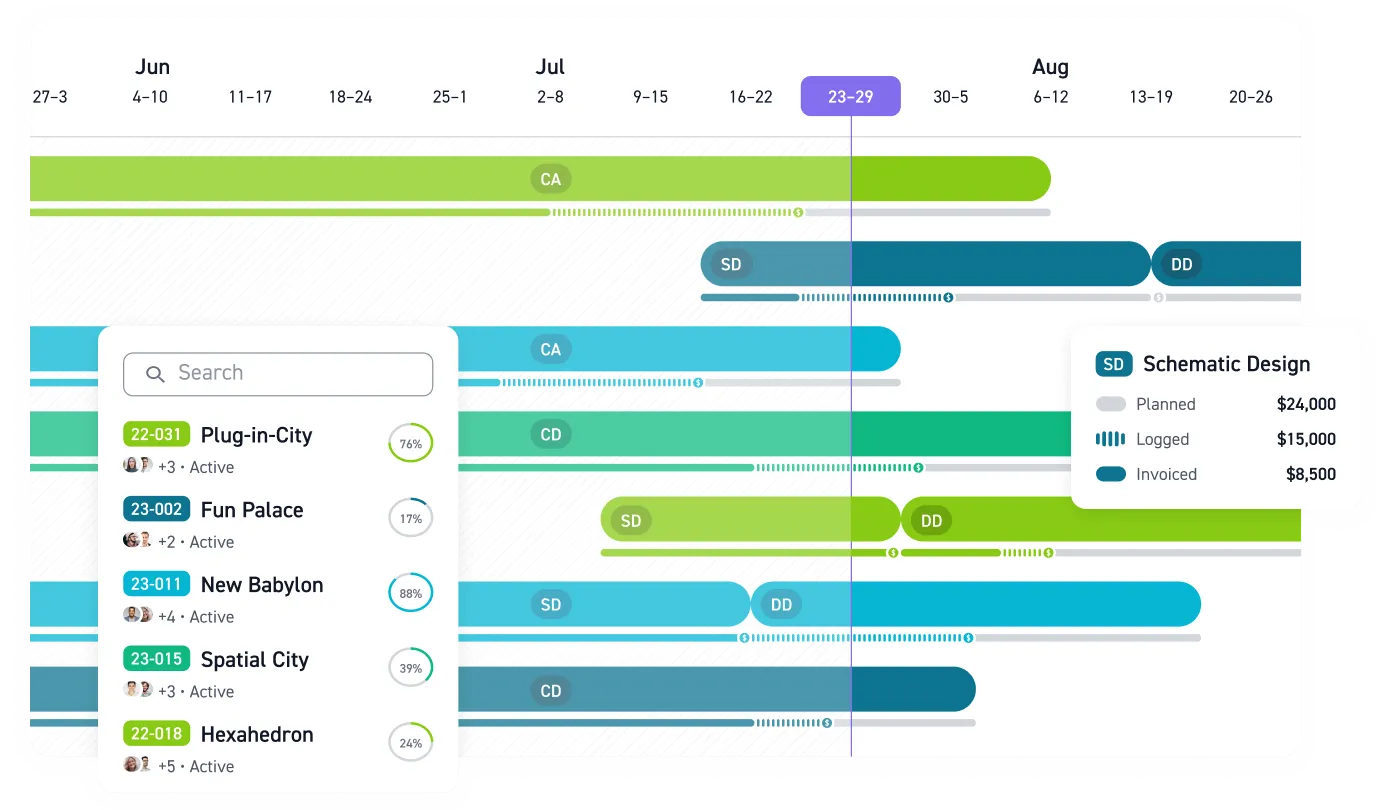
- Monograph centers on its signature MoneyGantt™ feature, which overlays real-time budget status on project schedules using live timesheet data. This phase-level visibility connects time entry to profitability, billing, staffing, and reporting. The QBO integration syncs invoices, expenses, consultant bills, and clients bidirectionally. Built for small-to-mid A&E firms, Monograph is praised for ease of use among purpose-built A&E tools.
- Factor AE provides architecture-specific phase-based accounting with real-time two-way QBO sync, showing fee consumption versus percent complete for budget adjustments.
- BQE CORE uses a modular structure and offers time tracking, invoicing by project phase, accounting, resource planning, and CRM.
An independent comparison says tools like Monograph prioritize ease of use and project visibility, while tools like BQE CORE prioritize billing complexity and accounting depth. That tradeoff shows up in practice: Workbench, a California firm that moved from BQE Core to Monograph, reported 8x faster staffing, 4x faster billing process, and 75% less unbilled fees after switching.
Full ERP replacements:
- Deltek Vantagepoint targets larger firms and added an Accounting Control Center plus an AI layer called "Dela." User feedback has been generally mixed.
- Unanet AE serves mid‑market, project‑driven architecture and engineering firms, and offers AR automation, resource forecasting, and CRM connections.
- Deltek Ajera remains an option for small-to-mid A&E firms focused on accounting depth, with WIP, aging invoice views, payroll services, and phase-based project accounting.
What Your Evaluation Should Actually Test For
Industry guidance establishes that A&E accounting packages must be project-based. Every tool in your workflow needs to demonstrate these capabilities:
- Net revenue tracking at the project level. Net revenue, not gross, is the primary A&E operational metric.
- Separate categorization of direct versus indirect labor. Mixing vacation, sick time, and support staff hours with billable labor distorts utilization data.
- Direct expense tracking by project. Subconsultant fees, testing costs, travel, and printing need to be allocable at the project level, not buried in overhead.
If a system misses any of those basics, project profitability turns into guesswork.
Beyond those requirements, real-time WIP dashboards are one of the most commonly missing capabilities in mid-size firms. The chargeability gap between target and actual utilization widened to 4.0% from 2.9% the prior year. Without live WIP data, that gap stays invisible until it hits the income statement.
Technology fragmentation makes the problem worse. Firms running multiple disconnected systems for accounting, CRM, project management, and utilization tracking struggle to get reliable firm-wide visibility.
During a demo, test for:
- A real multi-phase budget. Don't settle for a canned sample project.
- Consultant pass-through handling. Use the same consultant pass-throughs that create friction in your current workflow.
- Project manager access. Check whether PMs can get the data they need without calling finance.
Those three checks usually reveal whether the software will hold up under real project pressure.
Where AI Moves the Needle
Data from Monograph's 2026 Architecture & Engineering Business Benchmarks Report, built from real platform usage across 16,000+ architects and engineers, shows where AI adoption changes financial outcomes and where it does not.
Firms using AI-driven time tracking showed higher realization rates, and AI-investing firms reported $20,000 more in net revenue per employee compared to baseline. PSMJ's benchmark data also points to strong net revenue per staff performance. But cash captured still depends on realization, scope creep, and write-offs at the project level.
AI adoption showed no measurable effect on payment speed. The 2026 Benchmarks Report confirms that faster collections still require tighter invoicing cadence and collections workflows, not just better software.
For finance leaders, the pattern is straightforward: AI helps firms capture and bill for work, especially around utilization and realization, but it does not repair the collections process.
Choosing Based on How Your Firm Actually Works
A small architecture studio running QBO with a part-time bookkeeper needs a different tool than a larger engineering firm with a dedicated finance team and multi-entity structure. For many firms, the QBO-overlay versus full-ERP decision does most of the sorting.
Monograph gives small-to-mid A&E firms the financial clarity by project and phase that used to require a full ERP, without the migration cost or long rollout. For firms where principals and firm delivery leads need financial visibility alongside project data, that accessibility matters.
Whatever tool you evaluate, bring your actual project data into the demo. The tools that survive contact with your real workflows are the ones worth buying.
See Your Project Margins Before They Slip
Margin pressure doesn't wait for a clean implementation window. If your team is still piecing together WIP, consultant costs, and billing status across disconnected systems, the delay already has a cost.
Monograph gives small-to-mid A&E firms phase-based budgeting, real-time project visibility, and financial clarity inside the QBO workflow many teams already rely on. MoneyGantt™ connects timesheets, budgets, billing, and staffing so your team can see problems early and act while the project is still recoverable.
Bring a real project into the conversation and test the workflow against your firm's actual conditions. Book a demo.
Frequently Asked Questions
Should a small A&E firm keep QuickBooks Online or move to a full ERP?
For many firms with an established QBO workflow, keeping QuickBooks Online and adding an A&E-specific layer is the more practical path. If your biggest problems are project visibility, WIP tracking, and phase-based budgeting, an overlay may solve them without forcing a full accounting system replacement.
What financial capabilities matter most when comparing A&E software?
Net revenue tracking at the project level, separate categorization of direct versus indirect labor, and direct expense tracking by project are non-negotiable. Real-time WIP visibility also matters because hidden problems eventually show up in the income statement.
Are AI features actually useful for A&E finance teams?
Yes, but in specific parts of the workflow. The article shows that AI improved utilization and realization outcomes, but it did not improve payment speed. Collections still depend on invoicing cadence and billing discipline.