

If you're a finance manager or CFO at an A&E firm, you already know the frustration: project profitability data scattered across spreadsheets, consultant invoices sitting in email threads, and phase budgets that looked fine three months ago but now tell a different story. Project accounting methods demand a level of granularity that generic accounting systems were never designed to handle.
The stakes are real. Industry benchmark data shows the median profit margin for A&E firms recently hit a record 20.1% of net revenue. But that number masks wide variation. The firms falling below it share a common thread: poor visibility into where money is actually going at the project level.
Phase-Based Budgeting Starts With Deliverables, Not Percentages
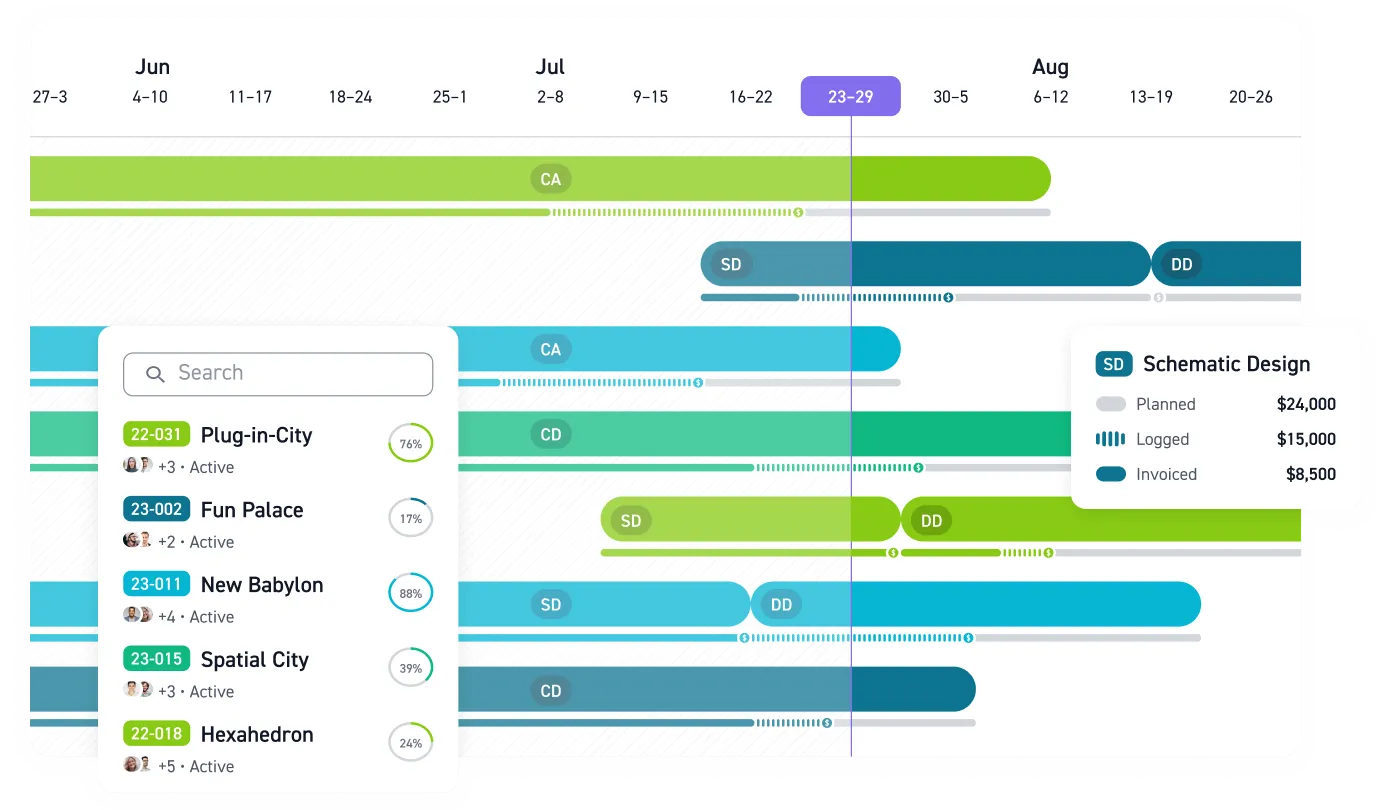
Most finance managers have seen the standard phase allocation benchmarks: Schematic Design at roughly 15% of total fees, Design Development at 20%, Construction Documents at 40%, and Construction Administration at 20%. These numbers circulate widely across practitioner communities and serve as useful starting points for initial planning.
But professional services guidance makes clear that phase budgets cannot be determined by percentages alone. They must align with negotiated deliverable expectations specific to each project. A separate quality management resource reinforces this, recommending that teams develop clearly stated deliverables after schematic design starts, tying each one to the phase's objectives and specific tasks.
Engineering firms face the same reality. Budget control research makes the same point in practice: budgets based only on "similar projects" break down quickly when complexity, site conditions, and project risks differ. This is also why experts emphasize front-end budget control and scoping discipline before a project is underway.
The practical takeaway for finance managers involves three shifts in approach:
- Treat phase percentages as estimates, not budgets. Adjust based on the actual deliverable requirements negotiated with each client before finalizing phase allocations.
- Tie time entries to phases. When a designer logs two hours in SD, that burn should hit the SD budget immediately, not appear in a monthly reconciliation report weeks later.
- Measure deliverables, not hours. Project management training resources recommend Earned Value Management for A&E firms, tracking Earned Value against Planned Value and Actual Cost to catch budget drift before it compounds.
This deliverable-based approach matters most for fixed-fee contracts, where time spent beyond plan comes directly out of margin. Leading practitioners emphasize that budget control has to start before the project kickoff, with an honest conversation about what the client wants versus what they actually need.
The Consultant Billing Reconciliation Challenge
Architecture projects rarely involve a single firm working in isolation. Structural engineers, MEP consultants, civil engineers, landscape architects, each bills on their own timeline, with their own documentation standards, across overlapping project phases.
The standard architect-consultant agreement establishes the contract framework for architect-consultant relationships, with compensation based on multiples of Direct Salary Expense.
But the real accounting headache comes from the payment cascade. Contract payment provisions create situations where subconsultants get paid only within a certain number of days after the owner pays the prime. That ties consultant payment timing to client billing cycles rather than work completion.
For finance managers, this creates a cash flow timing gap that compounds across multiple consultants on multiple projects. You've paid the structural engineer's invoice, but the client hasn't paid you for that same work yet. Multiply that across five consultants and ten active projects, and you're financing someone else's project with your working capital.
Markup practices add another layer. In lump sum environments, firms and clients often cite reduced administrative burden as a benefit, but public sector clients increasingly scrutinize markups.
Under federal procurement rules, A&E fees for public works design services are capped at 6% of estimated construction costs, and many state DOTs require FAR-compliant overhead rate audits as a condition of doing business. Government work demands defensible fee structures where every indirect cost is documented, classified, and auditable.
What finance managers actually need is a system that connects what you owe consultants to what clients owe you: tracking planned costs, actual fees, markup, amounts billed, and amounts collected in one view. Monograph's consultant overview provides exactly this visibility, showing the complete billing chain from consultant fee through client payment so you can manage bills proactively rather than discovering them at month-end.
Discipline-Based Tracking: The Industry's Unresolved Problem
Here's something most software vendors won't tell you: the gap between how firms actually work across disciplines and how their systems track costs remains wide open.
The leading A&E industry study classifies staff by function (technical, marketing, finance, administrative), not by design discipline. Firm management best practices cover broad operational topics and project delivery but don't address granular cost accounting for discipline-level profitability.
This gap exists for understandable reasons. How should a principal's review time be allocated when they're looking at both architecture and interior design work in the same session? When does landscape architecture become a separate discipline versus integral site design? The questions are genuinely hard.
For firms that need discipline-level profitability analysis, the foundation includes:
- Dual-coded time that captures both project and discipline for every entry
- Discipline cost centers within your chart of accounts
- Allocation keys for indirect costs shared across disciplines
- Software configuration that supports multi-dimensional tracking beyond single-dimension phase allocation (Practice management software)
This is an area where profitability-by-discipline analysis can pay dividends, since tracking profitability by customer, geography, and discipline helps you identify your sweet spot and focus on winning the right projects.
The Financial Metrics Driving Profitable Firms
Two metrics drive profit performance above all others, according to financial performance benchmarks: utilization rate and direct labor multiplier.
Data from architecture-specific benchmarks shows top quartile firms achieve 95.2% utilization rates, with a median of 82.4% across all firms. Meanwhile, overhead rates separate competitive firms from struggling ones. A detailed multiplier analysis shows top performers maintain approximately 145% overhead rates against a 161% industry median. That difference reduces the break-even multiplier from 2.61 to 2.45 and creates significant pricing flexibility.
The net multiplier remains the single most consistent indicator of A&E firm performance, combining utilization and pricing into one number: Net Revenue divided by Total Direct Labor Cost.
Real-Time Visibility Is No Longer Optional
The Architecture Billings Index has shown contraction for most of the past three years. In a declining market, accounting deficiencies that once caused minor margin erosion can threaten firm viability.
Firms using connected billing tools report 21% more revenue within a year compared to firms with disconnected systems, not because they're doing more work, but because cash arrives in time to support the next project cycle. For example, after switching from BQE Core, the 30-person firm Workbench cut unbilled fees by 75% and made their billing process 4x faster. That directly addresses the challenge of converting completed work into timely revenue.
Spreadsheets and generic accounting tools can't provide the real-time, granular view you need to protect your margins. While you're reconciling last month's data, your competitors are making proactive decisions based on live project financials and catching budget drift before it erodes profit.
The gap between reacting to problems and preventing them is widening. Close it. See how Monograph provides real-time project accounting clarity.
Frequently Asked Questions
My firm already uses QuickBooks. Isn't that enough for project accounting?
QuickBooks is essential for your overall business accounting, but it wasn't built for the phase-based, consultant-heavy reality of A&E projects. It can't show you real-time profitability by project phase or track consultant fees against your project budget. A platform like Monograph connects to QuickBooks to give you the project-level granularity you're missing, turning accounting data into actionable project insights.
How difficult is it to start tracking costs by discipline if there's no industry standard?
The lack of a single standard is exactly why flexible software is critical. You start by defining disciplines as custom tags or roles within your practice management system. Then, you build the habit of coding every time entry to both a project phase and a discipline. It requires some initial setup and team discipline, but a system designed for A&E workflows makes the ongoing tracking simple and far less manual than a spreadsheet.
What's the single biggest benefit of moving from spreadsheets to a dedicated project accounting system?
Real-time visibility. With spreadsheets, your data is always outdated. You're looking at last month's numbers to solve this week's problems. A connected system shows you budget vs. actuals the moment a timesheet is logged or a consultant bill is entered. This allows you to prevent budget overruns and protect your margins proactively, rather than just reporting on what went wrong after the fact.


.png)