



Firm management made easy

Managing project-based billing across multiple phases, consultant coordination, and complex fee structures shouldn't consume more time than designing. Most architecture and engineering firms still wrestle with manual invoicing processes that create bottlenecks, delay payments, and drain resources from core technical work.
The financial reality hits hard. A&E firms wait an average of 71 days for client payments while managing billing rates across 33 position levels and navigating fee structures that range from hourly billing to percentage-of-construction-cost arrangements. For a firm with $2 million in annual revenue, this 71-day collection cycle means $390,000 in outstanding receivables at any given time. That's capital that could fund operations, hiring, or growth investments.
Modern AI-powered billing platforms are transforming how A&E firms approach this challenge. They offer automated workflows that integrate with existing systems while addressing the unique complexities of project-based professional services.
The Current Landscape of AI Billing Platforms
The A&E billing automation market serves six distinct platforms, each positioned for different firm sizes and operational complexity levels. Enterprise-level platforms), mid-market platforms , and emerging A&E-focused platforms each serve different segments.
Enterprise platforms provide complete ERP platforms for midsize and larger architecture and engineering firms. These systems offer AR workflows, with full integration across project accounting, resource management, and financial reporting.
Mid-market platforms target firms with 20-100 employees. Many of them focus on billing tools and features critical for professional services workflows.
Emerging platforms like Monograph specifically address small-to-mid-size firms seeking modern platforms with AI-enhanced capabilities. Monograph combines budgeting, time tracking, invoicing, and payments in one platform, with particular emphasis on QuickBooks Online integration. This is an important feature for firms in the 5-50 employee segment.
The key differentiator isn't just automation. It's understanding A&E workflows. Traditional accounting software treats all billable hours the same. Architecture firms bill differently during schematic design versus construction administration. Engineering firms must coordinate across multiple disciplines with varying rate structures.
Integration: The Make-or-Break Factor
For finance managers evaluating billing automation, integration capability determines successful adoption more than any individual feature. Modern A&E billing platforms utilize three primary integration approaches.
Real-time bidirectional synchronization automatically flows expenses and invoices between billing platforms and accounting systems. API-based connections provide smooth automation without manual data export and import processes. Unified dashboard architecture creates single-interface access to multiple integrated systems. Project management platform integration connects time tracking, expense allocation, and progress-based invoicing workflows.
QuickBooks Online integration deserves special attention for finance managers at smaller firms. Proper integration means expense synchronization and invoice publishing that eliminates the double data entry that creates errors and delays in manual processes.
The integration benefits extend beyond data synchronization. BQE Core notes that when platforms integrate properly, platform access eliminates constant switching between systems.
Addressing Core A&E Billing Challenges
AI-powered billing platforms directly target the operational pain points that drain productivity from architecture and engineering firms.
Phase billing complexity represents a persistent challenge unique to A&E work. Projects progress through distinct phases, requiring percentage-based or milestone-based billing rather than simple time-and-materials invoicing. Modern platforms automate these workflows by tracking phase completion and triggering appropriate billing schedules without manual intervention.
Consultant coordination becomes manageable when billing systems can track multiple specialized consultants (structural engineers, MEP engineers, civil engineers) and automate pass-through billing coordination. Rather than reconciling consultant invoices manually, integrated platforms track consultant costs and generate client invoices with accurate pass-through charges.
Work-in-progress management gives project managers visibility into unbilled time and expenses before invoicing occurs.
The rate management challenge hits firms particularly hard given industry trends. According to recent research, firms have implemented 11% rate increases over three years, with 15% increases at upper quartile firms. Managing these rate changes across dozens of position levels while ensuring accuracy on every timesheet requires organized automation rather than spreadsheet updates.
Implementation Considerations for Finance Managers
Successfully implementing AI billing automation requires understanding both the technology capabilities and the organizational change management involved.
Data migration from existing systems must account for project history, client billing arrangements, and consultant relationships. While vendors emphasize smooth transitions, finance managers should plan for parallel system operation to ensure accuracy.
Staff training becomes critical since time entry workflows will change. The most successful implementations involve project managers and staff in system selection to ensure buy-in for new processes.
Performance measurement should establish baseline metrics before implementation. Track current DSO, billing cycle time from timesheet submission to invoice generation, error rates requiring invoice corrections, and FTE hours spent on billing administration. These metrics give you accurate ROI calculation and ongoing optimization.
Vendor selection should prioritize firms serving the A&E market specifically rather than generic professional services providers. The nuances of phase billing, consultant coordination, and project-based accounting require industry-specific expertise that generic platforms lack.
Modern AI billing automation represents more than efficiency improvements. It helps A&E firms focus resources on technical excellence rather than administrative coordination. For finance managers balancing cash flow management with operational efficiency, these platforms provide the organized workflows necessary to scale professional practices without sacrificing the attention to detail that defines quality architecture and engineering work.
Stop Wrestling with Manual Billing Processes
You're reading this because you recognize the problem. Your billing cycles take too long. Your project managers complain about administrative overhead. Your cash flow suffers because invoicing happens weeks after work completion. Meanwhile, the firm across town is billing twice as fast with half the effort.
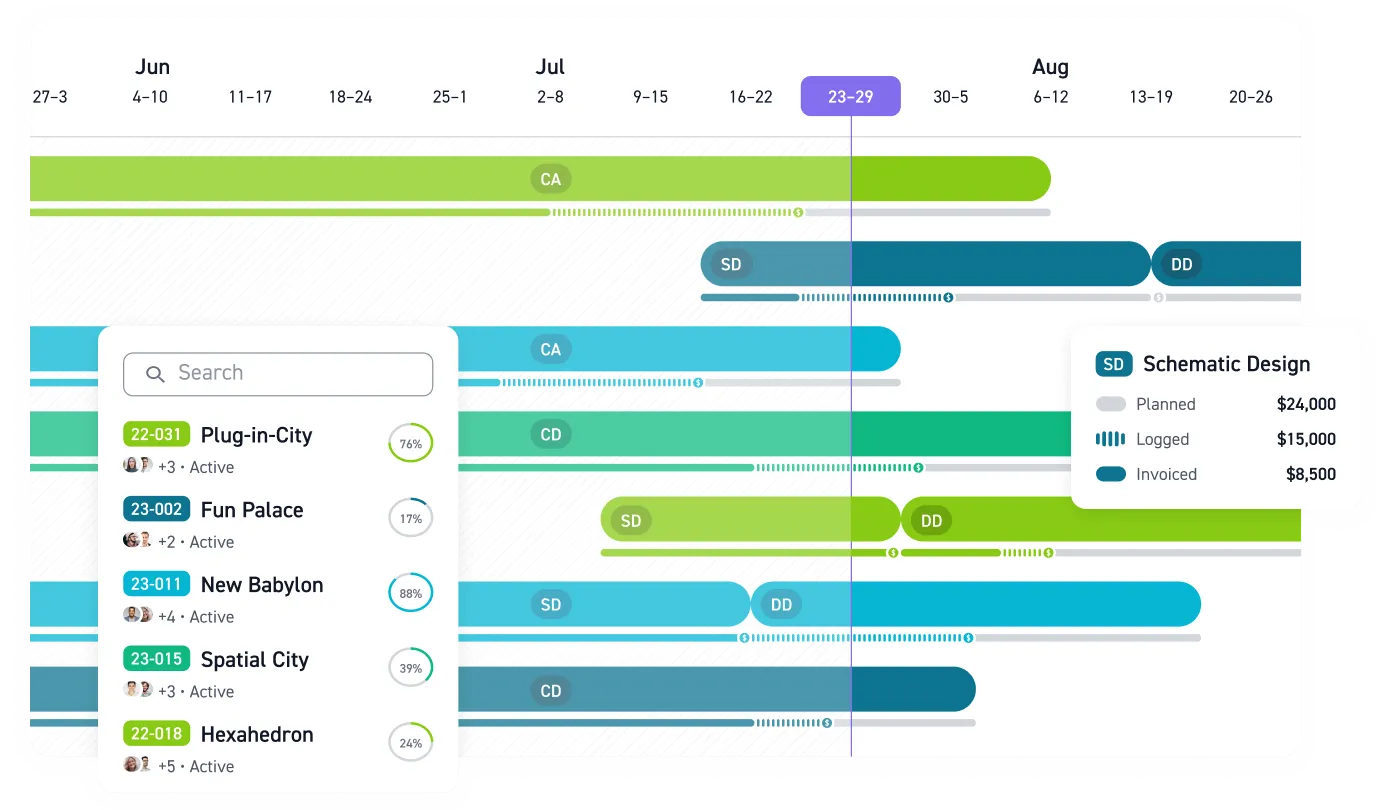
Platforms like Monograph provide project status workflows with Monograph's MoneyGantt™ visual budget tracking. This tool helps teams combine traditional timelines with budget-to-cash progression for clearer project insights. This prevents the surprise of discovering project overruns during billing cycles and helps firms make course corrections while projects remain active.
Our platform understands phase-based projects, consultant coordination, and the complex fee structures that make A&E billing different from generic professional services. Over 13,000+ architects and engineers across 1,800+ firms use Monograph to work smarter, faster. Firms using Monograph add 21% more revenue on average in their first year by combining clearer insights with more efficient workflows.
Finance managers use Monograph to automate invoice generation from timesheet data, process payments through integrated Stripe, and maintain QuickBooks Online synchronization without double-entry. Operations leaders deploy it to cut billing cycles in half while improving accuracy. Project managers let it handle consultant billing coordination and work-in-progress tracking.
Your competitors are already automating. Get started with Monograph →
Frequently Asked Questions
How long does it take to implement AI billing automation in our firm?
Implementation timelines depend on your firm size and existing systems, but most A&E firms see core functionality operational within 2-4 weeks. You'll spend the first week connecting your QuickBooks Online integration and importing historical project data. Week two focuses on configuring billing rates across your position levels and setting up phase-based project templates. Weeks three and four involve parallel system operation, running your old billing process alongside the new platform to verify accuracy before full transition. The firms that implement fastest involve project managers early, establish clear baseline metrics before starting, and resist the urge to customize everything immediately. Start with standard workflows, then refine based on actual usage patterns.
Will AI billing software integrate with our existing QuickBooks setup?
Modern A&E billing platforms provide two-way QuickBooks Online synchronization that eliminates double-entry between systems. Expenses entered in QuickBooks automatically appear within appropriate projects in your billing platform. Invoices created in the billing system push to QuickBooks upon finalization, and payments sync back to update project profitability in real-time. The integration handles client contacts, consultant vendor records, and real cost data without manual CSV exports or import processes. However, verify that your specific QuickBooks configuration (chart of accounts structure, class tracking, and custom fields) maps cleanly to the billing platform's architecture before committing to implementation.
What's the ROI timeline for implementing billing automation?
Most A&E firms see measurable returns within 60-90 days through three primary channels. First, billing cycle time drops from 3-5 days to 1-2 days, freeing administrative staff for higher-value work. Second, days sales outstanding improves by 15-25% when invoices go out faster and integrated payment processing reduces friction. Third, error rates requiring invoice corrections decrease by 40-60% when automation handles rate calculations and consultant billing coordination. For a $2 million firm with $390,000 in outstanding receivables, reducing DSO from 71 days to 60 days frees up approximately $60,000 in working capital. Calculate your own ROI by measuring current billing cycle time, invoice error rates, and days sales outstanding before implementation.
How do we migrate data from our current billing system without disrupting operations?
Successful data migration follows a structured three-phase approach. Phase one involves exporting historical project data, client billing arrangements, and consultant relationships from your existing system. Plan for 40-60 hours of data cleaning and validation. Phase two implements parallel system operation where both old and new platforms run simultaneously, allowing real-time comparison of outputs and identification of discrepancies before full transition. Phase three executes the cutover during a natural break in your billing cycle, typically month-end after invoices are finalized but before the next billing period begins. The firms that migrate smoothest start with new projects first, maintain detailed documentation of custom billing rules and rate structures, and resist the temptation to rush cutover before parallel testing confirms accuracy.
What training do staff need to adopt new AI billing workflows?
Staff training requirements vary by role but typically require 2-4 hours of focused instruction per person. Project managers need training on work-in-progress monitoring, phase-based budget tracking, and consultant coordination workflows. Staff members handling time entry learn automated timesheet workflows that sync with project assignments. Finance personnel focus on invoice generation, payment processing, and QuickBooks integration management. The most effective training happens in three stages: initial overview session covering platform philosophy and core workflows, hands-on practice with test projects that mirror real billing scenarios, and ongoing support during the first billing cycle when questions arise. Schedule training two weeks before go-live, not months in advance when details will be forgotten by implementation.