

The Utilization Problem No One Talks About
If you run an A&E firm, more than a third of your labor hours never make it onto an invoice. Industry benchmarks put healthy utilization at 60% to 65% of total labor dollars, which means a large share of every week goes to administration, coordination, and overhead.
Median utilization for healthy A&E firms now sits between 75% and 85% for billable roles, with most firms struggling to hold that line. In a fixed-fee world, every unbilled hour comes directly out of margin.
Senior managers at A&E firms charge only 26% to 53% of their time to client projects. These are the highest-cost people in your firm, buried in coordination work instead of leading projects or developing business. Whether AI-powered project management can reclaim some of those hours depends on a few caveats worth understanding.
What Breaks Down in Spreadsheet-Based Management
If your firm runs on Excel budgets, separate time-tracking apps, manual invoice assembly, and disconnected reporting, you already know the pain. You've lived the Friday scramble to reconstruct timesheets from memory. You've discovered at project close that SD burned through fee too early. Each system works in isolation. None of them talk to each other in real time.
Construction industry research found that AEC professionals lose up to 14 hours every week, roughly 35% of their time, to searching for project data, dealing with mistakes and rework, and handling conflict resolution.
That lost time usually shows up in the same places:
- Time gets entered late, after details are already fuzzy
- Budget status lives in a spreadsheet no one fully trusts
- Billing waits on manual cleanup before invoices can go out
Those breakdowns add up quickly into lost capacity that could go toward revenue-generating work or business development.
Firms relying on manual timesheets often struggle to capture employee time completely and accurately. Without reliable time capture, they may find it harder to set utilization targets by role, identify where hours are leaking, or catch budget overruns before projects close.
Where AI-Powered Tools Move the Needle
Three areas show the clearest operational gains.
The first is simpler time tracking and utilization visibility. AI and machine learning can help automate time collection and timesheet creation, moving firms toward complete time accounting. Once you capture all hours, you can benchmark utilization by role, team, and project type. A peer-reviewed study found that AI tools can reduce documentation time, and AI-generated outputs were rated favorably for quality and completeness compared to standard manual workflows.
The second is billing cycle acceleration. The gap between work performed and invoice sent is one of the most persistent cash flow drains in A&E. AI-powered billing connects logged time directly to invoices, eliminating that bottleneck. Workbench, a 30-person California firm, reported 8x faster staffing, a 4x faster billing process, and 75% fewer unbilled fees after moving off legacy software.
The third is proactive margin protection on fixed-fee work. Fixed-fee contracts transfer scope creep risk to the firm. Without phase-level visibility into hours burned against fee remaining, margin erosion usually surfaces only at project close. Tools that track budget consumption in real time, at the phase level, give project managers the chance to intervene while adjustments still matter.
Recent industry reporting documented how one global engineering firm turned days of administrative work into minutes for tasks like work package breakdown and operations manual queries. The firm reported that AI improved project execution by automating reporting, connecting planning tools, accelerating schedule development, and helping teams spot issues earlier to reduce rework.
What the Data Shows About AI-Investing Firms
Monograph's 2026 benchmark report, drawn from real platform usage across 13,000+ architects and engineers, includes comparisons between firms investing in AI tools and baseline firms. The performance differences are consistent across every tier:
- AI-investing firms average $210K in net revenue per full-time employee, compared to $190K at baseline firms
- AI-investing firms average full realization on fixed-fee projects, while baseline firms lose revenue to write-offs and scope creep
- The performance gap between top and bottom firms widened year over year
Firms pulling ahead tend to share one trait: stronger operational visibility driving better financial decisions.
The 2026 benchmark report includes new sections on AI adoption alongside core cash-flow metrics such as days sales outstanding and accounts receivable turnover. Faster payment still depends on invoicing discipline and client relationships working in concert with the technology.
Why Small Firms Can't Afford to Wait
Industry analysis documents that small and medium-sized firms face a specific adoption barrier: tight budgets and limited personnel time make it difficult to justify billable hours spent evaluating new tools. Recent research found that only 8% of firms have fully implemented AI solutions, with smaller practices reporting the lowest interest in adoption.
The risks for firms staying on the sidelines tend to fall into a few patterns:
- Adopters pull ahead on efficiency and margins, widening the competitiveness gap
- Other professions, better equipped with AI, begin moving into traditional A&E responsibilities
- Clients start expecting faster, more data-informed project delivery as the norm
- Firms without these tools lose their ability to stand apart as AI raises the baseline for professional capability
For smaller practices, awareness is rarely the issue. The blockers are time, staffing, and the reality that evaluating a new system often means pulling billable people into admin work you can barely afford.
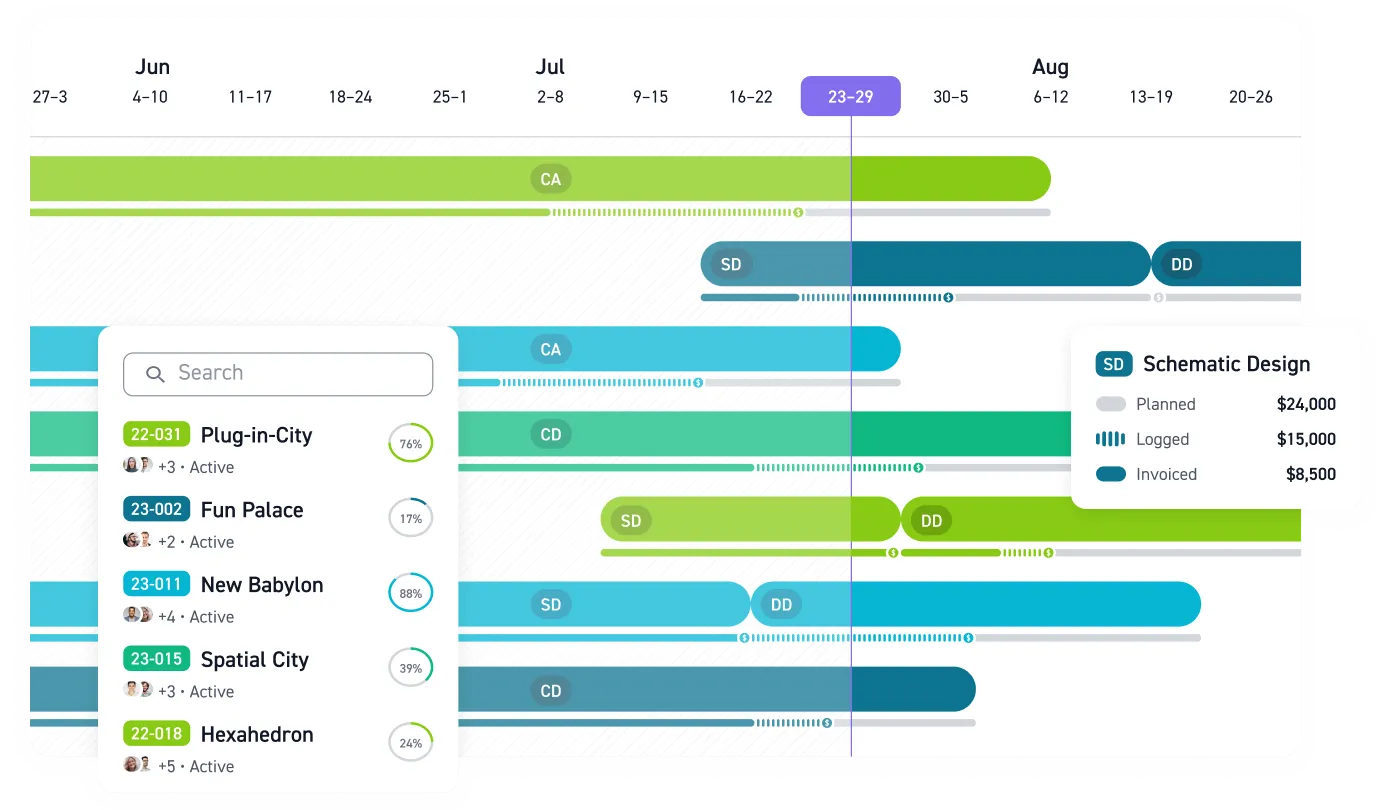
Monograph helps firms get out of spreadsheet chaos without adding more operational overhead. Monograph's MoneyGantt™ tracks budget-to-cash progression in real time, giving small teams visibility that usually takes much more manual coordination. The platform's AI contract parsing can generate project budgets from signed contracts, which helps teams move from project setup into active management with less manual re-entry.
The firms that will thrive are the ones that pair strong design work with strong systems, and stop losing their week to tasks a machine can handle.
Stop Losing Your Best Hours to Admin Work
Principals, project managers, and operations leaders already know where the drag shows up: incomplete timesheets, delayed invoices, scattered budget data, and project problems that surface too late to fix. The next step is getting time tracking, budget visibility, and billing into one connected workflow so your team can spend less time reconstructing what happened and more time leading projects.
Monograph helps A&E firms connect those workflows in one place. With Monograph's MoneyGantt™, simpler time tracking, and AI contract parsing, firms get clearer visibility into hours, fees, invoices, and margin risk before project close.
If your team is still stitching together timesheets, budgets, and invoices by hand, it's worth seeing what a connected workflow looks like in practice. Book a demo.
Frequently Asked Questions
Can a small A&E firm really benefit from AI project management?
Yes. Small and medium-sized firms often feel the pain more sharply because tight budgets and limited personnel time leave less room for admin-heavy workflows. Better visibility into time, budgets, and billing helps smaller practices recover capacity that would otherwise disappear into coordination work.
Will AI replace project managers or just reduce admin work?
The strongest case is for reducing admin work. The examples in this article focus on time capture, billing, reporting, and earlier visibility into budget consumption rather than replacing project manager judgment.
What's the best place to start: time tracking, billing, or budgeting?
Start where your firm is leaking the most time or margin. If time capture is inconsistent, fix that first because incomplete hours weaken utilization tracking and billing. If invoices are delayed, focus on connecting logged time to billing. If fixed-fee projects keep surprising you at closeout, phase-level budget visibility is the better first move.
Can AI still help if our current project data is messy?
Yes, but it helps most when your firm moves out of disconnected spreadsheets and into a system with real-time visibility. Better structure around time, budgets, and billing gives AI cleaner inputs to work with and gives your team sharper signals for decision-making.
Data was collected as of April 2026.