



Firm management made easy

Most architecture firms lose competitive proposals before they submit a single page. The difference usually comes down to pursuit selection, early positioning, and proof that you understand the client's problem.
Qualifications Win, Not Price
Under the Brooks Act, federal procurement rules require A&E contracts to be negotiated based on demonstrated competence, not price. This framework, known as qualifications-based selection, is widely used by states as well. Under QBS, agencies rank firms on qualifications first, then negotiate fees only with the top-ranked firm.
This means your proposal's job is to win the qualifications ranking. Fee negotiation happens after selection. Yet research from PSMJ indicates that 80% of AEC firms remain trapped in a price war, reflecting persistent commoditization across the industry.
For small and mid-size firms, QBS creates an opening. A large firm may have more overhead and more resumes, but it still has to prove it understands the client's specific needs.
Where to Find Architect RFP Opportunities
On average, repeat clients account for roughly 75% of revenue for A&E firms. New competitive pursuits matter for growth, but they should be chosen carefully.
No single portal covers everything. Most firm principals end up checking several sources before they find opportunities that actually match their practice.
Federal and state portals provide the broadest coverage:
- federal opportunity listings list federal opportunities and can be searched by NAICS code 541310. Registration is required for federal work.
- local government bid alerts deliver free email notices for municipal, county, and school district opportunities across multiple states.
- apital plan project data aggregates Capital Improvement Plans into searchable data, giving firms advance notice of projects before formal RFPs are issued.
- AIA state chapter websites often post local public-sector opportunities that do not appear on commercial databases.
Agency-specific portals can also gate access entirely. NYC's PASSport system, for example, requires pre-registration before firms can even see RFQs. Register on jurisdiction-specific portals early, keep your standard federal qualifications form current, and build relationships with agency contacts well before any RFP hits your inbox.
Pursue Fewer, Better Proposals
The highest-return move for improving your win rate has nothing to do with writing. It is saying no to the wrong pursuits. Formal go/no-go processes are designed to improve pursuit selectivity rather than simply increase proposal volume.
Most experienced proposal teams use a formal go/no-go process. For principals who write proposals between site visits and client calls, every pursuit you say yes to takes hours away from billable work and from the pursuits you are more likely to win.
A strong go/no-go review should weigh these factors before committing resources:
- Relationship strength: Did you know the client before the RFP dropped? Firms that begin positioning 2 to 3 years before formal procurement win at higher rates.
- Project fit: Does this project type match your firm's track record and the work you want more of?
- Team availability: Do you have the right people free to write the proposal and execute the project?
- Profitability: Can this project generate adequate margin based on your historical cost data for similar work?
The review should lead to a real decision. Each well-chosen pursuit gets more attention, a tighter narrative, and a stronger team.
What a Winning Proposal Actually Contains
Compliance comes before creativity. Any proposal that fails to address each specification in the RFP may be rejected without further review. Start by mapping your response structure directly to the RFP's evaluation criteria, in the order listed.
Evaluators read many submissions per cycle. The ones that stand out show, paragraph by paragraph, that the team studied this specific project rather than recycling an older submission.
Once compliance is covered, evaluators look for a few things that separate winning proposals from the pack:
- Project approach narrative: Generic resumes and boilerplate do not propose anything useful to the client. Reusing the same approach for every project is like reusing one set of construction documents for every site regardless of conditions. Study the RFP, identify the client's priorities, and thread those themes through every section.
- proposal writing quality: SMPS identifies six ways writing affects competitive outcomes, from early screening to differentiation. Short sentences, active verbs, and direct responses beat vague technical language.
- Visual design: Selection committee members told SMPS researchers that focused A3-format proposals were more desirable than paging through tabbed documents. Fewer words, stronger visuals, and tighter structure work in your favor.
Many teams also benefit from checking every submission against a short pre-flight list before it leaves the office:
- Compliance: Every required form, page limit, and attachment is included.
- Order: Sections follow the evaluation criteria in the same sequence as the RFP.
- Specificity: Project examples and approach language reflect this client and this site.
- Clarity: Sentences are short, direct, and easy to scan.
The proposal gives the owner a first direct experience of what working with your team would be like. Its clarity, organization, and judgment all count.
Build Your Fee Proposals on Real Data
If you have ever priced a project from memory and a rough gut check, you are not alone. That approach also leaves money on the table. Firms that track phase-level time actuals and project profitability can see where margins run thin and price future proposals with more confidence.
For example, a California architecture firm cut admin time by 50%, billed 4x faster, and reduced budget overages by 66% after standardizing its project data in Monograph. Cleaner operational data gives firms a better base for future pricing decisions.
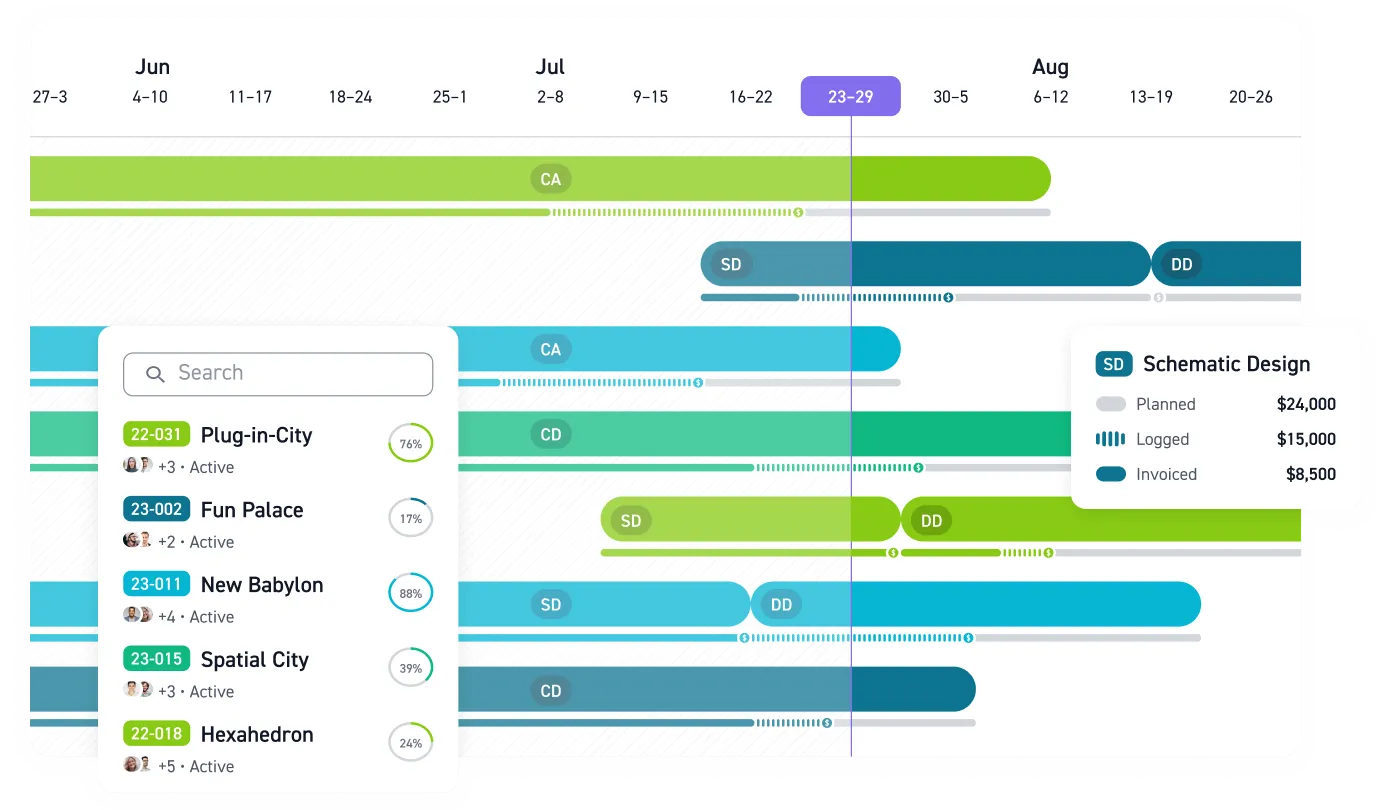
Monograph's 2026 Architecture & Engineering Business Benchmarks Report illustrates how wide performance gaps can get: the realization gap between low-performing and top firms translates to $24K on a $100K project. Monograph's MoneyGantt™ gives you a visual view of planned, logged, invoiced, and paid fees by phase over time. Phase-based budget tracking, historical hours-by-phase data, and consultant cost records from past projects form the building blocks of credible fee proposals.
When an RFP asks you to demonstrate capacity, 90-day resource forecasts backed by real workload data carry more weight than a line saying "we have availability." Every project you track well today becomes support for the next fee proposal.
Stop Guessing on Pursuits, Fees, and Capacity
The firms that win more of the right RFPs usually have better information before they start writing. They know which pursuits fit their strengths, what similar projects actually cost, and whether the team has the capacity to deliver the work profitably.
Monograph connects project budgets, historical phase data, and resource visibility in one place. Monograph's MoneyGantt™ gives you a visual view of planned, logged, invoiced, and paid fees by phase over time, while staffing and project data give you a clearer view of capacity before you commit to the next proposal.
Better proposals start long before the cover page. See Monograph in action.
Frequently Asked Questions
How do we decide whether an architect RFP is worth pursuing?
Start with a formal go/no-go review. Relationship strength, project fit, team availability, and expected profitability are the right filters. If you do not know the client, lack relevant project experience, or cannot support the fee with historical cost data, the pursuit is already working against you.
What matters most in a qualifications-based proposal?
Your job is to win the qualifications ranking before any fee negotiation begins. That means strict compliance with the RFP, a project approach tailored to the client's priorities, strong writing, and a proposal structure that follows the evaluation criteria in order.
How should we build fee proposals if our historical data is limited?
Start tracking phase-level time actuals, project profitability, and consultant costs as consistently as possible. Even a modest base of clean project data is more useful than pricing from memory.