



Firm management made easy

An RFP lands in your inbox, and the clock starts. You have limited time to pull together a proposal that proves your firm can deliver a project you may not have seen coming. The scope might be a new civic building or a campus renovation, and other firms are reading the same document. If you run operations at a firm, understanding architectural RFPs, and how to respond with focus, is the difference between chasing every opportunity and winning the right ones.
What an Architecture RFP Actually Is
An architectural RFP is a formal document from a client who needs design services for a specific project. It outlines the project's goals, scope, requirements, timeline, budget, and evaluation criteria. Public agencies are the most common issuers, but nonprofit organizations, developers, and institutional clients like churches and schools also use RFPs when accountability demands a structured selection process.
The quality of the RFP itself varies wildly. Some arrive with detailed scope narratives and clear evaluation weights; others omit budget ranges or leave the timeline vague enough that you can't assess staffing. Read the document closely before writing a single word, because what's missing often tells you as much as what's included.
The framework behind most architectural RFPs is Qualifications-Based Selection (QBS), codified federally through the Brooks Act. QBS means the architect is selected primarily on qualifications, not lowest price, and fee negotiation happens only after the most qualified firm is identified. QBS-selected projects had lower cost growth and faster construction speed than low-bid procurement. For project managers, that means qualifications usually matter more than perfecting your fee structure.
RFP vs. RFQ vs. RFI: A&E Definitions
If you've responded to public RFPs, you know the terminology differs from general business usage. Using "Request for Quotation" when the client means "Request for Qualifications" signals that your firm doesn't understand the procurement process.
- RFI (Request for Information): In procurement, a fact-finding step where clients gather firm capabilities before formal solicitation. In construction, something entirely different: a request to clarify ambiguities in construction documents.
- RFQ (Request for Qualifications): In A&E, this means Request for Qualifications, not "Request for Quotation" as used in IT or general purchasing. The RFQ is the qualifications screen, and only firms that pass are invited to submit full proposals.
- RFP (Request for Proposal): The formal solicitation for detailed proposals covering approach, team, schedule, and, depending on the client, fee.
Getting these terms right helps your proposal match the client's process from the first page.
How the Selection Process Works
The steps are familiar, though timelines vary by client type and project scale. Based on owner procurement guides and state procurement resources, the core steps are:
- Owner defines scope and publishes the RFP
- Optional pre-proposal meeting to align all firms
- Firms submit proposals by deadline
- Evaluation committee scores compliant proposals against defined criteria
- Shortlisted firms interview and rank; owner negotiates with the top-ranked firm
Clients also research projects and form informal shortlists of trusted firms long before the RFP goes public. An average of 80% of A&E work comes from existing clients, which means if you had no relationship with the client before the RFP appeared, your odds are lower from the start. Cold responses can still win, but that reality should shape how much time you invest.
The Go/No-Go Decision
Architecture firms have historically been poor at filtering pursuits. One industry survey found that only 22% of firms employed any go/no-go strategy at all. For A&E firms, chasing every RFP burns hours that could go toward winnable work.
The firms that win consistently apply a filter before committing proposal time. Experienced PMs usually look at:
- Relationship strength: Does the client already know your firm?
- Project fit: Does the work sit within your stated focus area?
- Competitive landscape: Who else is likely pursuing this?
- Team capacity: Is the right team actually available? Named individual team members are a top selection driver.
A scored threshold helps formalize the decision. Passing on marginal pursuits frees the team to invest real effort where the odds favor you.
Writing a Proposal That Evaluators Actually Score Well
Selection committees evaluate proposals against published criteria with assigned point values. Your proposal structure should mirror those criteria directly. One effective approach is converting each RFP section into your proposal's headings and subsections. If the RFP gives more weight to team qualifications than project approach, your depth of coverage should reflect that.
The proposals that score well address the client's actual problem, both the stated requirements and the unstated ones you read between the lines. They name specific team members with relevant experience rather than leading with firm history. Firms that show they already understand the project's constraints are the ones that make the shortlist.
Write your cover letter and executive summary last. The proposals that fall flat are usually the ones that lead with who the firm is instead of what the client needs.
Project Data as a Competitive Advantage
Firms that make specific, verifiable performance claims outcompete those relying on project photography and general statements. For example, Workbench shared specific performance gains: 8x faster staffing, a 4x faster billing process, and 75% less unbilled fees. For firms responding to RFPs, that kind of operational visibility makes it easier to back up claims about team availability, billing discipline, and delivery reliability with real numbers.
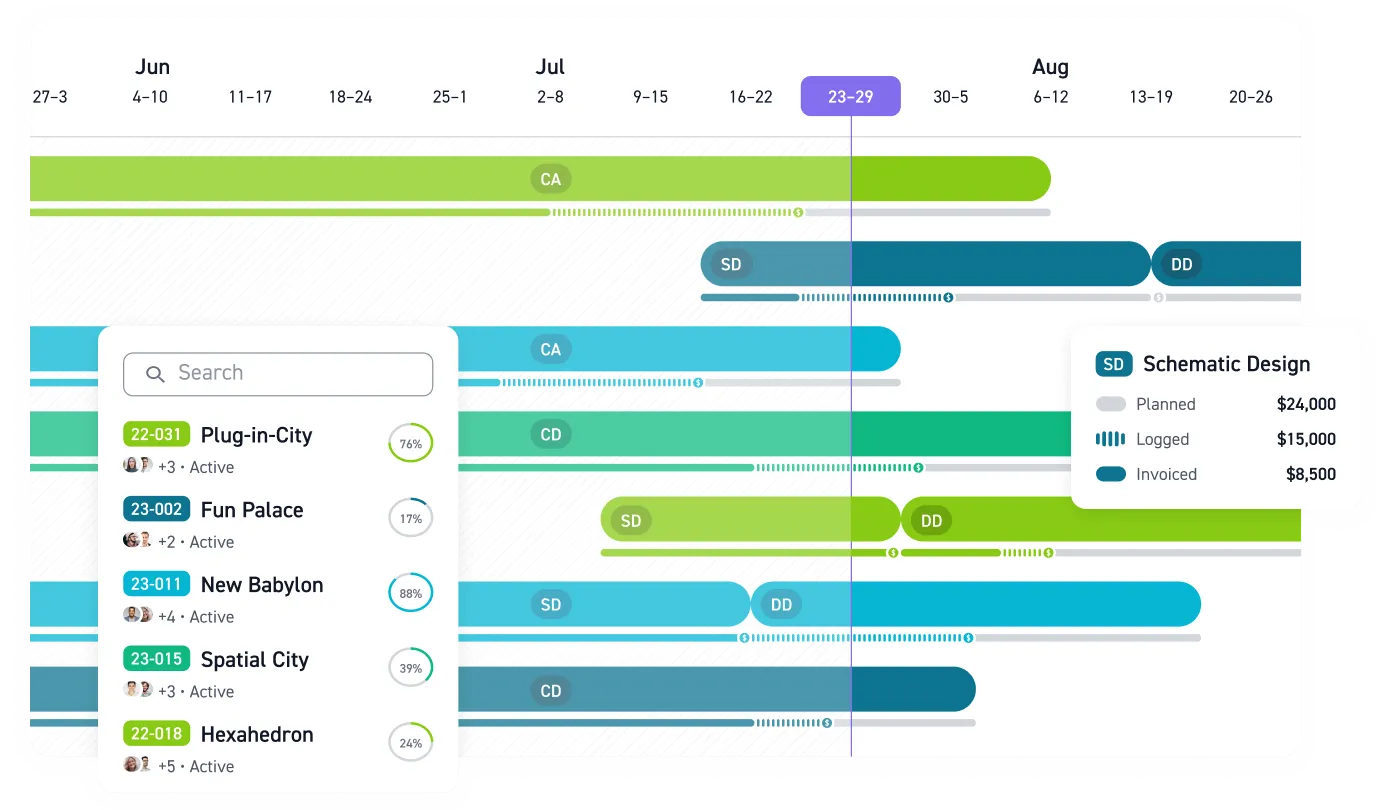
Monograph's platform, used by 13,000+ architects and engineers across 1,800+ firms, gives teams the phase-level budget tracking, realization rates, and on-time delivery data that turn a generic qualifications claim into a specific one.
The metrics worth tracking for firm management and proposal evidence include:
- Schedule performance: Delivered ahead of or on schedule
- Budget performance: Completed under budget
- Repeat client rate: Many firms report that over 70% of work comes from repeat clients.
- Utilization and realization rates: Useful data points that generic proposals often lack.
Tracked well, these numbers give your team proof instead of broad assurances.
Archiving this data in a searchable format lets your marketing team surface relevant projects and assess win probability without reconstructing information each cycle. Monograph's phase-level budgeting and capacity-aware forecasting help you confirm that the team you're proposing is actually available.
Build a Better RFP Process Before the Next One Hits
RFP performance improves when go/no-go decisions, staffing checks, and proposal proof points stop living in separate spreadsheets. If your team is still rebuilding pursuit strategy from scratch every time a new request arrives, you're burning effort before the proposal writing even starts.
Monograph gives A&E teams one place to track project budgets, team capacity, and the performance data that strengthens qualifications. That makes it easier to verify availability, pull relevant project evidence quickly, and respond with specifics instead of generic claims.
Frequently Asked Questions
How do you decide if an architecture RFP is worth pursuing?
Run it through the same go/no-go filter every time: relationship strength, project fit, competitive landscape, and team capacity. If the client doesn't know your firm, stronger competitors are already positioned, and your team is overloaded, passing is usually the right call.
Should architects include pricing in an RFQ response?
Not unless the document asks for it. In A&E procurement, an RFQ is about qualifications, not a fee proposal. Sending pricing in a qualifications-only submission signals that your firm misread the process.
Can a small firm win an RFP without a prior relationship?
Yes, but the odds are lower. Clients often form informal shortlists before the RFP goes public, and a large share of A&E work comes from existing clients. Cold responses can still win, but they need stronger project fit and sharper relevance.
What should you do if an RFP leaves out budget or timeline details?
Treat the missing information as part of the evaluation. Read the document closely, note the gaps, and decide whether you can responsibly staff and price the work with what you've been given. If the missing budget or timeline makes it impossible to assess effort, that should directly affect your go/no-go decision.
What makes an architecture proposal score better with selection committees?
Alignment with the published criteria. Mirror the RFP's structure, give more space to the highest-weighted sections, and lead with the people and experience most relevant to the project. The strongest proposals show that your team understands the client's problem, not just that your firm has existed for a long time.