
Engineering firms feel the cost of weak project controls long before it shows up in the year-end financials. Fixed-fee work across multiple disciplines makes budget drift and schedule slip expensive fast. The gap usually comes down to operational visibility, phase-level financial control, and software that actually fits A&E delivery.
The right choice starts with a simple question: why do generic project tools keep breaking down in engineering firms, and which platforms are better suited to the work?
Why Generic PM Tools Break Down for Engineering Firms
If you have ever tried to track a hospital project across SD, DD, CD, and CA phases using a tool built for marketing teams shipping campaigns, you already know the friction. Generic project management platforms are built on linear task hierarchies. Engineering projects are built on phases, each with a discrete fee allocation, billing rules, and completion definition. One firm documented in industry research spent years developing adequate project control systems.
Using a generic PM tool for engineering delivery creates predictable gaps:
- Phase budgets require manual reconstruction. Every project needs custom fields, workaround codes, and parallel spreadsheets to approximate what purpose-built platforms provide natively.
- Paused projects break resource allocation. When a client suspends work pending funding, generic tools have no operational state for it. Budget tracking loses continuity, and staff allocations go stale.
- Percent spent and percent complete diverge silently. On fixed-fee contracts, the question that determines margin is how much you've earned relative to what you've spent. Generic tools track hours against a budget number but cannot calculate whether the firm is ahead or behind on fee consumption at a given phase.
- Subconsultant costs live in spreadsheets. Markup calculations, invoice reconciliation, and pass-through tracking happen outside the PM system, with no fee ceiling alerts when total costs approach the contract limit.
These gaps explain why many firms evaluate industry-specific software alongside generic, off-the-shelf platforms.
What to Evaluate Before You Choose
The criteria that matter shift depending on where you sit in the firm. Principals need firm-level profitability visibility and accounting that connects to project data. Project managers need phase-level fee tracking and subconsultant coordination. Both roles need resource planning and utilization management.
These questions cut through vendor marketing:
- Does the platform track project profitability in real time during execution, or only at project close-out?
- Can you see budget consumption by phase without generating a report?
- Does time entry flow directly into project cost tracking and invoice generation without export steps?
- Are subconsultant budgets, markups, and invoices tracked within the project accounting structure?
- Does the system connect natively with your accounting software, or does it require manual reconciliation?
- Can forward-looking capacity forecasting show where staff are under- or over-allocated across multiple projects?
If the answer to any of those is "we'd need a workaround," the platform was not built for engineering delivery.
Engineering Project Management Platforms to Evaluate
These platforms were built specifically for A&E firms. Enterprise ERP systems such as Deltek Vantagepoint and BST Global serve firms with broader operational requirements. The group below reflects platforms many engineering firms are likely to evaluate.
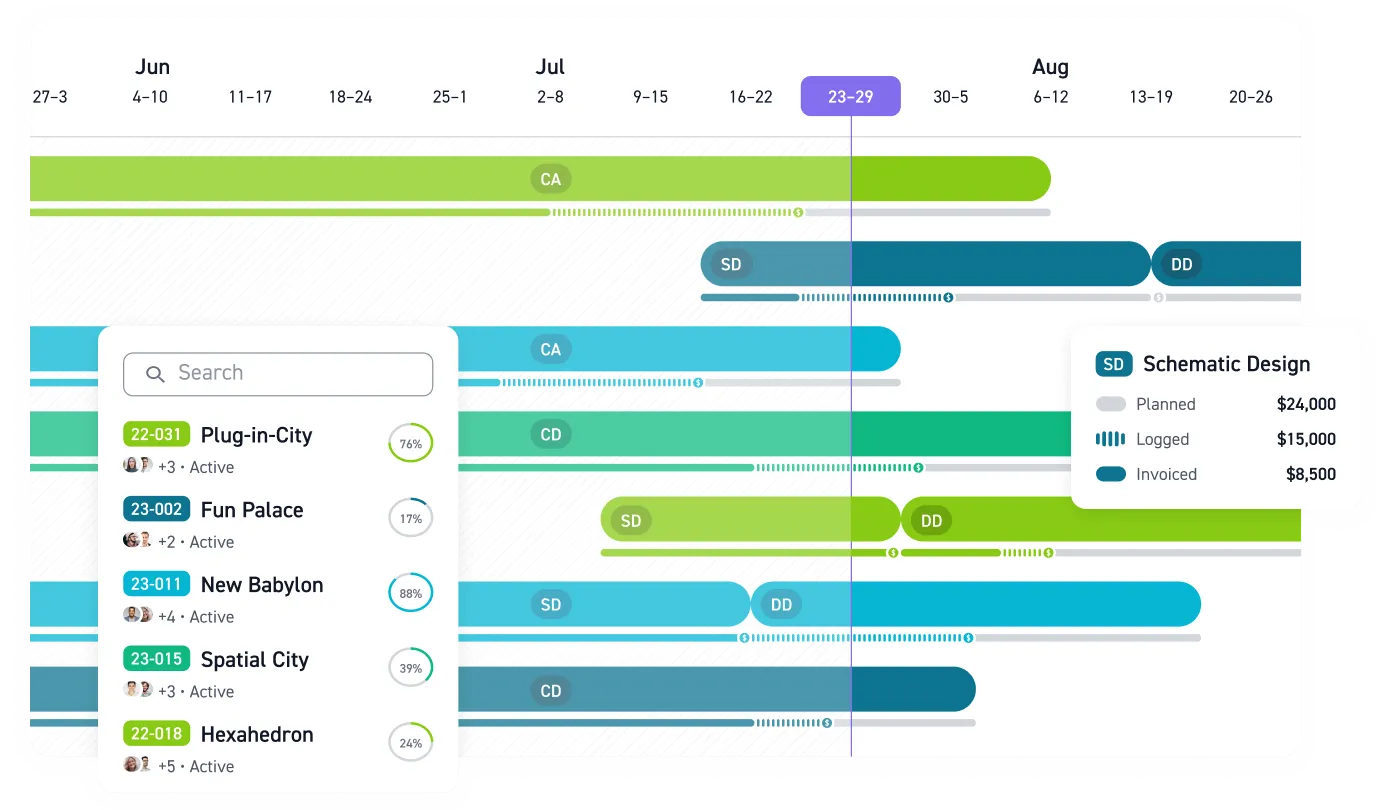
Monograph is a founder-led, venture-backed platform built by practicing architects and engineers. Monograph is built for A&E firms and centers its workflow on phase-based financial visibility. Its signature capability, Monograph's MoneyGantt™, combines project timelines with project budget visibility in a single view.
Features such as phase-based time tracking and invoicing, consultant collaboration, and resource planning all feed into Monograph's MoneyGantt™ view. The platform also syncs directly with QuickBooks Online. Dynamic Engineering reported a 2x efficiency gain after implementation.
BQE CORE covers project management, billing, CRM, and accounting for A&E firms. INC Architecture & Design documented a 6% firmwide profitability increase after implementation. Shear Structural, a women-owned structural engineering firm in Georgia, cut invoicing time from 10 hours to 30 minutes.
Deltek Ajera is a Deltek option that connects project management and accounting in a single system. It brings A&E-focused project accounting capabilities similar to Deltek Vantagepoint.
Unanet ERP AE targets government contractors and includes features designed to support DCAA compliance, making it a common option for federally focused practices. Many firms evaluating practice management platforms are looking for ways to simplify the transition from legacy systems.
Where AI Fits In
Engineering firms using AI tools are separating themselves on the metrics that matter most. Monograph's 2026 Architecture & Engineering Business Benchmarks Report shows stronger net revenue per employee, utilization, and realization results among firms using AI tools than among firms without them. The same report points to a clear direction, and recent industry surveys show more engineering firms developing AI strategies and increasing AI investment.
Choosing the Right Platform for Your Firm
Firms without dedicated ops staff benefit from a prescriptive workflow that imposes good habits from day one. Firms with federal compliance requirements or multiple offices need platforms that scale accordingly. If you are replacing spreadsheets and disconnected tools, match the platform to your current profile and migrate later as your needs evolve.
As a starting point:
- Firms without dedicated ops staff may benefit from prescriptive platforms like Monograph that impose structure from project setup through invoicing.
- Firms needing accounting and payroll in a single system should evaluate BQE CORE.
- Firms with federal contracts or DCAA compliance requirements should evaluate Unanet ERP AE.
- Firms with multi-office operations should evaluate Deltek Vantagepoint or BST Global.
Use that shortlist to narrow the field before you commit to demos and deeper evaluation.
Stop Running Engineering Projects Through Workarounds
If you're a principal, project manager, or ops lead trying to manage fixed-fee work across phases, consultants, and accounting tools, the warning signs are already familiar. Budget visibility lives in reports instead of in the work. Time tracking, invoicing, and staffing live in separate systems. Margins disappear quietly until someone pulls the year-end numbers.
Monograph was built for firms that need phase-level financial visibility while projects are still active. Monograph's MoneyGantt™ puts budgets, schedules, and fee consumption in one view, and connected workflows for time tracking, invoicing, consultant coordination, and QuickBooks Online help teams spend less time reconstructing the truth.
If the answers to your evaluation questions still depend on exports, spreadsheets, or manual reconciliation, it's time to see a system built for engineering delivery. Book a demo.
Frequently Asked Questions
What makes engineering project management software different from generic PM tools?
Engineering projects run on phases, fee allocations, billing rules, and completion definitions that generic PM tools do not handle well. Generic platforms can track tasks and hours, but they often cannot show whether a firm is ahead or behind on fee consumption at the phase level. That is why firms end up rebuilding budgets manually and tracking subconsultant costs outside the system.
Is industry-specific software worth it for a small engineering firm?
For many small firms, yes. Smaller teams usually have less room for billing delays, hidden overruns, or admin-heavy workarounds. If your firm does not have dedicated ops staff, a prescriptive platform can help impose structure from project setup through invoicing.
Can engineering project management software work with QuickBooks Online?
Some platforms do. In this list, Monograph syncs directly with QuickBooks Online, which matters because project data and accounting data need to stay connected if you want real-time profitability visibility instead of manual reconciliation.
Which platform makes the most sense for firms with federal contracts or compliance requirements?
The article points to Unanet ERP AE as a common option for federally focused practices because it includes features designed to support DCAA compliance. Firms with those requirements should evaluate that need early, because compliance constraints narrow the field quickly.