
Every request for proposal sitting on your desk represents a decision worth $12,000 to $15,000 in production costs. Because proposals do not always turn into awarded work, a firm pursuing RFPs without discipline can spend heavily and still come away empty-handed. Firms that win consistently are usually more disciplined about which pursuits to chase, how to structure a response, and where to focus limited time.
What Selection Committees Are Trained to Look For
Public-sector architecture procurement is governed by Qualifications-Based Selection, or QBS, established by the Brooks Act and mirrored in most state statutes. The critical implication: price is legally excluded from evaluating proposals for professional A&E services. ACEC has advocated against including cost as a weighted evaluation factor in A&E procurement and has published guidance favoring qualifications-based selection approaches.
Committees typically follow a sequence of qualifications review, shortlisting, interviews or discussions, and final ranking of the most qualified firms, followed by negotiation with the top-ranked firm.
Industry research from the SMPS Foundation offers insight into factors that influence client selection decisions for A&E firms. The leading factors include:
- Reputation and word of mouth: your track record precedes your proposal.
- Staffing and experience of proposed team members: named individuals matter more than firm credentials.
- Chemistry between consultant and owner teams: reviewers look for comfort with the working relationship.
- Relevant project history: evaluators want specific experience matched to the project type, not a general portfolio.
Those priorities tell you where proposal effort pays off and where generic content falls flat. In public-sector QBS procurements, qualifications carry the decision long before fees are negotiated.
Price and cost tend to matter more in private-sector contexts where QBS does not apply. For principals at small-to-mid-size firms, this means every hour spent sharpening your qualifications narrative pays more than time spent shaving your fee.
Structure Your Proposal Around the Client
The most common reason proposals lose is simple: they are firm-focused instead of client-focused. Industry research describes losing submissions as generic, packed with irrelevant statistics and boilerplate that says little about the client's concerns. Reviewers form a first impression quickly, and even a full read happens under time pressure.
Your proposal needs to pass a conformance check, then immediately signal relevance. A related PTAB RFP template specifies that proposals must begin with a cover letter and follow a defined sequence of sections. Deviate from this sequence and you risk elimination before anyone reads your project approach.
Core themes should run through the entire document, not appear only as section headers or highlighted callouts. A proposal strategy resource recommends weaving themes into introductory sentences, bullet point summaries, the executive summary, and the transmittal letter. The transmittal letter is where you introduce those themes and set the client-focused tone for everything that follows.
Build a Project Approach That Evaluators Can Score
Your project approach section is where you prove you've engaged with this specific project, not recycled a template. A public-sector RFP for architectural services outlines proposal requirements and notes that selection will be based on weighted evaluation factors.
Organize your scope using the standard AIA phase structure: Schematic Design, Design Development, Construction Documents, Procurement, and Construction. Construction includes administration of the contract. This matches how evaluators expect to see work broken down. Your phase fee structure should mirror this phasing, with a lump sum not-to-exceed total broken out by phase and separate hourly rates by role for time-and-materials work.
The methodology section separates strong proposals from generic ones. AEC storytelling best practices recommend shifting the narrative from square footage, delivery methods, and phased schedules to outcomes: how a space improves operations, how construction schedules minimize disruption, and how design choices mitigate long-term risk and cost. Connect each phase's activities to the performance goals stated in the RFP, and explicitly flag assumptions that will require programming to confirm. That level of specificity signals active engagement with the project.
Stop Chasing the Wrong Work
A functioning go/no-go process is often one of the most useful improvements firms can make to their win rate. If your team treats nearly every RFP as a yes, your pursuit framework may need more discipline.
Score each pursuit across these dimensions before committing resources:
- Client relationship strength: Do you have an existing relationship with decision-makers? Have you had substantive pre-RFP conversations? Pursuits with no prior contact carry the lowest win probability.
- Project fit: Does this project type align with your market focus? Do you have a clear differentiator for this work?
- Competitive landscape: Are you competing against the incumbent? Is the field crowded or narrow?
- Capacity: Is the team available? Can you staff the pursuit without cannibalizing a higher-priority effort?
This scorecard forces a hard conversation before proposal hours start piling up. A strong score earns full effort. Weak scores on relationship, qualifications, or capacity mean redirecting your team to a pursuit you can win.
Differentiate on Value, Not Price
Benchmark data shows that some architecture firms convert more pursuits than others. The gap comes down to positioning. A 2025 industry analysis found that 80% of A&E firms remain stuck in a price-competitive posture, even in QBS environments where price is legally irrelevant.
The firms winning at higher rates share three habits:
- They treat the RFP as the finish line, not the starting line. The proposal is usually the last step in what can be a multi-year business development effort.
- They address the client relationship directly in their proposals, something most competitors skip entirely.
- They quantify their credentials with project data rather than relying on photographs and generic claims of responsiveness.
These habits make value easier for evaluators to recognize and score. Teams rarely lose because they lacked another glossy page. They lose because the proposal did not make the value of working with them easy to score.
Tech-forward firms also show an advantage in business development outcomes. Better operational tools translate into better pursuit decisions and more accurate proposals.
Make Your Proposal Process Repeatable
A persistent bottleneck for small firms is content findability. Most A&E firms struggle with scattered project information across disconnected systems and overloaded email threads. Proposal workflows end up forcing teams to reconstruct or hunt for resumes, project sheets, and boilerplate not because the content was never created, but because incomplete indexing makes it hard to find.
Fixing this requires two things: a content library with actual indexing discipline, and real-time operational data so your go/no-go decisions and fee proposals are based on current information rather than guesswork. If you're spending more time hunting through folders and spreadsheets than shaping the proposal, something is broken.
Knowing which team members are available, which projects are running over budget, and what your actual margins look like by phase are the inputs that separate accurate proposals from aspirational ones. That kind of visibility is not theoretical: Workbench, a California firm, reported 8x faster staffing, 4x faster billing, and 75% less unbilled fees after centralizing project and financial operations in Monograph.
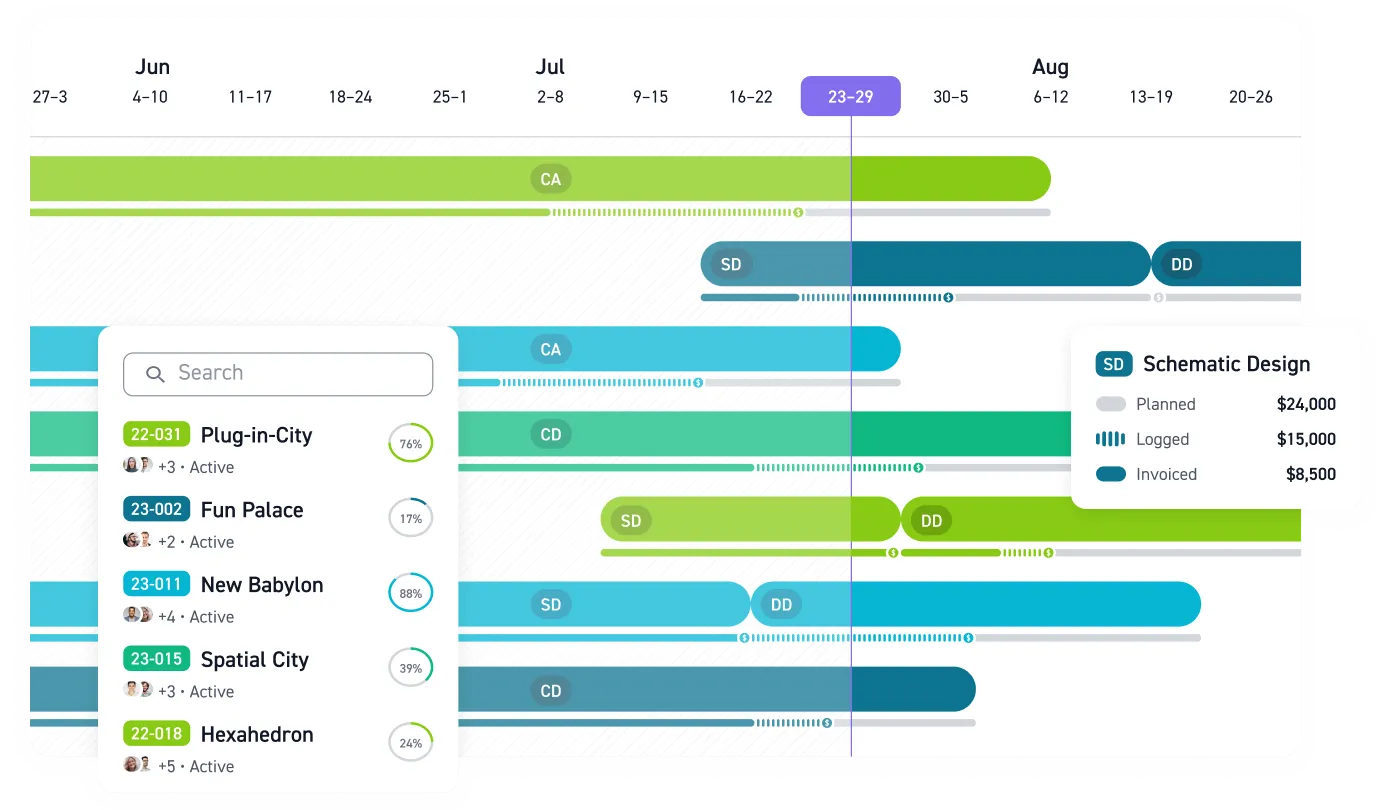
This is where A&E-specific tools matter. Monograph's phase-based budgeting aligns directly with how RFP responses require scoping work, and its staffing view shows team availability in real time, so the staffing commitments you make in a proposal reflect reality. Monograph's MoneyGantt™ combines timeline and fee burn into a single view, giving principals the operational snapshot they need to make informed go/no-go decisions without pulling data from different systems.
Every proposal your firm submits should reflect a deliberate choice backed by accurate operational data. The firms winning at the highest rates focus their time on fewer pursuits that match their strengths and capacity.
Stop Guessing Which RFPs Are Worth Your Time
Bad pursuit decisions are expensive. The cost shows up first in proposal hours, then again in rushed staffing decisions, weak scope assumptions, and fee proposals built on incomplete information.
If your firm is still making go/no-go calls from scattered spreadsheets and partial project data, you're making one of your highest-cost decisions without enough visibility. The same operational gaps that hurt staffing and budgeting also weaken the proposal itself.
Monograph helps A&E firms connect pursuit decisions to the data behind them. With phase-based budgeting, real-time capacity visibility, and Monograph's MoneyGantt™ in one place, principals and operations leaders can build proposals around actual team availability and project performance instead of guesswork.
The next RFP is already costing you time. Make it a deliberate choice. Book a demo.
Frequently Asked Questions
How do we know if an architecture RFP is worth pursuing?
Start with four filters: relationship strength, project fit, competitive landscape, and team capacity. If the client does not know you, the project sits outside your focus, or the right team is not available, the pursuit carries more risk before writing even starts. A simple go/no-go scorecard helps you protect time for work you can actually win.
Should public-sector architecture proposals include detailed pricing?
In QBS procurements, qualifications come first and fees are negotiated afterward. Price is excluded from evaluating professional A&E services in those contexts, so qualifications should carry the weight early in the process. Always follow the RFP instructions exactly, but do not let fee polishing crowd out the qualifications narrative when price is not part of the evaluation.
What makes a proposal feel generic to a selection committee?
Generic proposals read like they could go to anyone. They lead with firm history, boilerplate, unrelated statistics, and broad portfolio language instead of speaking directly to the client's project, goals, and concerns. A stronger proposal uses client-focused themes throughout, names the actual team, and ties relevant experience to the work being procured.
Can small firms win without responding to every RFP?
Yes. Small firms improve results by writing fewer, better proposals. Selective pursuit strategy, clearer positioning, stronger project-fit decisions, and accurate staffing commitments matter more than sheer proposal volume.
Why is qualifications language more important than fee polishing in QBS work?
Because in public-sector QBS procurements, qualifications drive the ranking before fees are negotiated. Selection committees are trained to review proposals on that basis. In those pursuits, time spent sharpening relevance, team fit, and project approach has more impact than extra time spent refining price language.
How does Monograph fit into the proposal process?
Monograph connects pursuit decisions to current project and staffing data. Phase-based budgeting, real-time capacity visibility, and Monograph's MoneyGantt™ help principals and operations leaders scope work against actual conditions. That matters when the proposal needs to reflect real availability and real performance, not a best-case assumption.