



Firm management made easy

A&E firms can stay busy on paper while cash still feels tight. If you run a small firm, you already know project revenue and money in the bank are rarely on the same timeline.
The gap between earning revenue and collecting it is where many small A&E firms lose their footing. The right cash flow management software helps close that gap. The wrong choice, or no choice at all, keeps you reconciling spreadsheets while payroll clears regardless.
The Cash Flow Problem Lives in Your Revenue Cycle
A long collection cycle leaves earned revenue tied up in receivables while rent, payroll, and consultant invoices arrive on schedule. Small firms often carry more of that burden and have less room to absorb the delay.
Three forces make this worse:
- Scope creep on fixed-fee or lump-sum contracts eats directly into margins without generating additional billings.
- Project pauses are widespread: 28% of firms reported increased projects on hold over the past six months, and 27% reported increased delays.
- The value of newly signed design contracts has declined for 25 consecutive months as of March 2026.
Benchmark data confirms that firms not tracking work in progress (WIP) lack meaningful cash flow visibility. The revenue cycle, labor to WIP to accounts receivable (AR) to cash, breaks whenever one link stalls. Many A&E firms still rely on manual processes and spreadsheets.
What A&E Finance Leaders Should Prioritize in Software
A single A&E project might span a long timeline, involve separate fee structures by phase, include subconsultant scopes, and generate reimbursable expenses. Generic accounting software breaks down fast under that complexity. The best billing software for A&E firms is built for these project-based workflows.
When evaluating cash flow management software, these capabilities matter most:
- Project-level financial visibility in real time. Firm-level P&L statements cannot tell you which projects are profitable and which are bleeding. Software should show labor and expense burn rates at the phase level without waiting for month-end close. The absence of forward-looking burn rates is a serious blind spot in A&E firms.
- Automatic WIP calculation from timesheet and project data. Think of WIP tracking the way you think about a coordinated drawing set: skip the coordination step and the conflict shows up later. Unbilled WIP works the same way, except the conflict shows up in your bank account. Software should flag aging WIP before it becomes a cash flow problem.
- Billing flexibility across contract types. Lump sum, hourly not-to-exceed, milestone-based, and percentage-complete billing should all work natively. A&E invoicing often requires multiple layers of billing verification and custom requirements per project.
- Cash flow forecasting tied to project schedules. Future cash inflows depend on project milestones and billing events. A forecast tied to the project pipeline is more useful than one built in isolation.
Firms with faster collection periods are a marker of strong financial discipline. Software that enforces billing cadence, tracks days sales outstanding (DSO) by client and project, and automates collection reminders goes straight at that discipline gap.
Top Cash Flow Management Software for A&E Firms
Each of these platforms takes a different approach to the A&E billing problem. The right fit depends on firm size, existing systems, and how much of the financial workflow you want in one place.
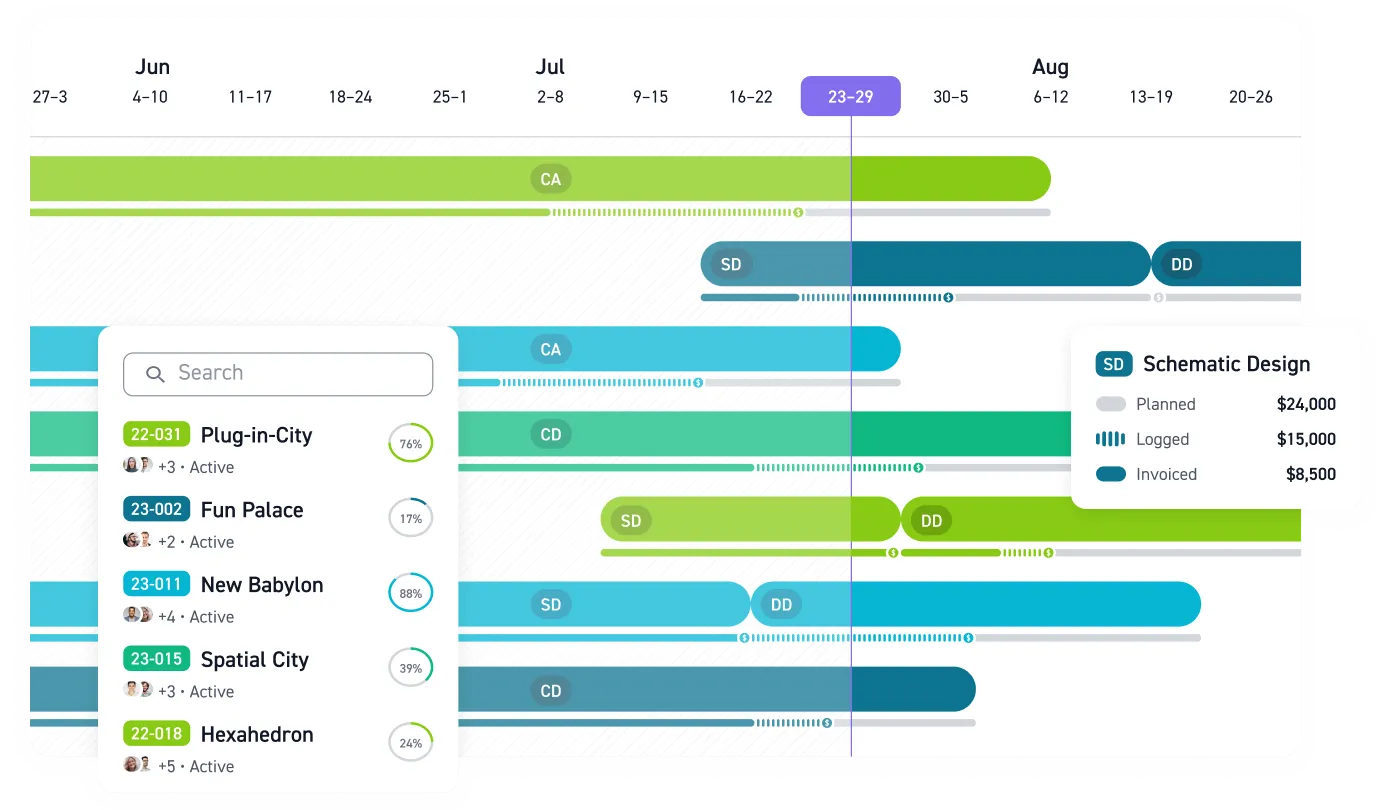
- Monograph is built specifically for small A&E design firms. Monograph's MoneyGantt™ overlays real-time budget status directly on project schedules, pulling live timesheet data and presenting phase-level budget consumption relative to project progress. The platform handles phase-based invoicing across fixed-fee and hourly projects with automated reminders, electronic payments, and QuickBooks Online sync. Monograph serves 13,000+ architects and engineers across 1,800+ firms.
- BQE CORE is positioned as an all-in-one platform for small to midsize professional services firms, with project accounting, AR workflows, payroll, CRM, and QuickBooks or Xero integration.
- Deltek Ajera suits small and mid-sized architecture and engineering firms needing unified project management and financial accounting. It includes WIP and aging invoice views, payroll services, and mobile time and expense capture. It has no built-in CRM.
- BigTime offers AI-assisted financial forecasting, automated invoice generation, and QuickBooks integration on all Essentials plans. Firms may need to adapt generic project fields to match design phases or engineering deliverables.
- Unanet AE ERP is positioned for mid-to-large A&E firms with more organizational complexity. It includes AR and AP automation, built-in CRM, and resource forecasting.
The practical choice usually comes down to workflow fit. Some firms want one platform that handles more accounting internally. Others want stronger project and billing visibility while keeping QuickBooks in place.
How Cash Flow Software Pays for Itself
The clearest ROI benchmark comes from collections. Top-performing firms collect in 52 days. Faster collections reflect billing and follow-up habits that purpose-built cash flow software can help reinforce.
Shorter collection cycles mean less earned revenue sitting in limbo between billing and payment.
Monograph customer outcomes show firms can finish billing 2x faster. Woodhull, a 25-person Maine architecture firm, reported 50% faster billing, 66% less budget overage, and 66% admin time saved after switching from their previous system.
The Integration That Matters Most
For most small A&E firms, QuickBooks is not going anywhere. The question is what sits alongside it. QuickBooks alone lacks A&E-specific invoicing workflows and robust phase-based project budgeting, though it does offer native project-level profitability tracking.
Most small firms pair an A&E practice platform for project phase visibility, time tracking, and invoicing with QuickBooks for accounting. When timesheet data flows into billing, and billing stays connected to accounting, the gaps in the labor-to-WIP-to-AR-to-cash chain start to close.
Turn Project Data Into Cash Flow Clarity
If billing is still driven by spreadsheets, delayed timesheets, and end-of-month guesswork, the problem usually starts before the invoice goes out. Weak WIP visibility, inconsistent billing cadence, and disconnected project data slow collections long before AR shows up on a report.
The cash is already in your projects. Monograph gives small A&E firms a way to connect project schedules, phase budgets, timesheets, invoicing, and payment status in one place. That means clearer phase-level visibility, faster billing, and fewer gaps between earned revenue and cash in the bank. Book a demo.
Frequently Asked Questions
What should small A&E firms look for in cash flow management software?
Start with the revenue cycle problems that hurt most: delayed billing, weak WIP visibility, and no clear view of phase-level performance. The right software should handle project-based workflows, calculate WIP from timesheet and project data, support multiple contract types, and connect forecasting to project schedules. Integration with QuickBooks Online matters for most small firms that want to keep their existing accounting setup in place.
Can cash flow software work with QuickBooks Online?
Yes. QuickBooks usually stays in place while the cash flow tool handles A&E-specific budgeting, invoicing, and project visibility. The important question is whether invoices and payment status stay connected to project financials so your team is not updating multiple systems by hand. A well-integrated workflow sends timesheet and billing data through automatically, which is where most of the time savings show up.
Do small firms need a full ERP to improve cash flow?
Not always. For many small A&E firms, the bigger need is better billing workflow, cleaner WIP tracking, and clearer project-level visibility. A lighter tool built around A&E workflows can solve those problems without forcing a small firm into a broader system built for larger organizational complexity. ERP makes more sense once a firm hits real operational scale and needs deeper accounting, HR, and procurement controls in one place.
How quickly can better billing workflows improve cash flow?
Faster than most operational changes because billing sits so close to cash collection. Shorter collection periods translate directly to cash in the bank, and firms using A&E-specific tools commonly report meaningful gains within the first year, including faster billing cycles, fewer aged invoices, and tighter visibility into unbilled WIP.
What is the difference between general accounting software and A&E-specific cash flow software?
General accounting software tracks the books. A&E-specific cash flow software connects the work behind the numbers: project phases, timesheets, WIP, billing events, and fee burn. For firms managing fixed-fee work, reimbursables, consultant scopes, and long project timelines, that difference matters because cash flow problems usually start inside the project workflow, not inside the chart of accounts.