


Firm management made easy

The AIA/Deltek Architecture Billings Index (ABI) scored 45.3 in November 2025, marking the 13th consecutive month of declining billings at architecture firms, with any score below 50 signaling contraction. Earlier in the year, February 2025 became the first month since the height of the pandemic when project inquiries actually declined at firms. For principals at small and midsize architecture and engineering (A&E) firms, healthy inquiry volume and a healthy contract pipeline are two different things. Pipeline management makes the difference visible.
Why Generic CRMs Don't Work for A&E Firms
Architecture and engineering pursuits do not move like a standard sales pipeline. Projects pass through go/no-go evaluation, active pursuit, shortlist, award, and contract negotiation. They can pause for months, defer indefinitely, or restart without warning. A generic sales CRM has no native concept of that workflow.
Practitioners have identified gaps in how standard tools support architecture-specific workflows. In small firms, the same principals delivering projects are often writing proposals. Heavy data entry competes directly with billable work.
The seller-doer model also makes poor pursuit decisions expensive. It disrupts project delivery and wastes proposal effort. Industry data reveals a 29.2 percentage point spread between top-quarter win rates of 60% and bottom-quarter win rates of 30.8%. Pursuit workflows help firms pursue fewer, better-fit projects.
What to Look for When Evaluating Pipeline Software
Many tools marketed as pipeline management were not built for A&E workflow realities. Focus on capabilities that match how your firm actually wins and delivers work:
- A&E-native pipeline stages: The system should handle awarded work that is not yet contracted and keep paused opportunities visible without distorting active pipeline metrics.
- Revenue forecasting: Forecasted revenue should update automatically as opportunities advance, stall, or disappear, with probability weighting that separates contracted backlog from probable pipeline.
- Resource capacity connected to pipeline: If your pipeline tool cannot show what winning a pursuit means for workload, you are still guessing.
- Project sync needs: For small firms, this is close to pass or fail. Confirm the sync covers phase-based invoices, subconsultant expenses, and reimbursable markups alongside basic transactions.
These checks matter because pipeline software only helps when it reflects the way A&E work actually starts, stalls, and turns into staffed projects.
Firm valuation also hinges on backlog visibility. A contracted pipeline extending 12 to 24 months positions a firm as lower risk in buyer evaluations, while thin or uncertain backlog typically results in a discounted offer.
Purpose-Built Options for A&E Firms
The A&E software market splits into two categories: platforms built specifically for A&E workflows, and general platforms that require significant configuration. For smaller firms, A&E software overview is often the more practical choice because the work already involves phase-based fees, consultant coordination, and uneven start dates.
That distinction shows up quickly in day-to-day use. A tool can look capable in a demo and still fail once pursuits pause, shortlist dates move, and project staffing starts shifting before a contract is signed. For A&E firms, the real test is whether the system maps to actual practice or forces your team to translate workflow into generic deal stages.
The major options break down as follows:
- Deltek Vantagepoint combines enterprise resource planning, CRM, resource planning, and financials in one system, though some smaller firms find the full suite heavier than they need.
- Unanet CRM by Cosential offers business development workflows built for architecture, engineering, and construction firms, including native go/no-go support and opportunity tracking.
- BQE CORE combines time tracking, billing, and project management with a CRM add-on module, and ERP roundups regularly list it alongside other A&E-focused tools.
- Factor A/E builds forecasting tools with opportunity tracking that keeps pipeline, workload, and revenue aligned.
- Total Synergy offers revenue forecasting tools with QuickBooks and Xero connectors.
- Monograph connects business development directly to project delivery with its dedicated Pipeline module, built for small to medium A&E firms.
For firms already juggling spreadsheets, email threads, and accounting data, the practical difference is how much translation work the software still leaves to your team.
General platforms like Salesforce and Microsoft Dynamics usually require specialist partners and IT resources many small firms lack.
The Real Cost of Choosing the Wrong Tool
A cautionary AEC implementation case describes a firm that implemented a CRM not designed for the industry. Employees ended up doing more work because critical processes were not mapped before implementation. The firm ultimately hired a full-time employee just to manage the CRM, at a cost exceeding the purchase price of the system itself.
For seller-doer firms, principal time spent managing a broken system compounds the loss. The chargeability gap between target and actual staff utilization widened to 4.0% in 2026, up from 2.9% the prior year, signaling that firms are falling further behind on productivity goals.
The warning signs are usually visible before the tool becomes a bigger problem:
- Principals avoid updating it because the work takes too long.
- Paused pursuits disappear from view.
- Awarded work and contracted backlog blur together.
- Staffing decisions still happen in spreadsheets.
When those patterns show up, the CRM is no longer helping the firm decide what to pursue.
How Monograph Connects Pipeline to Practice
Monograph's Pipeline module was built as a direct alternative to general CRMs. It connects leads, proposals, and revenue forecasts in one place, designed around how A&E firms actually win and deliver work. Adding a new opportunity shows the capacity impact by role and month by month, so you can see what winning a pursuit means for your team before you commit.
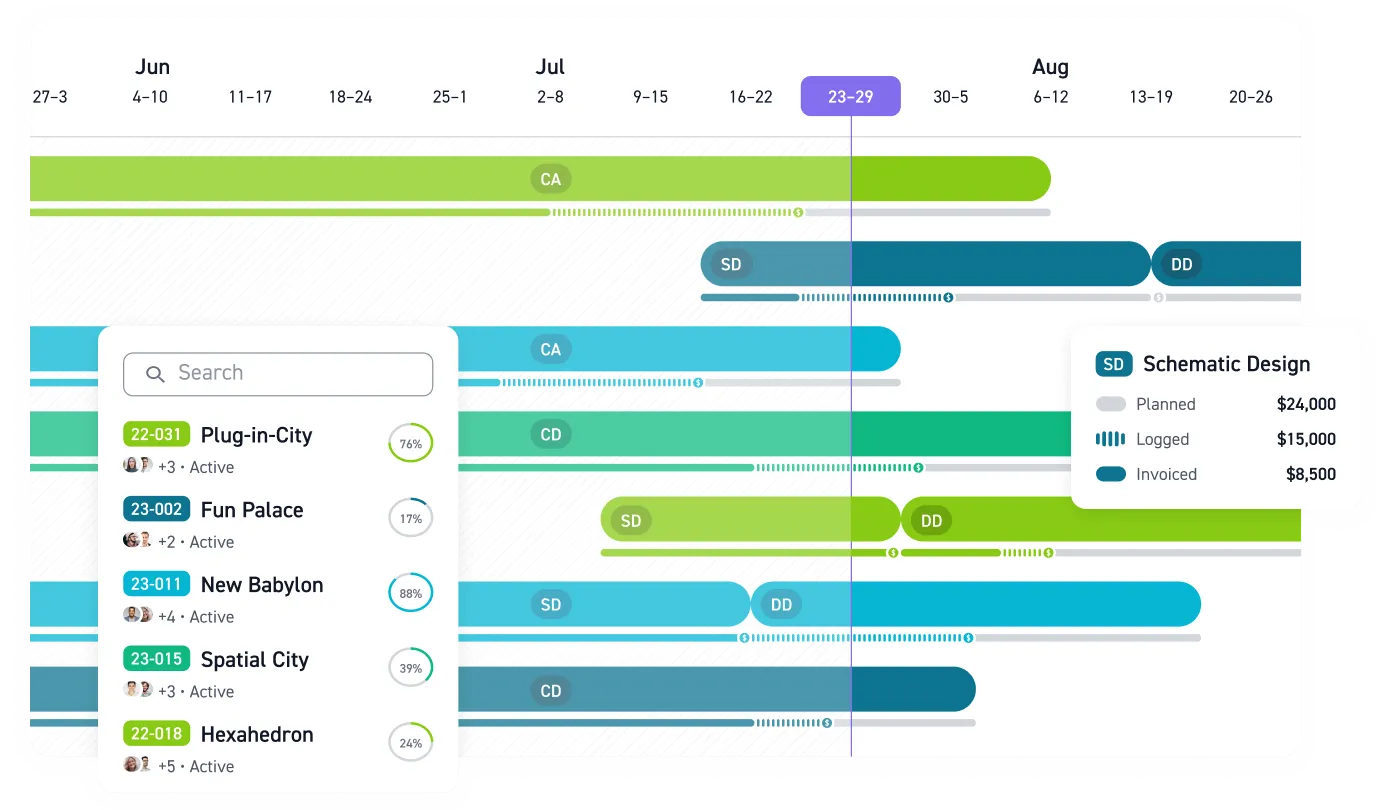
Monograph's MoneyGantt™ gives firms a visual way to understand budget, schedule, and cash movement across projects. It transforms complex budget data into a visual cross-section of scope, schedule, and cash for every project. It gives principals a clearer financial view without pulling data from disconnected sources.
The platform brings together additional financial and staffing capabilities:
- Staffing forecasts reveal capacity impacts across roles, helping you spot overload or underutilization before it hits.
- Planned profit reports surface profitability across firm projects in a month-by-month view.
- QuickBooks connection syncs invoices, expenses, and consultant bills without double entry.
Taken together, these capabilities connect pursuit decisions to workload and financial performance rather than leaving those decisions scattered across separate systems.
The results speak for themselves. Workbench has reported 8x faster staffing and 4x faster billing, alongside 75% less unbilled fees. Garrison Architects documented 50% admin cost savings, 1.5x faster billing, and 2.5x faster time-to-payment.
Stop Guessing Which Pursuits Will Turn Into Revenue
A healthy pipeline gives an A&E firm a clear view of which pursuits are worth chasing, when they could start, and what they will do to workload if they are won. If your current system cannot connect go or no-go decisions, revenue forecasting, and capacity planning, you are still making growth decisions with partial information.
That problem usually starts long before a proposal is submitted. It starts when active opportunities live in one place, staffing assumptions live in another, and nobody can see how likely revenue maps to actual team capacity. Firms feel that gap most when work is awarded but not contracted, or when paused pursuits quietly disappear until they come back all at once.
Monograph's Pipeline gives principals, operations leaders, and project managers one place to track opportunities, forecast fees, and see staffing impact before a proposal turns into a staffing problem.
Pick a platform built for how A&E firms actually win work. Book a demo.
Frequently Asked Questions
Do small A&E firms really need pipeline management software?
Yes. Small firms feel the cost of a bad pursuit decision faster because the same principals are often selling and delivering work.
What's wrong with using a generic CRM for pipeline tracking?
Generic CRMs are built for sales teams moving deals from open to closed. A&E pursuits stall, restart, move through shortlist and contract negotiation, and affect staffing long before a contract is signed.
What should we look for first in pipeline software?
Start with A&E-specific stages, revenue forecasting tied to probability, and capacity visibility.
Can pipeline software help with staffing decisions before a project starts?
It should. The best pipeline tools show capacity impact before you commit to a pursuit or proposal.
How do we know when to move from spreadsheets to a dedicated pipeline tool?
Move when your spreadsheet stops helping you decide. If you cannot reliably answer which pursuits are active, what revenue is likely to land, or whether your team has room to take on new work, you have outgrown manual tracking.