


Firm management made easy

Most A&E proposal processes bleed time. Most professionals will say that "faster firms win." But most firms still manually re-key data from every winning proposal. A well-designed proposal template paired with systematic go/no-go decisions and centralized content libraries does more than save time. It allows faster response to opportunities, positions your firm competitively by threading win themes throughout, and protects profitability by preventing the manual data re-entry that drains small firm resources. Firms with integrated proposal and project management systems see profit improvements of up to 25% and proposal turnaround reductions of 52%.
Essential Components Every Template Needs
Before building your template, understand what evaluators actually look for. Government procurement agencies establish technical evaluation committees of no fewer than two people who score based on criteria outlined in the RFQ. Your template must make their job easy.
Every proposal template should include these foundational elements:
- Cover letter with a client-specific value proposition that addresses their unique challenges
- Executive summary integrating win themes, not a generic firm description
- Staff qualifications with professional resumés pulled from a centralized database
- Project experience showcasing relevant case studies with visual documentation
- Project approach tailored to the specific scope and client needs
- Fee structure using templated formats that protect your margins
These basic components alone won't differentiate you. How you customize through win themes, client-specific value propositions, and alignment to evaluation criteria determines whether you stand out.
Building a Content Library That Actually Works
The smartest firms standardize staff resumés, fee tables, project sheets, and firm credentials. These components live in a centralized library. Win themes and project approaches? Those get customized for each pursuit. This distinction is where template architecture earns its keep.
Your content library should distinguish between:
Standardized content (library items):
- Staff resumés with certifications and project history
- Fee table templates with standard rate structures
- Project sheets with visual documentation
- Firm credentials and certifications
Customized content (fresh each pursuit):
- Win themes specific to this client
- Executive summary addressing their challenges
- Project approach tailored to scope
- Team justification for this opportunity
When standardized content lives in one searchable location, your team stops wasting hours hunting through old proposals. More importantly, you maintain consistent branding and eliminate the risk of sending outdated information.
Customized content requires fresh thinking for every pursuit. Your win themes, executive summary, project approach, and team justification can't be copy-pasted. Most A&E proposals contain basic components, but these "stock" components are insufficient without what sets you apart. The majority of your proposal can pull from standardized content, while client-specific elements demand focused attention unique to each pursuit.
Win Themes: Your Differentiator
If one concept separates winning proposals from also-rans, it's deliberate win-theme development. These key messages that differentiate your firm must appear throughout all proposal sections, not just the executive summary.
Win themes require different approaches depending on your client type. Government clients often value demonstrated compliance, safety records, and local hiring commitments. Private sector clients may prioritize innovation, speed to completion, or cost certainty. Repeat clients already know your capabilities. For them, win themes should emphasize what's new: recent relevant experience, expanded team expertise, or lessons learned from similar projects you've completed together.
Important elements include studying the RFP, preparing a proposal outline, and building proposal themes. Following these practices helps ensure your themes differentiate rather than serving as generic positioning.
From Proposal to Project: Why Integration Matters
You know the drill. You just won a project. Now someone needs to manually re-key every detail from your winning proposal into your project management system. This handoff between winning a proposal and starting a project is where most firms leak time and profit. If your business development lives in one system while project management happens in another, you're forcing manual data entry the moment you win.
Texas-based BRNS Design experienced this friction firsthand before implementing integrated systems. After moving from Harvest to an integrated platform, the 13-person firm achieved 4x faster billing processes and 50% reduction in budget overages. This demonstrates how eliminating the proposal-to-project handoff gap protects both time and profitability.
Industry guides and vendor analyses suggest A&E firms benefit from systems where proposal data connects to projects, though this is presented as best practice rather than formal research. This isn't about buying the fanciest software. It's about eliminating the administrative gap that buries project managers in data entry rather than project leadership.
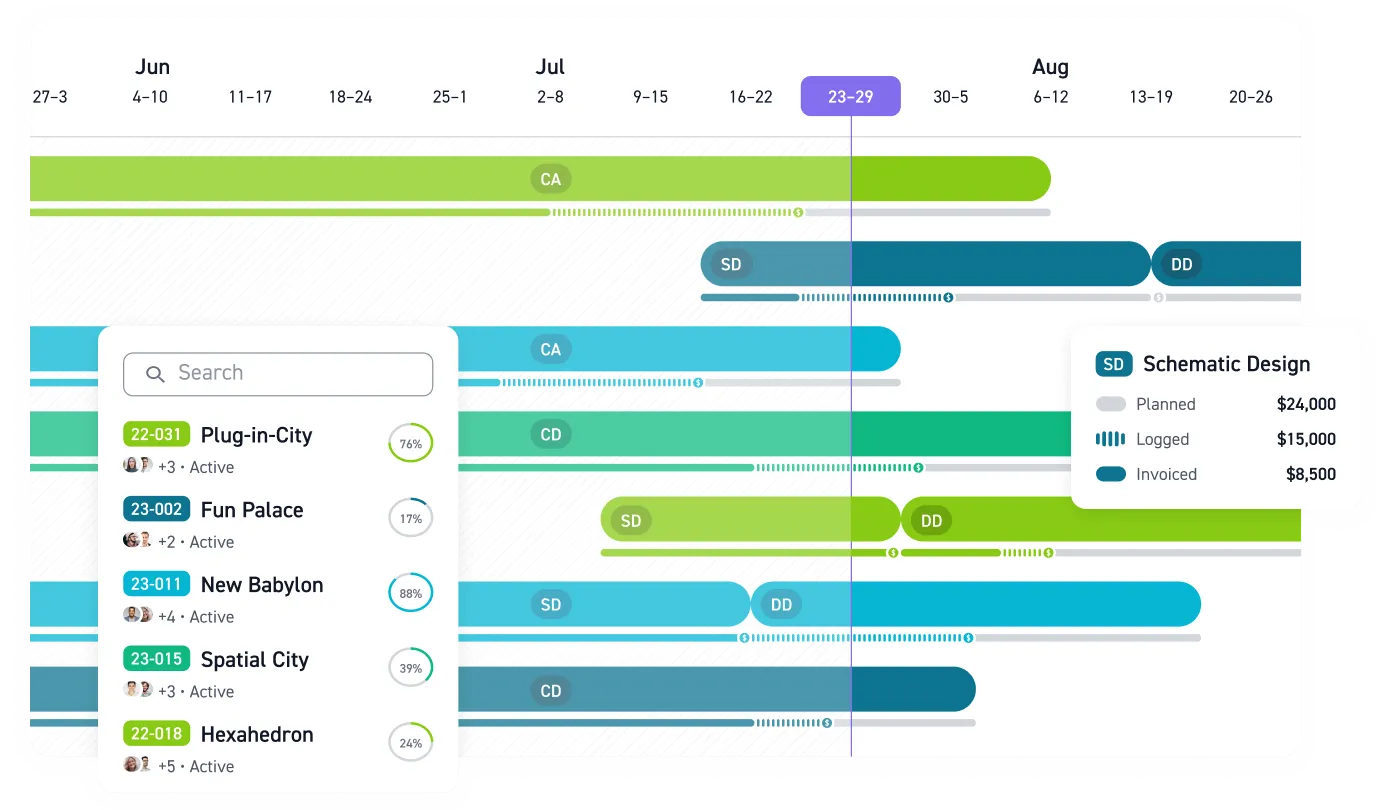
Monograph addresses this pain point through AI-powered project setup that converts data from winning proposals into project structures, automatically generating budgets without manual re-entry. Our signature MoneyGantt™ feature provides instant visual intelligence into project budget progression from proposal estimates through logged time to invoiced amounts, without mathematical complexity. You see budget-to-cash progression at a glance, tracking planned fees, logged time, and payment status across every phase.
Fee Structures That Protect Profitability
Your proposal template should include proven fee structure options that protect cash flow while building client trust. The AIA notes that "it is good practice to receive a portion of the overall fee at the initiation of the project as a 'retainer,' or advance payment, especially when working with a new client." The retainer should cover your services from project onset until the first invoice payment arrives.
For milestone payments, consider the 80/20 split model: 80% payment when work is completed by the architect, with the remaining 20% paid when the phase is accepted by the client. This protects your cash flow during client review cycles while creating an incentive for timely client feedback.
Timeline Formats That Set Clear Expectations
Effective project schedules require:
- Resource estimates showing team allocation
- Clear deadlines and milestones for each phase
- Visual timeline representation clients can review
- Deliverable tracking capability
These components work together to create a schedule that serves both your team and your client throughout the project lifecycle.
Your timeline must demonstrate mutual accountability through clear phase gate approvals and explicit client requirements. Show clients exactly when you need their input and what deliverables you expect at each milestone.
Set realistic phase durations from the start. Project phases vary widely depending on complexity. Compressing timelines to win work rarely ends well. You either sacrifice quality or profitability, sometimes both. When clients understand that their phase requires sufficient time for quality delivery, it builds trust rather than creating resistance.
Tracking What Matters
Proposal templates only improve performance when you measure results. Focus your tracking on these performance indicators:
- Bid-to-win ratio: wins divided by total proposals submitted, multiplied by 100
- Repeat client percentage (target: 80-85%)
- Proposal turnaround time from RFP receipt to submission
- Revenue generated per proposal effort invested
Tracking these metrics connects directly to financial forecasting, staffing projections, and marketing spend justification.
A&E firms generate 80-85% repeat business. This should shape your proposal strategy. Your existing clients represent your most valuable pipeline. Invest more in proposals to current clients where relationships already favor you.
Speed matters too. According to Zweig Group analysis, faster firms win in the current market. Pre-built modular templates with reusable content libraries allow quicker response without sacrificing quality. This creates a critical advantage when competing against larger firms with dedicated proposal teams.
Stop Losing Time Between Proposals and Projects
Your proposal template handles the front end. The real profit leak happens when you win. That moment when someone manually re-keys every project detail from your winning proposal into your project management system.
Over 13,000 architects and engineers across 1,800+ firms use Monograph to eliminate that handoff gap entirely. Upload your contract and our AI-powered platform automatically extracts phases, budgets, and staffing requirements. Build your proposal in Monograph, and the moment you win, your project structure is ready. No data entry, no missed details, no administrative burial.
The firms we work with see 52% faster proposal turnaround and 25% profit improvements by connecting proposal development directly to project execution. Your proposal data flows automatically into project budgets, phase structures, and team assignments without anyone touching a spreadsheet.
While you're still copying data between systems, your competitors are already billing their first phase.
Book a demo with Monograph.
Frequently Asked Questions
Won't a template make our proposals feel generic and impersonal?
Not if you build it correctly. The template standardizes components that should never change (staff resumés, fee tables, certifications) while forcing fresh thinking on what matters: win themes, executive summaries, and project approach. Firms that try to customize everything waste time on boilerplate while neglecting the strategic content that actually wins work. Your template should free up time for the high-value, client-specific sections that differentiate you.
How long does it take to build a proposal template that's actually useful?
Plan 2-3 weeks for your first complete template, including content library setup. That means collecting standardized components, building modular sections, and establishing your workflow. The ROI appears immediately: firms report 52% reduction in proposal turnaround time once templates are operational. That first template saves you more time than it costs within your first three proposals.
Do we need separate templates for different project types?
Yes, but they share 70% of the same content. Create one master template with your standardized content library (staff resumés, firm credentials, standard fee structures), then develop project-type-specific modules for approach sections and case studies. Most firms maintain 3-5 templates covering their primary work categories: residential, commercial, institutional for architects; structural, MEP, civil for engineers, all while pulling from the same staff and credentials database.
Can proposal templates integrate with project management systems?
The best ones do, and this is where most firms leak profit. If your proposal data doesn't flow directly into project setup, someone is manually re-keying everything the moment you win. Look for platforms where proposal information automatically generates project budgets, phase structures, and team assignments without manual transfer. Monograph's AI-powered contract processing extracts key project information and builds your project structure automatically, eliminating the handoff gap that buries project managers in data entry.
How do we measure if our proposal template is actually working?
Track four metrics: bid-to-win ratio (wins ÷ proposals × 100), proposal turnaround time, repeat client percentage, and revenue per proposal effort. If your template is working, you'll see faster turnarounds without sacrificing quality, higher win rates on well-matched opportunities, and more time for business development instead of proposal production. The goal isn't more proposals. It's better proposals submitted faster to the right opportunities.