



Firm management made easy

If you're spending more time hunting through spreadsheets than designing, something's broken. Most architecture and engineering firms struggle with lead tracking because they're using systems designed for full-time salespeople. These tools don't work for technical professionals juggling project delivery and business development.
Here's the reality: firms currently win only 50% of pursued bids. 60% of professionals in medium firms and 57% in large firms have to manage both project work and business development. This seller-doer model demands lead tracking approaches fundamentally different from traditional sales organizations.
Start With Qualification, Not Volume
The biggest mistake A&E firms make is pursuing too many low-probability opportunities. With average utilization rates at 81.1% and limited time for proposal development, chasing the wrong leads kills profitability.
Successful firms use data-driven qualification frameworks before investing proposal resources. They track historical win rates segmented by project type, client relationship strength, and competitive positioning. The goal isn’t to create complex scoring systems, but to protect your team's productive capacity.
Consider tracking these qualification factors for every opportunity:
- Historical Win Rates by Project Type: Segment your past performance by project category, client relationship strength, and competitive positioning. Use this data to make data-driven pursuit decisions.
- Resource Availability: Verify firm capacity before committing proposal resources. Connect opportunity assessment to current utilization rates (81.1% average for A&E firms) and project delivery timelines.
- Client Relationship Strength: Monitor the likelihood that existing relationships can expand (the approximately 80% of revenue that comes from current clients) versus the effort required for genuine new acquisition (approximately 20% of revenue).
- Competitive Positioning: Assess your firm's competitive advantages in this specific market segment. Determine whether your positioning supports a high-probability pursuit before investing resources.
- Alignment with Firm Goals: Evaluate whether the project fits your firm's strategic priorities. Consider service capabilities and financial targets alongside project requirements.
- Proposal Effort vs. Win Probability: Given that firms currently win only 50% of bids pursued, calculate the resource investment required relative to realistic win likelihood. Projects with weak qualification indicators consume billable time that seller-doers cannot recover.
Every low-probability pursuit you skip protects your team's capacity for work you can actually win. Focus your qualification framework on these critical data points:
- Historical win rate data: What's your track record on similar projects with this client type and market sector?
- Existing relationship strength: Have you worked with this client before, and what's the relationship depth?
- Resource availability and capacity: Can you actually deliver if you win, given current utilization rates and project pipeline?
- Competitive landscape intelligence: Who else is pursuing this work, and what's your realistic competitive position?
- Project fit with core capabilities: Does this align with your firm's technical expertise and service offerings?
The goal is eliminating low-probability pursuits rather than improving proposals for work you can't win. This principle is supported by research showing that A&E firms often report win rates below 50% on pursued bids. Furthermore, unsuccessful firms commonly overestimate their chances, underestimate effort, or pursue work that doesn't fit the firm's goals or capabilities when pursuit decisions aren't backed by data.
Track What Matters for Data-Driven Pursuit Decisions
Qualification only works when you can see the data that matters. Your team needs real-time visibility into resource availability and utilization rates before committing to proposals that will drain capacity you don't have.
Most A&E firms make pursuit decisions based on gut feel because their data lives in scattered spreadsheets. They guess at capacity, estimate win probability, and hope the numbers work out. That approach explains why half of pursued bids fail. Firms are betting billable hours on opportunities they should have passed on from the start.
Effective lead qualification depends on three connected data points:
- Current utilization rates that show whether your team has capacity for new work
- Historical win rates that reveal which pursuit types actually convert
- Project pipeline visibility that helps you predict resource availability three to six months out
When these metrics live in different systems, qualification becomes guesswork. The firms winning more than 50% of their pursuits track qualification data systematically. They know their utilization rates in real-time, not last quarter. They segment historical win rates by project type and client relationship. They see their project pipeline clearly enough to commit resources with confidence.
Stop Chasing Work You Can't Win
You already know which pursuits drain resources without generating revenue. That hospital RFP sits in your inbox with a 20% win probability and a three-week proposal timeline. The developer project comes with no existing relationship and five competitors with stronger positions. The scope doesn't match your core capabilities but looks good on paper.
Every one of those low-probability pursuits consumes billable hours your team can't afford to lose. If you're at 81.1% utilization, you're already operating near capacity. Chasing work you won't win just makes the problem worse.
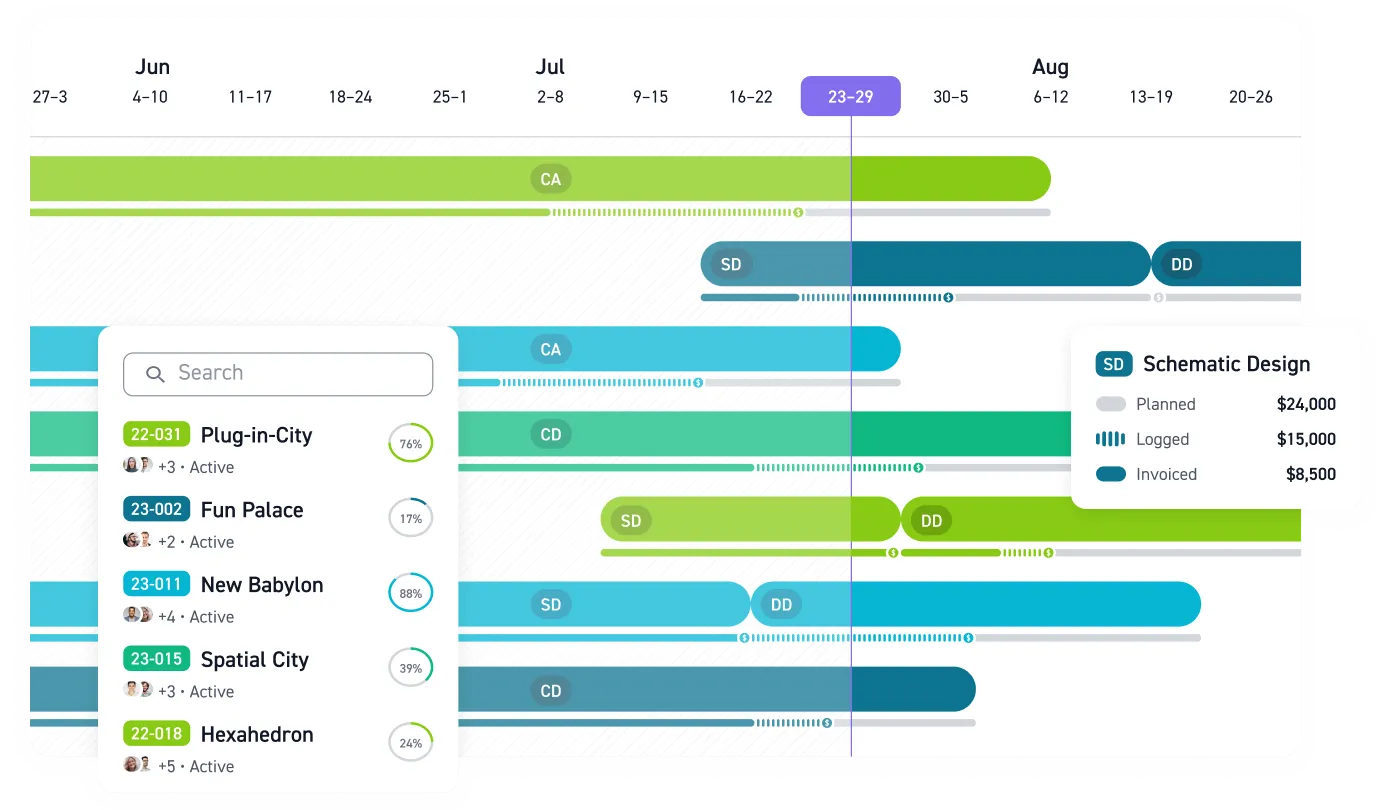
Monograph helps A&E firms make smarter pursuit decisions by connecting lead qualification to real capacity data. See your team's utilization rates in real-time through our dashboard. Track resource availability across active projects with Monograph's MoneyGantt™ visual intelligence. Monograph's MoneyGantt™ transforms complex financial data into simple visual insights, combining traditional timelines with budget-to-cash progression from planned through logged, invoiced, and finally paid status. This makes capacity planning decisions instant instead of agonizing. Know whether you can actually deliver before you commit proposal resources.
The firms using Monograph for capacity planning don't guess at qualification anymore. They see exactly which team members are overallocated, which projects are consuming more resources than budgeted, and whether they have the capacity to take on new work. That visibility transforms pursuit decisions from hopeful betting to data-driven strategy.
Your competitors are already qualifying smarter. Stop guessing. Book a demo.
Frequently Asked Questions
How do I start tracking win rates when I don't have historical data?
Start simple. Create a spreadsheet today with five columns: project name, pursuit decision date, win/loss outcome, project type, and client relationship status (existing vs. new). Every time you decide to pursue or pass on an opportunity, log it. After three months, you'll have enough data to spot patterns.
Don't wait for perfect data to make better decisions. Even basic tracking reveals which project types convert and which ones consistently waste proposal time. One structural firm we know tracked just twelve pursuits and discovered they won 80% of existing-client work but only 25% of cold RFPs. That insight alone changed their qualification approach.
The key is consistency, not sophistication. Track every pursuit decision, not just the ones you win. The losses teach you more than the victories. Within six months, you'll have enough data to make genuinely informed pursuit decisions instead of relying on optimism and hope.
What if passing on opportunities means missing revenue targets?
You're already missing revenue targets by chasing low-probability work. The 50% win rate means half your proposal effort generates zero revenue. Meanwhile, those failed pursuits consumed billable hours you could have spent on profitable project delivery or higher-probability business development.
Do the math. If your team spends forty hours on a proposal with a 20% win probability, you're investing resources you'll lose the majority of the time. Those same forty hours applied to project delivery at your standard billing rate generate guaranteed revenue. Every low-probability pursuit has an opportunity cost measured in lost billable work.
Selective qualification doesn't reduce revenue. It protects the capacity that actually generates income. Firms that pass on bad-fit work have more time to deliver excellent results on projects they win, which builds the reputation that attracts better opportunities. Focus on improving your win rate above 50%, and you'll generate more revenue from fewer proposals.
Can small firms realistically implement qualification frameworks?
Qualification frameworks work better for small firms because every billable hour matters more. When you have five people instead of fifty, a single bad pursuit decision impacts your entire team's capacity. You can't afford to waste proposal time on work you won't win.
Small firms don't need complex scoring systems. Track three things: historical win rate by project type, existing client relationship strength, and current team capacity. That's it. You can implement this framework in thirty minutes using a simple spreadsheet or project management tool.
The firms that benefit most from qualification are exactly the ones who think they're too small to bother. You don't need sophisticated systems. You need consistent data collection and the discipline to pass on bad-fit work. Start tracking today, and within three months you'll have actionable intelligence that transforms your pursuit decisions.
How do I balance qualification rigor with the need to pursue work?
Qualification isn't about pursuing less work. It's about pursuing smarter work. The goal is improving your win rate above 50% by focusing resources on opportunities where you have real competitive advantages. You might pursue the same number of projects but choose ones you'll actually win.
The seller-doer model already forces this balance. You have limited time for proposals because you're also delivering projects. Qualification simply helps you invest that limited time where it generates the best return. Would you rather spend forty hours on four proposals with 80% win probability or eight proposals with 40% probability?
Start by identifying your highest-probability pursuit categories based on historical performance. Focus business development there first. As your win rate improves and revenue stabilizes, you can selectively pursue stretch opportunities that build new capabilities. Just don't bet your team's capacity on long shots when you have bills to pay. Strategic qualification protects your firm's financial foundation while positioning you for sustainable growth.
What tools do I need to track these qualification factors effectively?
You can start with a spreadsheet, but the real power comes from connecting qualification decisions to capacity data. The firms making the smartest pursuit choices see their current utilization rates, project pipeline, and team availability in real-time, not last month's numbers.
Monograph gives you that visibility without complex implementation. Our platform shows exactly which team members have capacity for new work, how current projects are tracking against budgets, and whether you can realistically staff a new pursuit if you win it. That's the data you need for qualification decisions that actually work.
The difference between guessing and knowing comes down to real-time capacity visibility. You don't need another tracking system. You need the information that already exists in your projects consolidated into actionable intelligence. That's what Monograph does. When you can see your team's true capacity alongside pursuit opportunities, qualification becomes straightforward instead of agonizing.